Top Chiropractor in San Leandro, CA

San Leandro Chiropractor

  • blog
  • About Our Practice
  • What is Chiropractic?
  • SERVICES
    • Personal Injury
    • Cold Laser Therapy
    • Massage
    • Ultrasound
    • Electric Stimulation
    • Sports Injury
    • Workers Compensation
  • FAQs
  • Locations
  • CONTACT US
  • New Patient Forms
  • Nutrition Store
  • Home

Powered by Genesis

2026 U.S. Economic Outlook: Navigating Uncertainty, Mental Stress, and the Role of Chiropractic Care

May 8, 2026 by drburt

As we move through 2026, the U.S. economy presents a picture of moderate resilience amid persistent challenges. Forecasters project real GDP growth in the 2.0–2.3% range for the year. This pace reflects solid business investment—particularly in AI and technology—alongside fiscal policies and steady consumer spending. However, growth is uneven. Unemployment is expected to edge up modestly to around 4.3–4.6%, with job gains slowing in many sectors while healthcare and tech continue hiring. Inflation remains a concern. Core measures are easing but face upward pressure from energy prices, tariffs, and services costs. Many households still grapple with high housing expenses, healthcare costs, and everyday affordability issues. Policy uncertainty, geopolitical tensions, and elevated national debt add layers of volatility. While a sharp recession is not the baseline forecast, consumer sentiment stays cautious. For millions of Americans, economic pressures translate directly into heightened daily stress. Financial anxiety has become a defining feature of 2026. Surveys indicate nearly half of adults report higher stress levels than the previous year, driven by day to-day expenses, debt, job security worries, and concerns about the country’s direction. This chronic stress fuels a vicious cycle: elevated cortisol, sleep disruption, muscle tension, headaches, and reduced mental clarity. Younger generations, in particular, link financial strain to anxiety and feelings of lost control. When economic uncertainty lingers, the body and mind pay the price—poor posture from desk work or stress-induced clenching, neck and back pain, and nervous system overload. Here is where chiropractic care offers meaningful support. Chiropractic is not a solution for economic problems or a replacement for mental health therapy, but it serves as a powerful complementary tool for managing the physical and neurological effects of stress. Spinal adjustments help restore proper alignment, which can reduce nerve interference and shift the nervous system from sympathetic “fight or flight” dominance toward parasympathetic “rest and digest” balance. Many patients report lower muscle tension, fewer tension headaches, and improved sleep after consistent care. Research and clinical observations link chiropractic interventions to reduced cortisol markers, decreased blood pressure in some cases, and better overall emotional regulation. By addressing posture issues exacerbated by stress, chiropractic care helps break the feedback loop where physical pain amplifies mental strain. In a year of moderate economic growth but ongoing personal pressures, proactive self-care becomes essential. Regular chiropractic visits can improve resilience, boost energy levels, and enhance quality of life when finances and the future feel uncertain. Combined with exercise, financial planning, mindfulness practices, and professional mental health support when needed, it forms part of a holistic strategy. Looking ahead, 2026 rewards adaptability. The economy will likely avoid major contraction while delivering opportunities in innovative sectors. For individuals, protecting mental and physical health is key to navigating whatever comes next. If economic stress is weighing on your body and mind, consider scheduling a chiropractic evaluation. Small, consistent steps today—financial awareness, movement, and proper spinal care—can make 2026 feel more manageable and empowering.
Filed Under: Advice, Ankle, Auto Accidents, Carpal Tunnel Syndrome - CTS, Children, Chiropractic, D.C. Consulting, Diet, Exercises, FAQs, Games, Golfer's Elbow, Headache, Health, Insomnia, Knee, Low Back Pain, Modalities, Neck Pain, Nutriton, Opinion, Personal Injury, Posture, Questions/Answers, Shoulder, Soft Tissue Injury, Spine, Sports, Tennis Elbow, TMJ, TOS, Travel, Uncategorized, Weight Loss Tagged With: back pain, chiropractic, chiropractor, neck injury, san leandro

Heart Attack or Thoracic Outlet Syndrome ?

January 3, 2011 by drburt

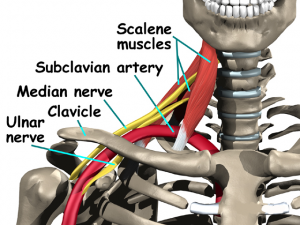
TOSToday’s post is about real case that have treated on Friday. I saw this patient over a year ago for severe neck pain and headaches. Patient’s problem was resolved with very good results. This morning patient’s husband calls and asks me to see his wife today as an emergency visit because she has numbness in her left upper extremity, loss of temperature in that extremity, and shooting pain. Over the phone he explained to me what has happened couple of days ago.

He took his wife to a near by Hospital Emergency Room suspecting that she had a heart attack. She had severe shooting pain in her left upper chest and shooting pain down her arm. In a Hospital medical Doctors performed a complete check up, including laboratory test and fancy CT- Scan diagnostic. After numerous hours they found nothing wrong with his wife and discharge her home with some pain medications. She was not very happy with an outcome since the symptoms were still there even with pain medications.

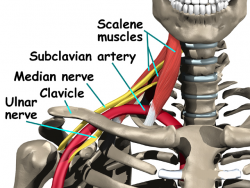
This morning I performed my examination and was trying to figure out what was wrong with this lady. First off all she always carries her heavy bag on her left shoulder with her belongings and belongings for her two young kids. That was a first sign that the problem was mechanical in nature and something was compressing her arteries and nerves. Her intercostal muscles between first and second ribs were extremely painful. Her left clavicle (look at the picture on a left) was out of alignment and did not have any movements during passive and active range of motion. Both of her rhomboid major and rhomboid minor muscles were very sore as well.

My Solution to This Problem:

I have diagnosed this lady with TOS. The first procedure was the electrical stimulation and moist heat. I used electrical stimulation on PAIN and CONSTANT settings for 15 minutes. Two pads were placed on her first and seconds intercostal spaces and two pads were placed around rhomboid major and minor muscles. Moist heat pack was placed in the same area for 15 minutes as well. Next, my massage therapist worked on her tight muscles for about 20 minutes or so. My CMT has informed that her entire left side is completely out of balance. Muscles were tight and patient was guarding during the massage which made her job a bit more difficult. But she got it done. After the massage I have performed full spine Chiropractic Adjustment ( that included cervical, thoracic and lumbar spine) and I have adjusted her first rib and clavicle on the left side.

I have called later on today to follow with this patient. Patient has informed me that she did not feel any pain since I saw her this morning. She has also informed me that she felt wave of heat coming into the left side of her body and left upper extremity.

The moral of this case: – please carry your heavy bags on both shoulders if you have too. Make sure that your kids’ backpacks are not too heavy and they carry them on both shoulders as well. Let’s start 2011 with a healthy habit.

Happy New Year !!!

Post a comment below or share your thoughts through Facebook, Twitter or comment section below to join the conversation. Feel free to add any additional tips.

Filed Under: Chiropractic, TOS Tagged With: back, biology, chest, chiropractic, Diagnose, heart attack, massage, medicine, neurology, orthopedic surgery, pain, pain medication, patient, possibilities, rhomboid major muscle, severe neck pain, shoulder, syndromes, thoracic outlet syndrome, tos, upper extremity

Types of Thoracic Outlet Syndrome – Part 3/3

October 27, 2010 by drburt

TOS types

There different types of TOS: neurogenic thoracic outlet syndrome, venous (VTOS) thoracic outlet syndrome, the arterial thoracic outlet syndrome, vascular thoracic outlet syndrome and the nonspecific thoracic outlet syndrome.

Neurogenic Thoracic Outlet Syndrome

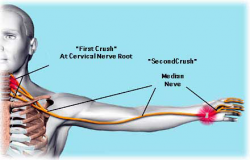
This is the most common type of Thoracic Outlet Syndrome. About 95% of cases of TOS belong to this type. The brachial plexus compression is the main characteristic of this type of TOS. This is related with the abnormalities of having a bony and soft tissue on the region of the lower neck that also include the area of the cervical rib. It compresses and irritates the brachial plexus which is a complex network of nerves that supply the sensation and movement of the arms and hands.

Venous (VTOS)  Thoracic Outlet Syndrome

This is a condition that is caused by major vein damage in the upper chest and lower neck. It develops quite suddenly and usually has an effect of tiring and unusual arm exercises.

If a patient is suffering from this type of TOS, he or she would experience symptoms such as hand, fingers and arm swelling. The patient may also feel like a weight is put on his neck or arms. Weakness of arms and neck may also be experienced. Swollen anterior chest wall veins may also appear.

Arterial Thoracic Outlet Syndrome

This is the least common type of thoracic outlet syndrome but this is also the most serious of all types. The cause for this type of TOS is congenital where an abnormality of the bones is situated on the lower neck and/or at the upper chest area. A person who suffers from this type of thoracic outlet syndrome experience symptoms such as sensitivity to cold in their fingers and hands, poor circulation of blood  to the arms, hands & fingers as well as pain, numbness and soreness of their fingers.

Vascular Thoracic Outlet Syndrome

This type of thoracic outlet syndrome affects the blood vessels located in the neck, armpit, shoulder, arm, hand or forearm. Usually, the affected vessels are the brachial plexus or the subclavian vessels. Compression of the vessels, whether it is due to muscle or bone inflammation or because of scar tissue will cause circulation impairment. Swelling or cyanosis can be caused by the loss of circulation in the hands. With severe cases, one can suffer from the condition known as Raynaud’s phenomenon which feels like your hands are burning. Cold usually trigger Raynaud’s phenomenon.

Nonspecific Thoracic Outlet Syndrome

It is also termed as common TOS or disputed TOS. There are doctors who doesn’t believe this type of TOS actually exist while other doctors say this condition is actually quite common. Patients suffering from this condition suffer from chronic pain on the thoracic outlet but there’s no known cause of the pain.

Filed Under: TOS

Thoracic Outlet Syndrome Treatment Techniques – Part 2/3

October 25, 2010 by drburt

Thoracic Outlet Syndrome treatment techniques

TOS

There are different treatment methods available for thoracic outlet syndrome such as exercises, treatment therapy and even surgery.  There are other non-conventional treatments available too, such as the Chinese acupuncture.

Chinese acupuncture needles

The Chinese acupuncture technique uses microcurrent device that are polarized at 50 to 75 microamperes, and zimmer pads. It uses point combination in treatment of TOS. PC6, SI3, ST41 and Liv4 are point combinations used.

The treatment takes 4 weeks with 2 to 3 sessions each week. The acupuncturist would insert the acupuncture needles subcutaneously and place stimulation pads (microcurrent) on top of each of the needles.

The polarized acutron mentor pads are applied on top of the needles directly. It has a positive and negative pad; the positive pad’s applied on the scalene muscle insertion (anterior) and the negative pad on the PC6 or the SI3. The electric stimulation usually cannot be felt by the patient as the microcurrent is sub-sensational. Some patients are more sensitive though and they can feel a tingling or vibrating sensation on the area but it’s quite subtle.

After 8 treatments, patients notice some improvement. The pain and burning or tingling sensation is minimized and the patient’s requirement for pain medication is also decreased or even stopped. Daily activities that require strength on the upper extremities are easily performed compared before the patient had the treatment.

With acupuncture therapy, the patient is still required to do some stretching exercises at home. These exercises are targeted on improving and recovery of the scalene muscles and tendons. It should be performed 3 times a day with at least 5 repetitions each time. Posture should also be improved to gain the proper biomechanics of the body.

Home exercises

A treatment plan for thoracic outlet syndrome or TOS requires a home exercise program to increase the speed of recovery. These exercises must be performed carefully and slowly. Each stretch position must be done to a point that you stretch without experiencing pain. Once you feel pain that means it’s too much and the patient must decrease the length of the stretch to a point that it is still painless. As you progress, you can extend the length of the stretch with pain as an indicator of your limit.

Corner stretch, neck stretch, shoulder rolls, thoracic extension, and overhead raise are just some of the home exercises prescribed by the medical professional to be exercised by the patient suffering from TOS.

Chiropractic Approach

Proper treatment of thoracic outlet requires an accurate understanding of the postural factors involved. Most recent treatment programs consider evaluation of joint mobility and muscular imbalance.

Once diagnosis of thoracic outlet syndrome is made by a Doctor of Chiropractic, a specific treatment program is designed for the patient.

More specifically, chiropractic management will focus on joint mobility in the cervical (neck) and thoracic (upper back) regions of the spine. Frequently, patients with thoracic outlet will have joint tightness in these areas which is treated with spinal manipulative therapy, stretching and rehabilitation in the office.

Keep in mind; there are other conditions that may cause similar symptoms. In either case, if you are currently suffering from similar symptoms, be sure to consult your chiropractor.

A chiropractic doctor might also advice you exercise routines and they may even prescribe you with their own exercise programs. Make sure you consult with the doctor before doing any of the home exercises to make sure that what you’re doing is actually going to improve and not worsen your condition.

The home exercises treatment technique combined with a proper treatment therapy from a medical professional is the best way to increase the speed of recovery and to diminish the pain suffered by TOS patients.

If you have any additional information, please write about it in our comment section.

Filed Under: TOS Tagged With: acupuncture, alternative medicine, back, chinese acupuncture, chiropractic, exercise, exercise program, home exercise, manipulative therapy, medicine, neurology, stretching exercises, syndromes, techniques, thoracic, thoracic outlet, thoracic outlet syndrome, thoracic outlet syndrome treatment, treatment

PLEASE FOLLOW & LIKE B.C.

RSS
Follow by Email
Facebook
Facebook
fb-share-icon
Twitter
Visit Us
Follow Me
Post on X
YouTube
YouTube
LinkedIn
LinkedIn
Share

15200 Hesperian Blvd #104

San Leandro, CA. 94578

(510) 481-2225

drburt@burtchiropractic.com


SEARCH

Categories

Recent Posts

  • Loss of Cervical Lordosis: How a Straight Neck and Pain Impact Your Health—and How a San Leandro Chiropractor Can Help Restore It
  • Hidden Injuries from Car Accidents That a San Leandro Chiropractor Can Help You Detect
  • Best San Leandro Chiropractor for Sciatica Pain Relief: Natural, Drug-Free Solutions That Work