Top Chiropractor in San Leandro, CA

San Leandro Chiropractor

  • blog
  • About Our Practice
  • What is Chiropractic?
  • SERVICES
    • Personal Injury
    • Cold Laser Therapy
    • Massage
    • Ultrasound
    • Electric Stimulation
    • Sports Injury
    • Workers Compensation
  • FAQs
  • Locations
  • CONTACT US
  • New Patient Forms
  • Nutrition Store
  • Home

Powered by Genesis

Heart Attack or Thoracic Outlet Syndrome ?

January 3, 2011 by drburt

TOSToday’s post is about real case that have treated on Friday. I saw this patient over a year ago for severe neck pain and headaches. Patient’s problem was resolved with very good results. This morning patient’s husband calls and asks me to see his wife today as an emergency visit because she has numbness in her left upper extremity, loss of temperature in that extremity, and shooting pain. Over the phone he explained to me what has happened couple of days ago.

He took his wife to a near by Hospital Emergency Room suspecting that she had a heart attack. She had severe shooting pain in her left upper chest and shooting pain down her arm. In a Hospital medical Doctors performed a complete check up, including laboratory test and fancy CT- Scan diagnostic. After numerous hours they found nothing wrong with his wife and discharge her home with some pain medications. She was not very happy with an outcome since the symptoms were still there even with pain medications.

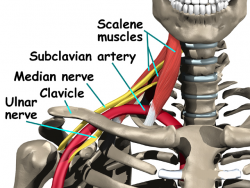
This morning I performed my examination and was trying to figure out what was wrong with this lady. First off all she always carries her heavy bag on her left shoulder with her belongings and belongings for her two young kids. That was a first sign that the problem was mechanical in nature and something was compressing her arteries and nerves. Her intercostal muscles between first and second ribs were extremely painful. Her left clavicle (look at the picture on a left) was out of alignment and did not have any movements during passive and active range of motion. Both of her rhomboid major and rhomboid minor muscles were very sore as well.

My Solution to This Problem:

I have diagnosed this lady with TOS. The first procedure was the electrical stimulation and moist heat. I used electrical stimulation on PAIN and CONSTANT settings for 15 minutes. Two pads were placed on her first and seconds intercostal spaces and two pads were placed around rhomboid major and minor muscles. Moist heat pack was placed in the same area for 15 minutes as well. Next, my massage therapist worked on her tight muscles for about 20 minutes or so. My CMT has informed that her entire left side is completely out of balance. Muscles were tight and patient was guarding during the massage which made her job a bit more difficult. But she got it done. After the massage I have performed full spine Chiropractic Adjustment ( that included cervical, thoracic and lumbar spine) and I have adjusted her first rib and clavicle on the left side.

I have called later on today to follow with this patient. Patient has informed me that she did not feel any pain since I saw her this morning. She has also informed me that she felt wave of heat coming into the left side of her body and left upper extremity.

The moral of this case: – please carry your heavy bags on both shoulders if you have too. Make sure that your kids’ backpacks are not too heavy and they carry them on both shoulders as well. Let’s start 2011 with a healthy habit.

Happy New Year !!!

Post a comment below or share your thoughts through Facebook, Twitter or comment section below to join the conversation. Feel free to add any additional tips.

Filed Under: Chiropractic, TOS Tagged With: back, biology, chest, chiropractic, Diagnose, heart attack, massage, medicine, neurology, orthopedic surgery, pain, pain medication, patient, possibilities, rhomboid major muscle, severe neck pain, shoulder, syndromes, thoracic outlet syndrome, tos, upper extremity

96 Tips For a Perfect Posture

August 5, 2010 by drburt

The spine, same as our feet, gets the hardest job in our body as it is used in practically every movement we make and it takes pressure from other body parts such as from the neck, shoulders, head and our arms. As we walk, stand, sit, carry a heavy object or dance, our spine takes the pressure to keep our body erect but at the same time it also has to have the flexibility to make other kinds of movements while keeping our balance.

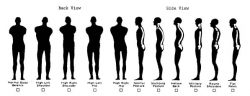
One of the following can be noticed when one has a bad posture: high shoulder, a forward stooping head, a rotated trunk (torso), a hunch back, a high hip, and a side-bent neck and one of the feet will be externally or internally rotated.  Abnormal  posture can result from trauma (like a car accident or fall), repetitive movements (turning your neck towards the monitor), and certain bad postural habits  (sleeping on your stomach).

The human body is often in a state of strain which causes a loss of proper balance between parts of the body and gravity. Such imbalance of posture distortion usually indicates internal body changes before  any  body functions appear disturbed.

All parts of the body are situated so this so this that they can interact efficiently with one another as well as with gravity. The body is able to repair itself and adjust to the many forces to which it is subjected, both internally and externally. This relationship produces a feeling of youth, energy and vitality.

By having correct posture, we are keeping our spinal vertebrae from being misaligned or subluxated.  Our spine is not only reliant on the strength of our back muscles but it also relies on its two arches (lumbar and cervical lordosis) which is why correct posture is vital. If we have poor posture, these natural arches would disappear and there’s going to be nothing left  that can absorb shock in our back. Once this happens, a person will experience pain in the neck and lower back. This paves the way for vertebral osteoarthritis, herniated disc and excessive pressure on the peripheral nerve. Osteoarthritis and herniated disc caused by uneven weight distribution on the vertebral bodies of the spine. Poor posture can lead to difficulty breathing by interfering with proper ribcage expansion, muscle soreness along the back of your neck, shoulders and upper back, as well as lower back pain.

When you already have poor posture, you can start practicing the correct posture by keeping yourself aware of the correct positions to maintain a good posture. There is a correct sitting position where you sit while keeping your back straight and your buttocks should be touching the back of the chair. When you want to lift a heavy object, you have to maintain your back straight and bend your knees & hips to lift the object up. You can start doing your research as to the correct positions to maintain a healthy spine. Also, muscle strengthening exercise is a must for a spine, for a better support of the spine.  Improper posture weakens muscles of the spine because they are not being used. By providing musculature the strength it needs, one can achieve a better maintenance of a good posture.

Also remember that this is not going to be a quick solution as it will take time especially with muscle strengthening. You may want to correct your posture now but won’t take it to heart and practice it daily then you won’t see real results. There should be a lifestyle change so that your body will get used to the correct posture that eventually you don’t even have to think about it.

You are probably wondering by now where  is the part about 96 tips for a perfect Posture. Below are the 5 links that  brings up total to 96 tips. Without further ado:

  1. 10 Tips for improving Posture and Ergonomics, by Dr. Kelly Andrews, D.C.
  2. 13 Tips on Getting a Good Posture, by  Celestine Chua
  3. 20 Tips from Yoga to Go, by Nancy Wile, Ed. D
  4. 32 Tips on how to Improve your Posture, by Savialeigh, Ben Rubenstein, Krystle C and many others
  5. 21 Tips on How to Maintain Good Posture, by ACA

To help you out, try finding ways to get yourself reminded of keeping a good posture. Perhaps you can put post-it notes on places that you would see on a regular basis. Like on your computer, put a small post-it note that says “stop slouching” or other reminders. You can also use an alarm that is set every 30 minutes or so to keep yourself aware and maintain a good posture.  I phone or any other smart phone has a build in calendar that can be set up as whatever time frequency you desire. I think it is one of the best ways to remind yourself about good posture habits. No one ever leaves a house without a cell phone in our days. These are simple solutions that really work as you exert an effort to inculcate the correct posture into your lifestyle.

Question: Have You Checked Your Posture Lately?  Do You Have Any Tips on How to Keep a Good Posture?

Filed Under: Posture, Spine Tagged With: anatomy, back posture, bad posture, body, correct posture, exercise, for a, health, human behavior, human body, improve posture, neck pain, necked, neutral spine, pain, perfect posture, poor posture, posture, posture and occupational health, posture brace, prevention, shoulder, sitting, spinal cord, spine, tips

Frozen Shoulder Syndrome and Chiropractic Rehabilitation in San Leandro, CA

June 7, 2010 by drburt

frozen shoulder

Frozen Shoulder Syndrome and Chiropractic Rehabilitation

Frozen shoulder (FS),medically referred to as adhesive capsulitis, is a disorder in which the the connective tissue surrounding the glenohumeral joint, becomes inflamed and stiff, and grows together with abnormal bands of tissue, called adhesions, greatly restricting motion and causing chronic pain. Some people experiencing this kind of problem don’t go for any forms of treatment in order to gain back the motion of their joints. The condition will get better eventually without treatment but it will take a very long time to do so. The pain and the reduced Range of Motion without any form of treatment means only one thing, you won’t be able to function to a full capacity. The more you try to move your joint, the more pain you will experience. Therefore, it is best to seek treatment for pain control. There several options for patients who have frozen shoulder pain:

1. Oral and Injectible Steroids

2.Hydrodilation and Hydroplasty

3. Chriopractic rehabilitation with Physical Therapy

4. Manipulation Under Anesthesia

Frozen shoulder(FS) is more common for people between the ages of 40 and 60. If you have diabetes, you are more prone to experiencing frozen shoulders as around 20% of diabetic patients also suffer from this condition at one point. Though, the actual causes of FS are still inconclusive but there are risk factors that may increase your chances of suffering from this condition. The conditon is twice more common in women than men. If you are between the ages of 40 and 60 and female who has diabetes, you have a higher risk of acquiring a frozen shoulder. Endocrine problems also increase your chance of experiencing a frozen shoulder. If you have Parkinson’s disease, you are also at a higher risk of suffering from a FS. Lastly, if you suffered from a shoulder injury or trauma and you immobilized your shoulder joints for a long period of time, you have the highest risk of developing a frozen shoulder.

According to health professionals who treat FS, the condition generally follows a course of three stages:

  • Stage one: a slow onset of pain, and the shoulder gradually loses the range of motion. This stage can last from six weeks to nine months.
  • Stage two: a slow improvement in pain relief, with stiffness remaining. This stage can last from four to nine months.
  • Stage three: a “thawing” as shoulder slowly regains motion and pain is relieved. This stage can last from five to 26 months.

There are two options for a treatment of FS: nonsurgical and surgical treatment. As a rule of thumb, the health care professional would advise the least invasive treatment first before they ask for a surgical intervention. For nonsurgical treatment there are chiropractic care and physical therapy, manipulation under anesthesia, as well as pain control using steroid medication.

Chiropractic care is a successful method in easing the frozen shoulder pain. Doctors of Chiropractic use TENS units, Ultraound, Erchonia Cold Laser PL 5000, stretching, educating patients about lifestyle change and diet.  The length of time spent on the chiropractic treatment depends on the severity of the condition. If the pain is more advance it can take months to rehabilitate the shoulder. Chiropractic can limit the devastating effects of all forms of physical disability such as FS. At this point research into its cause remains inconclusive.

As a general rule, prevention is better than cure. With chiropractic care, you can prevent FS even before it sets in. When you start feeling a slight pain in your shoulder area, you can try chiropractic care to avoid the stiffening of the joint that causes extreme pain and immobilization. If prevention is unsuccessful, treating the frozen shoulder with chiropractic care requires the use of modalities, chiropractic adjustmnts and deep tissue massage. This treatment is used to manage the pain, inflammation and increase range of Motion.

In the majority of cases, chiropractic involves few risks and has been proven beneficial in treating a FS syndrome. Reputable chiropractic professionals will assure their patients of the best program to follow in maintaining optimum physical movement and a quality life.

Filed Under: Shoulder Tagged With: adhesion, chiropractic, connective tissue, froze shoulder, frozen shoulder pain, frozen shoulder syndrome, musculoskeletal disorders, pain, physical therapy, shoulder, shoulder injuries, shoulder joints, shoulder problems

PLEASE FOLLOW & LIKE B.C.

RSS
Follow by Email
Facebook
Facebook
fb-share-icon
Twitter
Visit Us
Follow Me
Post on X
YouTube
YouTube
LinkedIn
LinkedIn
Share

15200 Hesperian Blvd #104

San Leandro, CA. 94578

(510) 481-2225

drburt@burtchiropractic.com


SEARCH

Categories

Recent Posts

  • Loss of Cervical Lordosis: How a Straight Neck and Pain Impact Your Health—and How a San Leandro Chiropractor Can Help Restore It
  • Hidden Injuries from Car Accidents That a San Leandro Chiropractor Can Help You Detect
  • Best San Leandro Chiropractor for Sciatica Pain Relief: Natural, Drug-Free Solutions That Work