Top Chiropractor in San Leandro, CA

San Leandro Chiropractor

  • blog
  • About Our Practice
    • YELP REVIEWS
  • What is Chiropractic?
  • SERVICES
    • Personal Injury
    • Cold Laser Therapy
    • Massage
    • Ultrasound
    • Electric Stimulation
    • Sports Injury
    • Workers Compensation
    • HS Sports Physical Examination
  • FAQs
  • CONTACT US
  • New Patient Forms
  • Nutrition Store

Powered by Genesis

Herniated vs. Bulging Disc: Understanding Your Diagnosis and Treatment Options in San Leandro

August 25, 2026 by drburt

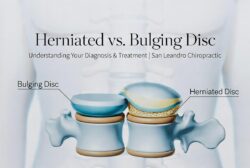
herniated vs duldging disc

If you’re dealing with back or neck pain in San Leandro or the East Bay, you’ve probably heard terms like “bulging disc” and “herniated disc.” These conditions are common, and understanding the difference can help you make better decisions about care—and avoid unnecessary worry or invasive treatments. At San Leandro Chiropractic, we regularly help local patients navigate these diagnoses with conservative, effective care focused on reducing pain, improving function, and supporting natural recovery.

What’s the Difference Between a Bulging Disc and a Herniated Disc?

Spinal discs act as cushions between your vertebrae. Each has a tough outer layer (annulus fibrosus) and a soft, gel-like center (nucleus pulposus).

  • Bulging disc: The outer layer remains intact, but the disc pushes outward, often evenly around a portion of its circumference (sometimes 25–50% of the disc). Think of a hamburger that’s been slightly squished—the filling stays contained, but the overall shape expands. Bulging discs are frequently age-related and can appear on imaging even in people with no pain.
  • Herniated disc (also called a slipped, ruptured, or prolapsed disc): The outer layer tears or cracks, allowing some of the inner gel material to push through. This is more localized and more likely to irritate or compress nearby nerves.

Both fall on a spectrum of disc degeneration and can occur in the lower back (lumbar) or neck (cervical). A “slipped disc” is informal language that usually refers to a herniation.Quick Comparison

FeatureBulging DiscHerniated Disc
Outer layerIntactTorn or cracked
Disc materialContained, broad outward pushInner gel may leak out
Nerve compressionLess commonMore likely
Typical symptomsMild to moderate localized ache/stiffnessOften sharper, radiating pain, numbness, or weakness
Common triggerGradual wear and tearInjury, lifting, or advanced degeneration

Symptoms: What You Might Feel

Bulging disc symptoms (when present) often include:

  • Dull, aching pain or stiffness in the back or neck
  • Discomfort that worsens with prolonged sitting or standing
  • Mild symptoms that may improve with movement

Herniated disc symptoms tend to be more intense and nerve-related:

  • Sharp, shooting, or burning pain that radiates into the arms (cervical) or legs (lumbar—often called sciatica)
  • Numbness, tingling, or “pins and needles”
  • Muscle weakness in the affected limb
  • Pain that increases with coughing, sneezing, or certain movements

Many people have disc changes on MRI with little or no symptoms. The key is correlating imaging findings with your actual pain and function.Red-flag symptoms that need prompt medical attention: progressive weakness, loss of bladder or bowel control, saddle anesthesia, or severe unrelenting pain. These are uncommon but serious.

What Causes These Disc Problems?

Common factors include:

  • Age-related disc dehydration and degeneration
  • Repetitive strain, poor posture, or prolonged sitting (common for desk workers and Bay Area commuters)
  • Improper lifting or sudden twisting movements
  • Trauma or injury
  • Excess body weight or weak core musculature

Lifestyle factors in San Leandro and surrounding areas—long hours at a computer, driving, or physical jobs—can contribute to spinal stress over time.

How Are Bulging and Herniated Discs Diagnosed?

Diagnosis starts with a thorough history and physical exam. Your provider will assess range of motion, strength, reflexes, and nerve function. Imaging (typically MRI) confirms the disc status and rules out other issues when symptoms warrant it. X-rays may show alignment or degenerative changes but do not visualize soft discs well. At San Leandro Chiropractic, we take time to evaluate how your symptoms relate to your daily activities and goals before recommending next steps.

Treatment Options: Most People Improve Without Surgery

The good news: The majority of bulging and herniated discs improve with conservative care. Surgery is usually reserved for cases with severe or progressive neurological deficits that don’t respond to non-surgical approaches.Conservative care often includes:

  • Activity modification and short-term relative rest (avoid complete bed rest)
  • Gentle movement, specific exercises, and physical therapy to improve mobility and strength
  • Anti-inflammatory strategies, heat/ice, and posture/ergonomic corrections
  • Chiropractic care, including spinal manipulation or mobilization when appropriate

Research supports spinal manipulative therapy as a reasonable option for many patients with disc-related low back pain and radiculopathy. Studies have shown meaningful improvements in pain and function for both acute and chronic cases, and some data associate chiropractic care with lower odds of progressing to discectomy in certain patient groups. Care is typically multimodal—combining adjustments with soft-tissue work, exercise guidance, and lifestyle advice.

How San Leandro Chiropractic Can Help


We provide personalized chiropractic care for patients in San Leandro and the East Bay dealing with disc-related pain. Our approach focuses on restoring joint motion, reducing nerve irritation, improving spinal function, and empowering you with practical strategies for recovery and prevention. Many patients experience reduced pain and better mobility through conservative management tailored to their specific diagnosis and lifestyle. Treatment plans are individualized. Not every disc issue is treated the same way, and we coordinate or refer when other interventions (such as injections or specialist evaluation) may be beneficial.

What to Expect and Recovery Timeline

Recovery varies. Milder bulging discs or smaller herniations may improve in weeks with consistent care. More symptomatic herniations can take longer—often several weeks to a few months of progressive improvement. Consistency with recommended exercises and posture habits matters.Prevention tips for San Leandro residents:

  • Maintain good workstation ergonomics
  • Strengthen your core and practice proper lifting
  • Stay active with walking and mobility work
  • Address minor back or neck discomfort early

Frequently Asked Questions

Can a bulging disc become a herniated disc?
Yes, ongoing stress or progression of degeneration can lead from bulge to herniation in some cases. Do I always need an MRI?
Not always. Clinical findings often guide care, and imaging is used when it will change management. Is chiropractic safe for disc herniations?
When performed by a trained professional after proper evaluation, spinal manipulation is generally considered safe for appropriately selected patients. We screen carefully and adapt techniques as needed. Will I need surgery?
Most people do not. Conservative care is the first-line approach for the vast majority of cases.

Take the Next Step Toward Relief

Living with disc-related pain doesn’t have to mean putting life in San Leandro on hold. Understanding whether you have a bulging or herniated disc is the first step getting the right care is the second. If you’re experiencing back pain, neck pain, sciatica, or related symptoms, contact San Leandro Chiropractic today to schedule an evaluation. We’re located at 15200 Hesperian Blvd., Ste. 104, San Leandro, CA 94578. Call (510) 481-2225 to book your appointment and start your path toward feeling better. Early, informed care often leads to better outcomes. We’re here to help local patients move with less pain and more confidence.

Filed Under: Chiropractic, Low Back Pain, Neck Pain Tagged With: alternative medicine, back pain, buldging disc, chiropractic, herniated disc, manipulative therapy, pain, san leandro chiropractor, spinal adjustment

2026 U.S. Economic Outlook: Navigating Uncertainty, Mental Stress, and the Role of Chiropractic Care

May 8, 2026 by drburt

spine chiro scaled

As we move through 2026, the U.S. economy presents a picture of moderate resilience amid persistent challenges. Forecasters project real GDP growth in the 2.0–2.3% range for the year. This pace reflects solid business investment—particularly in AI and technology—alongside fiscal policies and steady consumer spending. However, growth is uneven. Unemployment is expected to edge up modestly to around 4.3–4.6%, with job gains slowing in many sectors while healthcare and tech continue hiring. Inflation remains a concern. Core measures are easing but face upward pressure from energy prices, tariffs, and services costs. Many households still grapple with high housing expenses, healthcare costs, and everyday affordability issues. Policy uncertainty, geopolitical tensions, and elevated national debt add layers of volatility. While a sharp recession is not the baseline forecast, consumer sentiment stays cautious. For millions of Americans, economic pressures translate directly into heightened daily stress. Financial anxiety has become a defining feature of 2026. Surveys indicate nearly half of adults report higher stress levels than the previous year, driven by day to-day expenses, debt, job security worries, and concerns about the country’s direction. This chronic stress fuels a vicious cycle: elevated cortisol, sleep disruption, muscle tension, headaches, and reduced mental clarity. Younger generations, in particular, link financial strain to anxiety and feelings of lost control. When economic uncertainty lingers, the body and mind pay the price—poor posture from desk work or stress-induced clenching, neck and back pain, and nervous system overload. Here is where chiropractic care offers meaningful support. Chiropractic is not a solution for economic problems or a replacement for mental health therapy, but it serves as a powerful complementary tool for managing the physical and neurological effects of stress. Spinal adjustments help restore proper alignment, which can reduce nerve interference and shift the nervous system from sympathetic “fight or flight” dominance toward parasympathetic “rest and digest” balance. Many patients report lower muscle tension, fewer tension headaches, and improved sleep after consistent care. Research and clinical observations link chiropractic interventions to reduced cortisol markers, decreased blood pressure in some cases, and better overall emotional regulation. By addressing posture issues exacerbated by stress, chiropractic care helps break the feedback loop where physical pain amplifies mental strain. In a year of moderate economic growth but ongoing personal pressures, proactive self-care becomes essential. Regular chiropractic visits can improve resilience, boost energy levels, and enhance quality of life when finances and the future feel uncertain. Combined with exercise, financial planning, mindfulness practices, and professional mental health support when needed, it forms part of a holistic strategy. Looking ahead, 2026 rewards adaptability. The economy will likely avoid major contraction while delivering opportunities in innovative sectors. For individuals, protecting mental and physical health is key to navigating whatever comes next. If economic stress is weighing on your body and mind, consider scheduling a chiropractic evaluation. Small, consistent steps today—financial awareness, movement, and proper spinal care—can make 2026 feel more manageable and empowering.

Filed Under: Advice, Ankle, Auto Accidents, Carpal Tunnel Syndrome - CTS, Children, Chiropractic, D.C. Consulting, Diet, Exercises, FAQs, Games, Golfer's Elbow, Headache, Health, Insomnia, Knee, Low Back Pain, Modalities, Neck Pain, Nutriton, Opinion, Personal Injury, Posture, Questions/Answers, Shoulder, Soft Tissue Injury, Spine, Sports, Tennis Elbow, TMJ, TOS, Travel, Uncategorized, Weight Loss Tagged With: back pain, chiropractic, chiropractor, neck injury, san leandro

Is Your Mattress Causing You Back Pain?

December 6, 2018 by drburt

SLEEPING BEAUTYIs Your Mattress Causing You Back Pain?

Often, we ignore an occasional ache and pain when we’ve been active in physical sports or other activities that could be responsible. If it’s an ongoing problem and there is no other explanation for a morning backache, your mattress could be to blame [1]. 

It’s more common than you think

Even if your mattress has been a comfortable place to rest for years, these sleeping spaces change their shape over the years. The materials of even high-quality mattresses begin to wear over time and the changes in the integrity of the materials can certainly lead to aches and pains in the morning.

A chiropractor knows best

The spokesman for the American Chiropractic Association is Dr. Robert Hayden of Atlanta. He suggests that a repeated pattern of back pain in the morning is a strong indication that your mattress may be the source of your pain. This is the most common explanation for sudden back pain that is recurring when all other possible causes have been ruled out by your physician.

How can you tell if a mattress is the problem?

One of the best ways to determine if your mattress is the culprit is to do a few light stretching exercises to limber the muscles in your back and in the area that the pain is coming from. If the pain is gone within a half-hour then it’s a sign that your mattress may be the cause. Another sign is tossing and turning at night. If you don’t remember, a good way to tell is if the covers on your bed are disheveled. If you wake up with the covers on the floor or around your neck, then you’ve had a restless night.

Do you have a new mattress? 

If your back pain started shortly after sleeping on a new mattress, you may have bought one that isn’t the right degree of firmness or softness to meet your sleeping requirements. People are all individuals and we all sleep in different positions that we find comfortable. Some people prefer a hard mattress while others need a soft one. There are several different degrees of firmness and when a mattress is too firm, it can push on pressure points in your body as you sleep, causing stiffness and soreness when you wake up [2].

When to replace your mattress 

We all know that buying a good quality mattress is an investment, so it’s not something that people usually do until they are forced to. Mattresses should be replaced at least every eight years. If your mattress is aging or if it is beginning to sag or change from its original shape, then it’s time for a replacement because your well-being may depend upon it.

How to choose the right mattress 

Ideally, the best way to choose the best mattress is to test it out first. There are retailers that will allow you to push on the mattress with your hands and some will even allow you to sit on it or even lie on it and stretch out. The perfect mattress to prevent backaches is the one that feels good on your back and gives you a nearly floating sensation. The new mattress should support your entire body and it must allow for the proper alignment of your spine. Look for a mattress that doesn’t press on your main spinal pressure points, but make sure it isn’t too soft to provide your back and neck with support [3].

What to do if your mattress is the problem

Replace the mattress as soon as you can with one that is suitable for your firmness needs. If you can’t afford to replace it right away, you may want to consider purchasing a bed topper in a firmness that better meets your needs. You may also want to consider visiting a chiropractor, explaining the situation and getting an examination to see if you need to have a spinal adjustment. These often help to relieve mattress induced back pain.

Final thoughts

There are many different things that can cause morning back pain. It’s always wise to see a health care provider for recurring pain that does not resolve after a few days. If you notice a pattern of painful periods or if the pain is getting worse, see a professional for an examination to rule out any other causes of your discomfort. When you’re certain that there isn’t a physical injury, illness or organic cause for your pain, it’s probably your mattress. Replacing the mattress or altering the firmness can help to alleviate your discomfort. Life is much too short to put up with nuisance back pain when the answer can be as simple as getting a new mattress for a more restful and comfortable night’s sleep.

Web References

1.https://www.saatvamattress.com/blog/can-a-mattress-cause-back-pain/

2.https://www.thejoint.com/california/seal-beach/seal-beach-31037/how-to-tell-if-your-mattress-is-causing-you-back-p

  1. https://bestmattress.reviews/best-mattress-for-back-pain-reviews/

Filed Under: Advice Tagged With: back pain, mattress

How to prevent aches and strains

November 15, 2017 by drburt

lower back painBack pain and neck pain are among the most common issues complained about by most travelers. Most of the time, we usually take it for granted until when it finally blows out. With holidays approaching, many people usually have plans to travel. It can be either by bus or if going abroad; many may use airplanes. It is during this time when most people claim on back and neck pains. This is usually because of sitting in a car or plane for long hours. It is apparent that with long hours of sitting in one position, it can lead to various complications such as stress, tiredness, and stiffness. A good reason as to why long-distance travelers experience such travel aches and pains. Travel ache can, however, be prevented in numerous ways. In this article we discuss some of them.


Travelling By Airplane


  • To avoid aches and strains, there are various methods you can apply for quick relief. According to HealthMax, Toronto Chiropractors, it is crucial that you should warm up and cool down both prior and after travel. A few stretches and workouts can be a great idea to drive the pains away hence leaving you much healthier.
  • You can use blankets to help you maintain the S curve of your spines
  • Avoid too much strain on your body by carrying luggage that does not exceed your weight. This is by ensuring that all your bags are checked thus being suitable for overhead lifting.
  • Ensure that you vary positions from time to time while sitting. Also, massaging your calves and legs can be a great idea. This not only makes you flexible but encourages blood circulation.
  • Shoulder and neck muscle tensions are usually caused by drafts. To avoid this, therefore, do not sit under air controls.


Travelling By Car


  • A good sitting position is usually with your knees slightly higher than your hips. If traveling by car, you can achieve this by adjusting your seats appropriately.
  • It is necessary to think about having a backrest/support to reduce discomfort. This is also a better way to prevent swelling risks that might occur much later after the journey.
  • Your legs are another part of you that might experience severe fatigue during traveling. This is always when you drive for long hours, and your legs have to perform the same routines for more extended hours. For these reasons, you can do various tactics such as opening your toes open for minutes and tighten your thigh and calf muscle amongst others.
  • Take into consideration the driving indications from your instructors.
  • A better way to reduce muscle fatigue and increase blood circulation, it is a good idea to loosen the grip on the steering wheel frequently.
  • During your journey, you can often take rest breaks to loosen your body.


As they normally say, prevention is always better than cure. For these reasons, it is better if you consider taking appropriate preventive measures before and after traveling. This will, without a doubt, ensure that you are safer from any possible back and neck pain. Various sites such as “Aruba tourism” a site focused on Aruba tourism, are a good guide on proper tips to avoid travel aches. This can be a better option for most exciting and safer trip.

Filed Under: Advice Tagged With: back pain, chiropractic

PLEASE FOLLOW & LIKE B.C.

RSS
Follow by Email
Facebook
Facebook
fb-share-icon
Twitter
Visit Us
Follow Me
Post on X
YouTube
YouTube
LinkedIn
LinkedIn
Share

15200 Hesperian Blvd #104

San Leandro, CA. 94578

(510) 481-2225

drburt@burtchiropractic.com


SEARCH

Categories

Recent Posts

  • San Leandro Chiropractor for Auto Accident & T-Bone Collision Rehabilitation
  • The Hidden Danger of Whiplash: Why Minor San Leandro Intersections Lead to Major Pain
  • How to Sleep with Lower Back or Neck Pain: Practical Advice from a San Leandro Chiropractic Office