Fluoride Levels in San Leandro Drinking Water
San Leandro receives water primarily from the East Bay Municipal Utility District (EBMUD). EBMUD fluoridates its supply in accordance with California requirements for larger systems. Recent monitoring data show fluoride concentrations typically around 0.7–0.8 mg/L (parts per million), aligning with the U.S. Public Health Service and CDC recommended optimal level of 0.7 mg/L for cavity prevention. California’s regulatory framework sets an optimal range and maintains a primary maximum contaminant level stricter than the federal standard.
Community water fluoridation has a long track record of reducing tooth decay. Public health authorities, including the CDC and California Department of Public Health, continue to support it at controlled levels. At the same time, some individuals prefer to minimize additional fluoride exposure from water, toothpaste, and other sources for personal reasons. Local water quality reports confirm that San Leandro’s supply meets or exceeds regulatory standards for safety.
The Pineal Gland: Function and Calcification
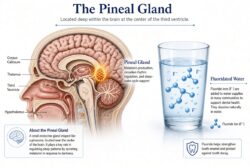
The pineal gland is a small endocrine structure near the center of the brain, outside the blood-brain barrier, with a rich blood supply. Its primary known role is producing melatonin, the hormone that helps regulate circadian rhythms and sleep-wake cycles. Melatonin production rises in darkness and is suppressed by light.
Pineal calcification (the accumulation of calcium phosphate deposits, often hydroxyapatite) is common and increases with age. Imaging studies frequently detect it in a substantial percentage of adults; it is often an incidental finding rather than a diagnosed disease. Calcification has been observed for more than a century, predating widespread community water fluoridation.
What Research Shows About Fluoride and the Pineal Gland
A key study frequently referenced is Jennifer Luke’s 2001 work published in Caries Research. Examining pineal glands from aged human cadavers, Luke found fluoride concentrations in the pineal substantially higher than in muscle tissue and, on a relative basis in the calcified portions, comparable to or exceeding levels in bone. There was a positive correlation between pineal fluoride and pineal calcium content. Subsequent analyses have confirmed that the pineal can accumulate fluoride at relatively high levels among soft tissues, consistent with its location, vascularity, and the affinity of fluoride for hydroxyapatite.
Animal research (including Luke’s earlier gerbil work) has reported reduced melatonin metabolite excretion and altered pubertal timing under higher fluoride exposure. A Canadian population based study has explored associations between fluoride exposure and sleep duration, hypothesizing a possible pineal pathway, though results remain associative.
Important caveats apply. Accumulation is not the same as proven functional harm at typical drinking-water concentrations. Large-scale human trials directly measuring fluoride’s effect on living human pineal melatonin production or calcification progression at 0.7 mg/L levels are lacking. Pineal calcification is multifactorial (age, calcium metabolism, genetics, and other factors play roles). Mainstream reviews, including the National Research Council’s examination of fluoride, have not identified pineal mediated clinical problems as a primary concern at regulated exposure levels. Claims that ordinary fluoridated water “turns the pineal to stone” or completely blocks its function overstate the evidence.
Pineal Gland, Consciousness, and Free Will: Science Versus Speculation
Historically and culturally, the pineal gland has carried symbolic weight. René Descartes famously described it as the “seat of the soul.” In various spiritual traditions it is associated with the “third eye,” intuition, or higher awareness. Some modern alternative narratives link pineal calcification to reduced spiritual perception, diminished intuition, or even impaired free will suggesting that environmental factors could make people more passive or compliant.
From a scientific standpoint, free will is a complex philosophical and neuroscientific question involving prefrontal cortex decision-making, agency, consciousness, and volition. No rigorous evidence establishes that pineal calcification (fluoride related or otherwise) directly diminishes human free will or autonomous decision-making. Melatonin influences sleep and circadian biology; disrupted sleep can affect mood, cognition, and executive function, but this is far removed from claims of mind control or loss of agency. Sleep quality, stress, nutrition, physical activity, and overall nervous system function have clearer, better documented impacts on daily cognitive performance and sense of agency.
It is reasonable for individuals to value melatonin optimization for better sleep and recovery. It is not supported to treat fluoride accumulation as a proven mechanism that overrides personal free will.
A Holistic Approach Through Chiropractic Care in San Leandro
A San Leandro chiropractor typically focuses on the musculoskeletal system and its relationship to the nervous system. Spinal alignment, joint mobility, soft-tissue function, and posture influence how the body processes sensory information, manages stress, and recovers. Many patients report improvements in sleep, energy, and overall well being after addressing mechanical stressors. In a comprehensive wellness context, chiropractic care can complement lifestyle measures that support pineal and endocrine health indirectly:
- Prioritizing consistent sleep hygiene and darkness at night to support natural melatonin rhythms.
- Managing physical tension that contributes to poor sleep or chronic stress.
- Encouraging movement, hydration, and nutrition that support general detoxification pathways and mineral balance.
- Educating patients about cumulative exposures so they can make informed personal choices (for example, using filters if preferred, or discussing fluoride with a dentist).
Chiropractic does not “decalcify” the pineal gland or reverse environmental exposures. It supports the nervous system’s capacity to adapt and function optimally. Patients concerned about water quality, sleep, or cognitive sharpness often benefit from a multimodal plan that includes professional evaluation rather than single issue focus.
Practical Considerations for San Leandro Residents
Those who wish to reduce fluoride intake can review EBMUD water quality reports, consider point-of-use filtration options certified for fluoride reduction if desired, and balance dental health needs with a dentist. Maintaining good oral hygiene, a nutrient-dense diet, regular physical activity, and quality sleep remains foundational regardless of water source.
Questions about free will, consciousness, and environmental influences are legitimate areas of personal and philosophical inquiry. Grounding those questions in the actual strength of the evidence fluoride does accumulate in the pineal; functional consequences at municipal levels are not clearly established; free-will effects are speculative allows clearer decision-making.
If you live in San Leandro or the surrounding East Bay and experience musculoskeletal discomfort, sleep challenges, or simply want support for nervous system resilience, consulting a local chiropractor can be one practical step. A thorough history, examination, and individualized plan help address the factors within your control while you navigate broader environmental and lifestyle considerations.
In summary, San Leandro’s water is fluoridated at the recommended public-health level. The pineal gland can accumulate fluoride and commonly calcifies with age. Links to major disruption of free will lack scientific substantiation. Focusing on verifiable supports for sleep, spinal health, stress management, and informed personal choices offers a more evidence aligned path to feeling clearer, more rested, and more capable in daily life.