Top Chiropractor in San Leandro, CA

San Leandro Chiropractor

  • blog
  • About Our Practice
  • What is Chiropractic?
  • SERVICES
    • Personal Injury
    • Cold Laser Therapy
    • Massage
    • Ultrasound
    • Electric Stimulation
    • Sports Injury
    • Workers Compensation
  • FAQs
  • Locations
  • CONTACT US
  • New Patient Forms
  • Nutrition Store
  • Home

Powered by Genesis

Heart Attack or Thoracic Outlet Syndrome ?

January 3, 2011 by drburt

TOSToday’s post is about real case that have treated on Friday. I saw this patient over a year ago for severe neck pain and headaches. Patient’s problem was resolved with very good results. This morning patient’s husband calls and asks me to see his wife today as an emergency visit because she has numbness in her left upper extremity, loss of temperature in that extremity, and shooting pain. Over the phone he explained to me what has happened couple of days ago.

He took his wife to a near by Hospital Emergency Room suspecting that she had a heart attack. She had severe shooting pain in her left upper chest and shooting pain down her arm. In a Hospital medical Doctors performed a complete check up, including laboratory test and fancy CT- Scan diagnostic. After numerous hours they found nothing wrong with his wife and discharge her home with some pain medications. She was not very happy with an outcome since the symptoms were still there even with pain medications.

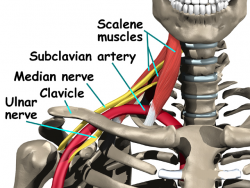
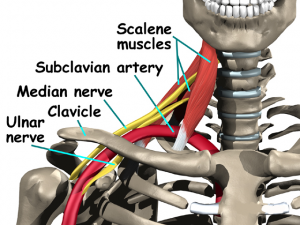
This morning I performed my examination and was trying to figure out what was wrong with this lady. First off all she always carries her heavy bag on her left shoulder with her belongings and belongings for her two young kids. That was a first sign that the problem was mechanical in nature and something was compressing her arteries and nerves. Her intercostal muscles between first and second ribs were extremely painful. Her left clavicle (look at the picture on a left) was out of alignment and did not have any movements during passive and active range of motion. Both of her rhomboid major and rhomboid minor muscles were very sore as well.

My Solution to This Problem:

I have diagnosed this lady with TOS. The first procedure was the electrical stimulation and moist heat. I used electrical stimulation on PAIN and CONSTANT settings for 15 minutes. Two pads were placed on her first and seconds intercostal spaces and two pads were placed around rhomboid major and minor muscles. Moist heat pack was placed in the same area for 15 minutes as well. Next, my massage therapist worked on her tight muscles for about 20 minutes or so. My CMT has informed that her entire left side is completely out of balance. Muscles were tight and patient was guarding during the massage which made her job a bit more difficult. But she got it done. After the massage I have performed full spine Chiropractic Adjustment ( that included cervical, thoracic and lumbar spine) and I have adjusted her first rib and clavicle on the left side.

I have called later on today to follow with this patient. Patient has informed me that she did not feel any pain since I saw her this morning. She has also informed me that she felt wave of heat coming into the left side of her body and left upper extremity.

The moral of this case: – please carry your heavy bags on both shoulders if you have too. Make sure that your kids’ backpacks are not too heavy and they carry them on both shoulders as well. Let’s start 2011 with a healthy habit.

Happy New Year !!!

Post a comment below or share your thoughts through Facebook, Twitter or comment section below to join the conversation. Feel free to add any additional tips.
Filed Under: Chiropractic, TOS Tagged With: back, biology, chest, chiropractic, Diagnose, heart attack, massage, medicine, neurology, orthopedic surgery, pain, pain medication, patient, possibilities, rhomboid major muscle, severe neck pain, shoulder, syndromes, thoracic outlet syndrome, tos, upper extremity

Thoracic Outlet Syndrome Treatment Techniques – Part 2/3

October 25, 2010 by drburt

Thoracic Outlet Syndrome treatment techniques

TOS

There are different treatment methods available for thoracic outlet syndrome such as exercises, treatment therapy and even surgery.  There are other non-conventional treatments available too, such as the Chinese acupuncture.

Chinese acupuncture needles

The Chinese acupuncture technique uses microcurrent device that are polarized at 50 to 75 microamperes, and zimmer pads. It uses point combination in treatment of TOS. PC6, SI3, ST41 and Liv4 are point combinations used.

The treatment takes 4 weeks with 2 to 3 sessions each week. The acupuncturist would insert the acupuncture needles subcutaneously and place stimulation pads (microcurrent) on top of each of the needles.

The polarized acutron mentor pads are applied on top of the needles directly. It has a positive and negative pad; the positive pad’s applied on the scalene muscle insertion (anterior) and the negative pad on the PC6 or the SI3. The electric stimulation usually cannot be felt by the patient as the microcurrent is sub-sensational. Some patients are more sensitive though and they can feel a tingling or vibrating sensation on the area but it’s quite subtle.

After 8 treatments, patients notice some improvement. The pain and burning or tingling sensation is minimized and the patient’s requirement for pain medication is also decreased or even stopped. Daily activities that require strength on the upper extremities are easily performed compared before the patient had the treatment.

With acupuncture therapy, the patient is still required to do some stretching exercises at home. These exercises are targeted on improving and recovery of the scalene muscles and tendons. It should be performed 3 times a day with at least 5 repetitions each time. Posture should also be improved to gain the proper biomechanics of the body.

Home exercises

A treatment plan for thoracic outlet syndrome or TOS requires a home exercise program to increase the speed of recovery. These exercises must be performed carefully and slowly. Each stretch position must be done to a point that you stretch without experiencing pain. Once you feel pain that means it’s too much and the patient must decrease the length of the stretch to a point that it is still painless. As you progress, you can extend the length of the stretch with pain as an indicator of your limit.

Corner stretch, neck stretch, shoulder rolls, thoracic extension, and overhead raise are just some of the home exercises prescribed by the medical professional to be exercised by the patient suffering from TOS.

Chiropractic Approach

Proper treatment of thoracic outlet requires an accurate understanding of the postural factors involved. Most recent treatment programs consider evaluation of joint mobility and muscular imbalance.

Once diagnosis of thoracic outlet syndrome is made by a Doctor of Chiropractic, a specific treatment program is designed for the patient.

More specifically, chiropractic management will focus on joint mobility in the cervical (neck) and thoracic (upper back) regions of the spine. Frequently, patients with thoracic outlet will have joint tightness in these areas which is treated with spinal manipulative therapy, stretching and rehabilitation in the office.

Keep in mind; there are other conditions that may cause similar symptoms. In either case, if you are currently suffering from similar symptoms, be sure to consult your chiropractor.

A chiropractic doctor might also advice you exercise routines and they may even prescribe you with their own exercise programs. Make sure you consult with the doctor before doing any of the home exercises to make sure that what you’re doing is actually going to improve and not worsen your condition.

The home exercises treatment technique combined with a proper treatment therapy from a medical professional is the best way to increase the speed of recovery and to diminish the pain suffered by TOS patients.

If you have any additional information, please write about it in our comment section.

Filed Under: TOS Tagged With: acupuncture, alternative medicine, back, chinese acupuncture, chiropractic, exercise, exercise program, home exercise, manipulative therapy, medicine, neurology, stretching exercises, syndromes, techniques, thoracic, thoracic outlet, thoracic outlet syndrome, thoracic outlet syndrome treatment, treatment

Carpal Tunnel Syndrome (CTS) and Chiropractic

July 20, 2010 by drburt

Carpal tunnel syndrome happens when there is a compression of the median nerve in the wrist formed by the carpal bones and the transverse carpal ligament – a strip of tendon that supports the wrist from the bottom. The Carpal Tunnel is a narrow passageway in the wrist where tendons and nerves pass through to control the hand. These nerves and tendons are covered with a sheath of fluid that protects it. When a person uses the hand repetitively, swelling can happen due to the irritation of the chamber. As it swells, there’s no more space to accommodate the swelling thus the nerve is being compressed which results in  numbness and tingling in the hands, primarily the thumb and thumb pad, index, middle, and inner half of the ring fingers.

When a person uses their hands on a repetitive motion, like for example when typing, there is a tendency that it can result in carpal tunnel syndrome. There’s no known real cause for the Carpal Tunnel Syndrome as it’s an idiopathic condition but those that are more prone to suffering from this syndrome are women and those with diabetes. Around 80% of cases of Carpal Tunnel Syndrome are women and studies are still being conducted to understand why majority of cases are females.

The symptoms of CTS are usually experienced at night and are most likely caused by the sleeping position of the patient. As the patient unknowingly bends the wrist during sleep, the pain would then flare up. In cases of patients suffering from pain at night due to carpal tunnel syndrome, the patient can use a brace or a splint to keep them from bending their wrist and compressing the nerves while sleeping.

Carpal tunnel syndrome can be treated through a chiropractic treatment. The patient must first undergo a series of examinations such as a physical examination and  x-ray to properly diagnose the patient’s case.  Since carpal tunnel syndrome is considered an RSI or a repetitive stress injury, the usual chiropractic treatment for this is by manipulation of the elbow and wrist and also with the manipulation of the patient’s cervical spine. Aside from this, the patient also has to rest the affected arm and to apply a cold compress to prevent further inflammation. A brace or a splint may also be advised for the patient to wear.

Spinal and arm manipulation is not the only chiropractic treatment available for treating carpal tunnel syndrome although it is the most common. An ultrasound therapy may also be conducted. In this type of therapy, a device that emits either high or low energy sound is used to the affected area. These energy sounds produce sound waves that penetrate into the skin and tissue thus relaxing the muscles and reducing the pain and inflammation. Cold Laser by Erchonia PL 5000 is another effective modality that will help to expedite the healing process and control the pain.

Chiropractic treatment for carpal tunnel syndrome is non-invasive. There’s no need for medications or surgery if you choose this treatment. Based on studies, the chiropractic treatment is also just as effective as the allopathic treatment for repetitive stress injury or RSI.

While I was doing research for this article I have come across a really interesting article on Eioba.com The title is: Kevin’s 52 Tips On Carpal Tunnel Syndrome and Wrist Pain. This article covers every angle on how to prevent CTS and RSI. It is a must list for everyone who has wrist pain. Thumbs up Kevin for this information. I am also providing a list of exercises intended to help prevent carpal tunnel syndrome. Remember doing a quick five minute exercise warm-up before starting work, just as runners stretch before a run, can help prevent work-related injuries.

In conclusion I would like you to watch this excellent 3D video by Christopher Travers. It will help one to better understand about the patho physiology of CTS.

Question: Waht kind fo treatment did you or someone you know have for CTS?

Filed Under: Carpal Tunnel Syndrome - CTS Tagged With: anatomy, carpal, carpal bones, carpal tunnel, carpal tunnel syndrome, chiropractic, cts, flexor retinaculum of the hand, human anatomy, median nerve, medicine, musculoskeletal disorders, nerve, neurology, repetitive strain injury, syndrome, syndromes, wrist

PLEASE FOLLOW & LIKE B.C.

RSS
Follow by Email
Facebook
Facebook
fb-share-icon
Twitter
Visit Us
Follow Me
Post on X
YouTube
YouTube
LinkedIn
LinkedIn
Share

15200 Hesperian Blvd #104

San Leandro, CA. 94578

(510) 481-2225

drburt@burtchiropractic.com


SEARCH

Categories

Recent Posts

  • Loss of Cervical Lordosis: How a Straight Neck and Pain Impact Your Health—and How a San Leandro Chiropractor Can Help Restore It
  • Hidden Injuries from Car Accidents That a San Leandro Chiropractor Can Help You Detect
  • Best San Leandro Chiropractor for Sciatica Pain Relief: Natural, Drug-Free Solutions That Work