Top Chiropractor in San Leandro, CA

San Leandro Chiropractor

  • blog
  • About Our Practice
  • What is Chiropractic?
  • SERVICES
    • Personal Injury
    • Cold Laser Therapy
    • Massage
    • Ultrasound
    • Electric Stimulation
    • Sports Injury
    • Workers Compensation
  • FAQs
  • Locations
  • CONTACT US
  • New Patient Forms
  • Nutrition Store
  • Home

Powered by Genesis

Sciatica Pain Relief and Chiropractic Treatment

November 5, 2010 by drburt

What is Sciatica?

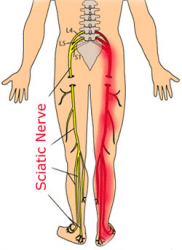
SCIATIC NERVE AND CHIROPRACTICSciatica is not a medical condition in itself but rather a symptom of other medical problems. It refers to the pain, numbness, tingling or weakness felt in the legs as an effect of compression or injury of the sciatic nerve.

The pain is usually felt in the buttocks, lower back or at various parts of the patient’s leg including the foot. The pain is usually severe combined with weakness of the muscles as well as numbness and tingling sensation. This condition is usually felt only on one side of the patient’s body.

Treatment Options

The treatment for the symptoms depends on the problems that cause the symptoms. Sciatica can be caused by spinal disc hernia, spinal stenosis, pregnancy, piriformis syndrome and many other conditions. What’s important is that the patient gets a proper diagnosis of his or her problem in order to get the right treatment.

Treatments for this condition vary from taking pain medications to surgery. Anti-inflammatory medications and paracetamol are taken to relieve the pain experienced by the patient. If this isn’t enough, narcotics can also be used especially if the pain is already severe.  Steroid injections provide short-term relief and benefits as well. Acupuncture, physical therapy, massage therapy and chiropractic care are also great treatment for sciatica. Some also benefit from yoga sessions and weight loss to reduce the pressure on the nerve roots of the spine.

Chiropractic treatment

Sciatica is treatable by chiropractic care and most of the time, it responds positively after spinal adjustments on the patient’s lower lumbar vertebrae as well as on the sacroillac joints. Some types of nerve irritation respond much faster while some takes a little while depending on the severity of the case and especially if the symptoms are already chronic.

A type of sciatica that is very difficult to deal with even for a chiropractor is when there is an actual herniation of the patient’s intervebral disc. This causes extreme pain that even taking narcotics and analgesics won’t give enough relief for the patient.

Before considering a chiropractic treatment to aid in your symptoms, you must know that most spinal adjustments done can only provide you with short-term relief to pain. It really depends on what causes the symptoms of nerve irritation and you must consult with your health professional regarding the matter. Your local chiropractor would tell you if your problem that results to sciatica symptoms can be improved through chiropractic care.

The best way to get real pain relief the pain in this condition is to relieve the sciatic nerve of the pressure. Correcting the root of the problem is the best solution in order to completely recover from the injury. If you only want pain relief then it will only be a temporary solution. Finding the real source and correcting it would get rid of the symptoms for a long time. By permanently relieving pressure off the sciatic nerve is the best solution to the problem.

Question: Have you or anyone you know experienced Sciatica?  What kind of treatment have you had?
Filed Under: Low Back Pain Tagged With: acupuncture, chiropractic, chiropractic treatment, general practice, intervertebral disc, manipulative therapy, medical conditions, medicine, neurology, orthopedic surgery, pain, pain medication, pain relief, piriformis syndrome, sciatic nerve, sciatica, sciatica pain relief, sciatica symptoms, spinal adjustment, treatment

Thoracic Outlet Syndrome Treatment Techniques – Part 2/3

October 25, 2010 by drburt

Thoracic Outlet Syndrome treatment techniques

TOS

There are different treatment methods available for thoracic outlet syndrome such as exercises, treatment therapy and even surgery.  There are other non-conventional treatments available too, such as the Chinese acupuncture.

Chinese acupuncture needles

The Chinese acupuncture technique uses microcurrent device that are polarized at 50 to 75 microamperes, and zimmer pads. It uses point combination in treatment of TOS. PC6, SI3, ST41 and Liv4 are point combinations used.

The treatment takes 4 weeks with 2 to 3 sessions each week. The acupuncturist would insert the acupuncture needles subcutaneously and place stimulation pads (microcurrent) on top of each of the needles.

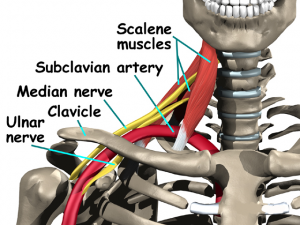
The polarized acutron mentor pads are applied on top of the needles directly. It has a positive and negative pad; the positive pad’s applied on the scalene muscle insertion (anterior) and the negative pad on the PC6 or the SI3. The electric stimulation usually cannot be felt by the patient as the microcurrent is sub-sensational. Some patients are more sensitive though and they can feel a tingling or vibrating sensation on the area but it’s quite subtle.

After 8 treatments, patients notice some improvement. The pain and burning or tingling sensation is minimized and the patient’s requirement for pain medication is also decreased or even stopped. Daily activities that require strength on the upper extremities are easily performed compared before the patient had the treatment.

With acupuncture therapy, the patient is still required to do some stretching exercises at home. These exercises are targeted on improving and recovery of the scalene muscles and tendons. It should be performed 3 times a day with at least 5 repetitions each time. Posture should also be improved to gain the proper biomechanics of the body.

Home exercises

A treatment plan for thoracic outlet syndrome or TOS requires a home exercise program to increase the speed of recovery. These exercises must be performed carefully and slowly. Each stretch position must be done to a point that you stretch without experiencing pain. Once you feel pain that means it’s too much and the patient must decrease the length of the stretch to a point that it is still painless. As you progress, you can extend the length of the stretch with pain as an indicator of your limit.

Corner stretch, neck stretch, shoulder rolls, thoracic extension, and overhead raise are just some of the home exercises prescribed by the medical professional to be exercised by the patient suffering from TOS.

Chiropractic Approach

Proper treatment of thoracic outlet requires an accurate understanding of the postural factors involved. Most recent treatment programs consider evaluation of joint mobility and muscular imbalance.

Once diagnosis of thoracic outlet syndrome is made by a Doctor of Chiropractic, a specific treatment program is designed for the patient.

More specifically, chiropractic management will focus on joint mobility in the cervical (neck) and thoracic (upper back) regions of the spine. Frequently, patients with thoracic outlet will have joint tightness in these areas which is treated with spinal manipulative therapy, stretching and rehabilitation in the office.

Keep in mind; there are other conditions that may cause similar symptoms. In either case, if you are currently suffering from similar symptoms, be sure to consult your chiropractor.

A chiropractic doctor might also advice you exercise routines and they may even prescribe you with their own exercise programs. Make sure you consult with the doctor before doing any of the home exercises to make sure that what you’re doing is actually going to improve and not worsen your condition.

The home exercises treatment technique combined with a proper treatment therapy from a medical professional is the best way to increase the speed of recovery and to diminish the pain suffered by TOS patients.

If you have any additional information, please write about it in our comment section.

Filed Under: TOS Tagged With: acupuncture, alternative medicine, back, chinese acupuncture, chiropractic, exercise, exercise program, home exercise, manipulative therapy, medicine, neurology, stretching exercises, syndromes, techniques, thoracic, thoracic outlet, thoracic outlet syndrome, thoracic outlet syndrome treatment, treatment

TMJ Dysfunction Treatments Options

October 4, 2010 by drburt

Home Treatments for TMJ Dysfunction

You can perform self-care treatments at home for TMJ dysfunction. Most often, the Temporomandibular joint dysfunction does not develop into a full disorder and the symptoms would disappear after it is able to recover and have enough rest.

Pain medications such as aspirin, ibuprofen or acetaminophen can ease the pain suffered due to TMJ dysfunction. Since chewing can be quite painful for sufferers of TMJ dysfunction, it is advised to eat soft foods during this time.  Apply ice packs on the injured area when the injury is still present. Rest your jaw as this could help in healing your TMJ.

Warm compress application is also advised to be put on the area where you feel pain.  20 minutes after applying the warm compress, you can try home therapy exercises such as opening and closing of the jaw moving from side to side. Repeat this up to 5 times a day at five minutes per session for 2 to 4 weeks. Make sure you don’t open your mouth wide while doing this exercise.

Medical Treatments for TMJ Dysfunction

Conservative medical treatments may also be necessary. The doctor may ask you to perform gentle stretching for the muscles on your jaw. He or She may also require you to perform relaxation exercises.  Stress can be a factor that will affect TMJ treatment thus stress-reduction techniques that manages the stress will help the patient relax his or her jaw alongside with the rest of his or her body.

A bite plate or splint may also be used. This is like a mouth guard that will help in reducing the teeth grinding or clenching especially when the patient sleeps at night. This will also ease the muscle tension on the jaw. However, if using the splint will increase the pain, the patient must stop using it.

If conservative treatments won’t work, a doctor may require you to go a step further and consider some of the invasive techniques to treat TMJ dysfunction.

Cortisone injection can be quite helpful in relieving the pain and inflammation of the jaw. Another procedure that would help in relieving the pain quickly is done at the doctor’s office and under local anesthetics.  The doctor would insert 2 needles in your TMJ for washing. One of the needles would be connected to a syringe that has a cleansing solution and it exits through the other syringe. Sometimes, aside from cleansing agents, the doctor may also inject pain medication this way as well.

If these still won’t work for the patient, surgery may be necessary though this is already considered as the final option. Artificial implants may be used as a replacement to the jaw joints. This is an irreversible method and must be avoided if other options are still available.

Chiropractic treatment for TMJ Dysfunction

This is a protocol that we use in our office: Electrical stimulation is used for 15 minutes on effected side. Deep tissue massage of the masseter muscle bilaterally.  Using rubber gloves on one hand perform a deep tissue massage of internal lateral pterigoid muscle (very painful but very useful and effective procedure). 5 minutes of Erchonia Cold Laser PL 5000 in the painful side of a TMJ.  Upper cervical chiropractic adjustment.

Do take note that most of the cases of TMJ dysfunction cannot be cured as it is most often a cyclic disorder. Modifications in lifestyle and proper treatment could improve the patient’s life without any limitation in function or pain.

Questiom: Was this information helpful? What kind of therapy have you had for your TMJ Dysfunction?

Filed Under: TMJ Tagged With: dysfunction, home treatments, jaws, options, pain medication, self care, tmj, tmj dysfunction, tmj treatments, treatment, treatment options, treatments

Neck Pain and Chiropractic Treatment in San Leandro

May 28, 2010 by drburt

neck pain chiropractic treatment in san leandro

Neck Pain and Chiropractic Treatment in San Leandro

Experiencing neck pain is really annoying and can take the focus off your work or activity that you should be paying attention to. It can be a little nuisance no matter if it’s mild or not. It is quite a common problem that many people experience at some point in their lives. Neck pain intensity can be mild to severe and the causes for the pain vary from just a muscular strain to a spinal misalignment (subluxation) or injury. The neck plays a vital role as it connects our head to the upper back. Since it supports the head so it won’t wag down, there are 3 top joints in the neck that provides flexibility and movement for both our neck and head. These joints support the head and if they get affected, the muscles tightening will cause the pain. Of course this is just the most common reason why a person experiences the neck pain. If a patient experiences neck pain, it would be best to consult a health care professional to figure out what caused the pain to begin with. It can just be a symptom and not the actual problem. It can be a referred pain caused by upper back problems or by an acute coronary syndrome. There are different available treatments out there depending on the severity of the neck pain. For many, a conservative treatment of chiropractic is their preferred choice. Chiropractors won’t proceed with chiropractic on the patient without initially diagnosing what caused the problem. A patient’s medical history is important as well as physical examination to test the movement of the patient’s neck ROM as well as to examine the muscles and testing of the nerves, in other words orthopedic and neurolgical examination. Chiropractic treatment may sound scary to some as twisting of the neck may mortify them and fear for the worst that could happen. However, licensed D.C. don’t just twist the neck or snap, one actually performs gentle manipulations of the cervical spine to improve the overall biomechanics which is quintessential to return the motion of the joints to normal. Chiropractors are well-trained and before they get their license, they are already equipped with the right knowledge to do the job well so you are assured that you won’t jeopardize your life if you try the treatment. In fact, you will greatly benefit from it. If the neck pain is caused by an injury, it would be best to have chiropractic rehabilitation along with physical therapy modalities (ultrasound, electrical stimulation and heat, Cold Laser – Erchonia PL 5000), deep tissue massage and possible pain medication. Medications can be prescribed to the patient by a medical doctor depending on the level of pain suffered by the patient. If after 1 or 2 weeks of  chiropractic rehabilitation the pain level goes down to a tolerable level, the patient can stop taking pain medications. Allopathic physician and Doctor of Chiropractic would know what’s best for you, so do ask for the suggestions. Question: What was your neck pain like? What kind of treatment did you choose for your neck pain?

About Dr. Burt
Dr. Burt

Filed Under: Neck Pain Tagged With: alternative medicine, annoying, back, chiropractic, chiropractic in canada, chiropractic treatment, experience, manipulative therapy, medicine, neck pain, necked, nociception, pain, paying attention, referred pain, san leandro chiropractor, treatment, vertebral subluxation

  • 1
  • 2
  • Next Page »

PLEASE FOLLOW & LIKE B.C.

RSS
Follow by Email
Facebook
Facebook
fb-share-icon
Twitter
Visit Us
Follow Me
Post on X
YouTube
YouTube
LinkedIn
LinkedIn
Share

15200 Hesperian Blvd #104

San Leandro, CA. 94578

(510) 481-2225

drburt@burtchiropractic.com


SEARCH

Categories

Recent Posts

  • Loss of Cervical Lordosis: How a Straight Neck and Pain Impact Your Health—and How a San Leandro Chiropractor Can Help Restore It
  • Hidden Injuries from Car Accidents That a San Leandro Chiropractor Can Help You Detect
  • Best San Leandro Chiropractor for Sciatica Pain Relief: Natural, Drug-Free Solutions That Work