Top Chiropractor in San Leandro, CA

San Leandro Chiropractor

  • blog
  • About Our Practice
  • What is Chiropractic?
  • SERVICES
    • Personal Injury
    • Cold Laser Therapy
    • Massage
    • Ultrasound
    • Electric Stimulation
    • Sports Injury
    • Workers Compensation
  • FAQs
  • Locations
  • CONTACT US
  • New Patient Forms
  • Nutrition Store
  • Home

Powered by Genesis

Thoracic Outlet Syndrome Treatment Techniques – Part 2/3

October 25, 2010 by drburt

Thoracic Outlet Syndrome treatment techniques
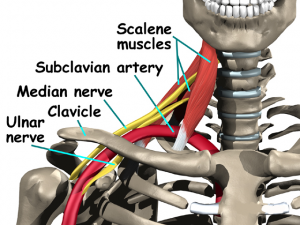
TOS

There are different treatment methods available for thoracic outlet syndrome such as exercises, treatment therapy and even surgery.  There are other non-conventional treatments available too, such as the Chinese acupuncture.

Chinese acupuncture needles

The Chinese acupuncture technique uses microcurrent device that are polarized at 50 to 75 microamperes, and zimmer pads. It uses point combination in treatment of TOS. PC6, SI3, ST41 and Liv4 are point combinations used.

The treatment takes 4 weeks with 2 to 3 sessions each week. The acupuncturist would insert the acupuncture needles subcutaneously and place stimulation pads (microcurrent) on top of each of the needles.

The polarized acutron mentor pads are applied on top of the needles directly. It has a positive and negative pad; the positive pad’s applied on the scalene muscle insertion (anterior) and the negative pad on the PC6 or the SI3. The electric stimulation usually cannot be felt by the patient as the microcurrent is sub-sensational. Some patients are more sensitive though and they can feel a tingling or vibrating sensation on the area but it’s quite subtle.

After 8 treatments, patients notice some improvement. The pain and burning or tingling sensation is minimized and the patient’s requirement for pain medication is also decreased or even stopped. Daily activities that require strength on the upper extremities are easily performed compared before the patient had the treatment.

With acupuncture therapy, the patient is still required to do some stretching exercises at home. These exercises are targeted on improving and recovery of the scalene muscles and tendons. It should be performed 3 times a day with at least 5 repetitions each time. Posture should also be improved to gain the proper biomechanics of the body.

Home exercises

A treatment plan for thoracic outlet syndrome or TOS requires a home exercise program to increase the speed of recovery. These exercises must be performed carefully and slowly. Each stretch position must be done to a point that you stretch without experiencing pain. Once you feel pain that means it’s too much and the patient must decrease the length of the stretch to a point that it is still painless. As you progress, you can extend the length of the stretch with pain as an indicator of your limit.

Corner stretch, neck stretch, shoulder rolls, thoracic extension, and overhead raise are just some of the home exercises prescribed by the medical professional to be exercised by the patient suffering from TOS.

Chiropractic Approach

Proper treatment of thoracic outlet requires an accurate understanding of the postural factors involved. Most recent treatment programs consider evaluation of joint mobility and muscular imbalance.

Once diagnosis of thoracic outlet syndrome is made by a Doctor of Chiropractic, a specific treatment program is designed for the patient.

More specifically, chiropractic management will focus on joint mobility in the cervical (neck) and thoracic (upper back) regions of the spine. Frequently, patients with thoracic outlet will have joint tightness in these areas which is treated with spinal manipulative therapy, stretching and rehabilitation in the office.

Keep in mind; there are other conditions that may cause similar symptoms. In either case, if you are currently suffering from similar symptoms, be sure to consult your chiropractor.

A chiropractic doctor might also advice you exercise routines and they may even prescribe you with their own exercise programs. Make sure you consult with the doctor before doing any of the home exercises to make sure that what you’re doing is actually going to improve and not worsen your condition.

The home exercises treatment technique combined with a proper treatment therapy from a medical professional is the best way to increase the speed of recovery and to diminish the pain suffered by TOS patients.

If you have any additional information, please write about it in our comment section.

Filed Under: TOS Tagged With: acupuncture, alternative medicine, back, chinese acupuncture, chiropractic, exercise, exercise program, home exercise, manipulative therapy, medicine, neurology, stretching exercises, syndromes, techniques, thoracic, thoracic outlet, thoracic outlet syndrome, thoracic outlet syndrome treatment, treatment

96 Tips For a Perfect Posture

August 5, 2010 by drburt

The spine, same as our feet, gets the hardest job in our body as it is used in practically every movement we make and it takes pressure from other body parts such as from the neck, shoulders, head and our arms. As we walk, stand, sit, carry a heavy object or dance, our spine takes the pressure to keep our body erect but at the same time it also has to have the flexibility to make other kinds of movements while keeping our balance.

One of the following can be noticed when one has a bad posture: high shoulder, a forward stooping head, a rotated trunk (torso), a hunch back, a high hip, and a side-bent neck and one of the feet will be externally or internally rotated.  Abnormal  posture can result from trauma (like a car accident or fall), repetitive movements (turning your neck towards the monitor), and certain bad postural habits  (sleeping on your stomach).

The human body is often in a state of strain which causes a loss of proper balance between parts of the body and gravity. Such imbalance of posture distortion usually indicates internal body changes before  any  body functions appear disturbed.

All parts of the body are situated so this so this that they can interact efficiently with one another as well as with gravity. The body is able to repair itself and adjust to the many forces to which it is subjected, both internally and externally. This relationship produces a feeling of youth, energy and vitality.

By having correct posture, we are keeping our spinal vertebrae from being misaligned or subluxated.  Our spine is not only reliant on the strength of our back muscles but it also relies on its two arches (lumbar and cervical lordosis) which is why correct posture is vital. If we have poor posture, these natural arches would disappear and there’s going to be nothing left  that can absorb shock in our back. Once this happens, a person will experience pain in the neck and lower back. This paves the way for vertebral osteoarthritis, herniated disc and excessive pressure on the peripheral nerve. Osteoarthritis and herniated disc caused by uneven weight distribution on the vertebral bodies of the spine. Poor posture can lead to difficulty breathing by interfering with proper ribcage expansion, muscle soreness along the back of your neck, shoulders and upper back, as well as lower back pain.

When you already have poor posture, you can start practicing the correct posture by keeping yourself aware of the correct positions to maintain a good posture. There is a correct sitting position where you sit while keeping your back straight and your buttocks should be touching the back of the chair. When you want to lift a heavy object, you have to maintain your back straight and bend your knees & hips to lift the object up. You can start doing your research as to the correct positions to maintain a healthy spine. Also, muscle strengthening exercise is a must for a spine, for a better support of the spine.  Improper posture weakens muscles of the spine because they are not being used. By providing musculature the strength it needs, one can achieve a better maintenance of a good posture.

Also remember that this is not going to be a quick solution as it will take time especially with muscle strengthening. You may want to correct your posture now but won’t take it to heart and practice it daily then you won’t see real results. There should be a lifestyle change so that your body will get used to the correct posture that eventually you don’t even have to think about it.

You are probably wondering by now where  is the part about 96 tips for a perfect Posture. Below are the 5 links that  brings up total to 96 tips. Without further ado:

  1. 10 Tips for improving Posture and Ergonomics, by Dr. Kelly Andrews, D.C.
  2. 13 Tips on Getting a Good Posture, by  Celestine Chua
  3. 20 Tips from Yoga to Go, by Nancy Wile, Ed. D
  4. 32 Tips on how to Improve your Posture, by Savialeigh, Ben Rubenstein, Krystle C and many others
  5. 21 Tips on How to Maintain Good Posture, by ACA

To help you out, try finding ways to get yourself reminded of keeping a good posture. Perhaps you can put post-it notes on places that you would see on a regular basis. Like on your computer, put a small post-it note that says “stop slouching” or other reminders. You can also use an alarm that is set every 30 minutes or so to keep yourself aware and maintain a good posture.  I phone or any other smart phone has a build in calendar that can be set up as whatever time frequency you desire. I think it is one of the best ways to remind yourself about good posture habits. No one ever leaves a house without a cell phone in our days. These are simple solutions that really work as you exert an effort to inculcate the correct posture into your lifestyle.

Question: Have You Checked Your Posture Lately?  Do You Have Any Tips on How to Keep a Good Posture?

Filed Under: Posture, Spine Tagged With: anatomy, back posture, bad posture, body, correct posture, exercise, for a, health, human behavior, human body, improve posture, neck pain, necked, neutral spine, pain, perfect posture, poor posture, posture, posture and occupational health, posture brace, prevention, shoulder, sitting, spinal cord, spine, tips

PLEASE FOLLOW & LIKE B.C.

RSS
Follow by Email
Facebook
Facebook
fb-share-icon
Twitter
Visit Us
Follow Me
Post on X
YouTube
YouTube
LinkedIn
LinkedIn
Share

15200 Hesperian Blvd #104

San Leandro, CA. 94578

(510) 481-2225

drburt@burtchiropractic.com


SEARCH

Categories

Recent Posts

  • Loss of Cervical Lordosis: How a Straight Neck and Pain Impact Your Health—and How a San Leandro Chiropractor Can Help Restore It
  • Hidden Injuries from Car Accidents That a San Leandro Chiropractor Can Help You Detect
  • Best San Leandro Chiropractor for Sciatica Pain Relief: Natural, Drug-Free Solutions That Work