Top Chiropractor in San Leandro, CA

San Leandro Chiropractor

  • blog
  • About Our Practice
  • What is Chiropractic?
  • SERVICES
    • Personal Injury
    • Cold Laser Therapy
    • Massage
    • Ultrasound
    • Electric Stimulation
    • Sports Injury
    • Workers Compensation
  • FAQs
  • Locations
  • CONTACT US
  • New Patient Forms
  • Nutrition Store
  • Home

Powered by Genesis

2026 U.S. Economic Outlook: Navigating Uncertainty, Mental Stress, and the Role of Chiropractic Care

May 8, 2026 by drburt

As we move through 2026, the U.S. economy presents a picture of moderate resilience amid persistent challenges. Forecasters project real GDP growth in the 2.0–2.3% range for the year. This pace reflects solid business investment—particularly in AI and technology—alongside fiscal policies and steady consumer spending. However, growth is uneven. Unemployment is expected to edge up modestly to around 4.3–4.6%, with job gains slowing in many sectors while healthcare and tech continue hiring. Inflation remains a concern. Core measures are easing but face upward pressure from energy prices, tariffs, and services costs. Many households still grapple with high housing expenses, healthcare costs, and everyday affordability issues. Policy uncertainty, geopolitical tensions, and elevated national debt add layers of volatility. While a sharp recession is not the baseline forecast, consumer sentiment stays cautious. For millions of Americans, economic pressures translate directly into heightened daily stress. Financial anxiety has become a defining feature of 2026. Surveys indicate nearly half of adults report higher stress levels than the previous year, driven by day to-day expenses, debt, job security worries, and concerns about the country’s direction. This chronic stress fuels a vicious cycle: elevated cortisol, sleep disruption, muscle tension, headaches, and reduced mental clarity. Younger generations, in particular, link financial strain to anxiety and feelings of lost control. When economic uncertainty lingers, the body and mind pay the price—poor posture from desk work or stress-induced clenching, neck and back pain, and nervous system overload. Here is where chiropractic care offers meaningful support. Chiropractic is not a solution for economic problems or a replacement for mental health therapy, but it serves as a powerful complementary tool for managing the physical and neurological effects of stress. Spinal adjustments help restore proper alignment, which can reduce nerve interference and shift the nervous system from sympathetic “fight or flight” dominance toward parasympathetic “rest and digest” balance. Many patients report lower muscle tension, fewer tension headaches, and improved sleep after consistent care. Research and clinical observations link chiropractic interventions to reduced cortisol markers, decreased blood pressure in some cases, and better overall emotional regulation. By addressing posture issues exacerbated by stress, chiropractic care helps break the feedback loop where physical pain amplifies mental strain. In a year of moderate economic growth but ongoing personal pressures, proactive self-care becomes essential. Regular chiropractic visits can improve resilience, boost energy levels, and enhance quality of life when finances and the future feel uncertain. Combined with exercise, financial planning, mindfulness practices, and professional mental health support when needed, it forms part of a holistic strategy. Looking ahead, 2026 rewards adaptability. The economy will likely avoid major contraction while delivering opportunities in innovative sectors. For individuals, protecting mental and physical health is key to navigating whatever comes next. If economic stress is weighing on your body and mind, consider scheduling a chiropractic evaluation. Small, consistent steps today—financial awareness, movement, and proper spinal care—can make 2026 feel more manageable and empowering.

Filed Under: Advice, Ankle, Auto Accidents, Carpal Tunnel Syndrome - CTS, Children, Chiropractic, D.C. Consulting, Diet, Exercises, FAQs, Games, Golfer's Elbow, Headache, Health, Insomnia, Knee, Low Back Pain, Modalities, Neck Pain, Nutriton, Opinion, Personal Injury, Posture, Questions/Answers, Shoulder, Soft Tissue Injury, Spine, Sports, Tennis Elbow, TMJ, TOS, Travel, Uncategorized, Weight Loss Tagged With: back pain, chiropractic, chiropractor, neck injury, san leandro

Gardening Injury Prevention Tricks and Tips

April 4, 2016 by drburt

gardening injury preventionGardening Injury Prevention Tricks and Tips

Gardening is one of the best forms of exercise any of us can take, it is good for flexibility, strength, and stamina. However, you need to prepare properly for gardening injury prevention. Digging, lifting, raking, shifting, and planting can all cause significant strain to the muscles and the back.

A Gallup poll of more than 2,000 British adults found that nearly 42% had suffered from back pain. Of these, nearly half (47%) said their problems were caused by gardening. Among the 35-plus age group, the proportion was even higher at 56%. Gardening can cause muscle strains, ligament sprains, and back muscle spasms.

Dr. Stan Gorchynski, former President of the Ontario Chiropractic Association (OCA), said that “Eight out of every ten Canadians can expect to suffer from back pain at some time during their lives. During the spring gardening season, however, we generally see an increase in the number of visits to chiropractors due to muscle strains, sore joints, and back pain.” He added, “The warmer weather really inspires people to get out in the yard, but for many people a winter of inactivity makes them prone to back and muscle injuries.”

To have a happy and healthy gardening season, follow the healthy gardening “do’s and don’ts” listed below.

For chronic back pain sufferers, raised garden beds can be very helpful. A raised bed height of 2-3 feet will allow you to sit while gardening. Also consider using ground cover plants to reduce the need for continuous weeding.

Healthy gardening dos and don’ts

Do:

  • Choose lightweight, long-handled garden tools to help avoid bending over too often.
  • Wear loose, comfortable clothing.
  • Wear sun block and sun protection garments.
  • Warm-up before gardening and cool-down afterward—take a short 10 to 15 minute walk.
  • Perform some simple lower-back stretches.
  • Switch hands frequently while raking or hoeing.
  • Dig and lift a little at a time.
  • Keep your back straight while lifting.
  • Use mechanical devices when moving heavy containers.
  • Use a cushion if you are going to be on your knees for a long time.
  • Change positions every 10 to 20 minutes—take a break and walk around for a minute or two.

Don’t:

  • Strain, twist, or reach too far in front.
  • Take large shovelfuls of soil.
  • Hesitate to use a small spade.
  • Dig continuously.
  • Overload the wheelbarrow.
  • Stay in the same position too long.
  • Perform the same activity too long.
  • Stoop or work too far in front of you.
  • Stretch or squat with a bent back.

Filed Under: Health Tagged With: gardening injury prevention, Injury, injury prevention

Human Body Energy Clock and Qi Building and Balancing

March 2, 2016 by drburt

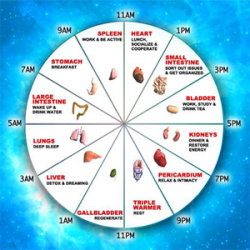
human body energy and qi balancingHuman Body Energy Clock and Qi Building and Balancing

Human body energy clock works on Qi (energy) according to the traditional Chinese medicine (TCM). Our 12 main meridians have a maximum and minimum energy flow. Each meridian is linked to specific organs in our body. Issues with organs generally appear either during the maximum or minimum energy flow. Knowing this can help treating the correct area that needs the most.

The nearest Western equivalent to qi human body energy is an inspiration. But there is a decisive difference between Eastern and Western attitudes. Westerners tend to regard this sweet spiritual inebriation as something that either fills us or deserts us, completely out of our control. In the Eastern mind, though, this is something that you can control. You can awaken, stimulate, increase and utilize the qi energy, according to your will.

Therefore, this post is focused on the strictly practical aspects of qi energy: how to get it started and make it grow, and how to use it. Inspiration is yours to call upon at your own wish.

It is not even difficult.  Anyone can do exercises without much effort. Nor do they take much time. There is just one snag: You have to repeat them, preferably every day, and you should do that long enough to establish new habits. It is the only method to make your body act in a way that stimulates your qi, without your mind having to think about it constantly.

You will soon find that life gets another luster. So give it a chance.

 Building Qi in the Body

Human body energy can be increased. Consequently, the development of Qi can make an ill person robust or a weak person vibrant. More Qi can enhance mental capacity too.

The concept of Qi also extends beyond the physical body, to the subtle energies that activate all human functions, including emotions and thought. Unbalanced Qi causes your emotions to become agitated and distressed. Balanced Qi causes your emotions to become smooth and more satisfying.

From the perspective of thought, when your mental Qi becomes more refined it enhances your creativity at all levels–art, business, relationships, child bearing, etc.

Spiritual Qi makes it more possible for us to personally enter into higher states of consciousness, which lie at the heart of religious experience.

Qigong, tai chi and other form of Taoist martial and healing arts, help you to develop subtle chi-energy, not as an idea but rather lead you to directly feel and experience what this is in your body.

Qi Circulation

To maintain pain-free, optimal health, Qi or energy should circulate throughout your entire body, without disruption, in a smooth, powerful fashion.

The classic Chinese medical phrase is teng jr bu tong. If the circulation of your chi is blocked (bu tong), you have pain and disease (teng). Conversely, if your Qi or life force energy in your acupuncture meridian lines if fully connected and circulating without blockages (tong), you have neither pain nor disease (bu tong) – tong jr bu teng.

Making your Qi tong i is the most basic goal of Chinese medicine and most apparent with tai chi, qigong and acupuncture. Balancing out and connecting your chi so that it has no blockages will both get rid of the pain of disease and make you feel a whole lot better.

Filed Under: Advice, Health Tagged With: energy, health, human body energy, qi, tcm, traditional chinese medicine

Chia Seeds Superfood and Health Benefits for a Human Body

March 2, 2016 by drburt

Chia Seeds Superfood and Health Benefits for a Human BodyChia Seeds Superfood and Health Benefits for a Human Body

Chia seeds are tiny black seeds from the plant Salvia Hispanica, which is related to mint. This plant grows natively in South America. Chia seeds were an important food for the Aztecs and Mayans back in the day. They prized them for their ability to provide sustainable energy … in fact, “chia” is the ancient Mayan word for “strength.”

Despite their ancient history as a dietary staple, only recently did chia seeds become recognized as a modern day superfood. In the past few years, they have exploded in popularity and are now consumed by health conscious people all over the world.

Chia Seeds were largely unknown in North America until researcher Wayne Coates began studying chia as an alternative crop for farmers in northern Argentina about 29 years ago.

Coates started his work on chia in 1991, and since then has become an advocate of the tiny seed’s health benefits. The human trials are limited —as is often the case with food research— but the anecdotal evidence of chia’s positive health effects include boosting energy, stabilizing blood sugar, aiding digestion, and lowering cholesterol.

Chia seeds are among the healthiest foods on the planet. They are loaded with nutrients that can have important benefits for your body and brain.  Chia Seeds are rich in fiber, omega-3 fats, protein, vitamins and minerals such as:

Dietary fiber (11g – 42% recommended daily value)

Protein (4.4g – 9% RDV)

Omega-3 fatty acids (4915 mg)

Omega-6 fatty acids (1620 mg)

Calcium (77 mg – 18% RDV)

Copper (0.1 mg – 3% RDV)

Phosphorus (265 mg – 27% RDV)

Potassium (44.8 mg – 1% RDV)

Zinc (1.0 mg – 7% RDV)

Chia also contains essential fatty acids alpha-linolenic and linoleic acid, mucin, strontium, Vitamins A, B, E, and D, and minerals including sulphur, iron, iodine,  magnesium, manganese, niacin, thiamine, and they are a rich source of antioxidants.

This is particularly impressive when you consider that this is just a single ounce, which supplies only 137 calories and one gram of digestible carbohydrate! Just so that we’re all on the same page, 1 ounce equals 28 grams, or about 2 tablespoons.

Interestingly … if you subtract the fiber, which may not end up as usable calories for the body, chia seeds only contain 101 calories per ounce. This makes them one of the world’s best sources of several important nutrients, calorie for calorie.

8 Super Facts of Chia Seeds from Scullivan
 Chia seeds used to be a niche ingredient you could only scout out at health food stores next to the hemp seeds and spirulina. But chances are you can now find chia at your local supermarket, in everything from granolas and cereals to yogurts and energy drinks. You can find it at restaurants, too: Chia pudding has become a mainstay at trendy cafés and luncheonettes like NYC’s Dimes and L.A.’s Café Gratitude. Want to enjoy them at home?

Lemon Cake with Chia Seeds from Tastes of Health

Buying Tips
You can find chia at any Whole Foods Market, health food stores, and well-stocked supermarkets like Kroger. Some of the more widely available chia seed brands include The Chia Co., Nutiva, and Bob’s Red Mill. All chia seeds are naturally vegan and gluten-free, but check the packaging if you want to buy seeds that are certified organic and non-GMO. Look for seeds that are either a speckled black or white, but not uniformly brown. The Chia Co. founder John Foss explains brown chia seeds are immature seeds that haven’t had a chance to mature properly, and this can result in fewer nutritional benefits and give the seeds a bitter taste.

How to Store
Chia seeds have a long shelf life, and will keep for several years when stored in a cool, dry place. Easy!

Filed Under: Diet, Health, Nutriton Tagged With: chia seeds, health, health benefits, human body, nutrition

  • 1
  • 2
  • 3
  • …
  • 12
  • Next Page »

PLEASE FOLLOW & LIKE B.C.

RSS
Follow by Email
Facebook
Facebook
fb-share-icon
Twitter
Visit Us
Follow Me
Post on X
YouTube
YouTube
LinkedIn
LinkedIn
Share

15200 Hesperian Blvd #104

San Leandro, CA. 94578

(510) 481-2225

drburt@burtchiropractic.com


SEARCH

Categories

Recent Posts

  • Loss of Cervical Lordosis: How a Straight Neck and Pain Impact Your Health—and How a San Leandro Chiropractor Can Help Restore It
  • Hidden Injuries from Car Accidents That a San Leandro Chiropractor Can Help You Detect
  • Best San Leandro Chiropractor for Sciatica Pain Relief: Natural, Drug-Free Solutions That Work