
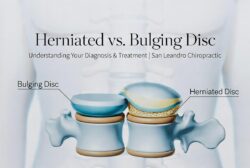
If you’re dealing with back or neck pain in San Leandro or the East Bay, you’ve probably heard terms like “bulging disc” and “herniated disc.” These conditions are common, and understanding the difference can help you make better decisions about care—and avoid unnecessary worry or invasive treatments. At San Leandro Chiropractic, we regularly help local patients navigate these diagnoses with conservative, effective care focused on reducing pain, improving function, and supporting natural recovery.
What’s the Difference Between a Bulging Disc and a Herniated Disc?
Spinal discs act as cushions between your vertebrae. Each has a tough outer layer (annulus fibrosus) and a soft, gel-like center (nucleus pulposus).
- Bulging disc: The outer layer remains intact, but the disc pushes outward, often evenly around a portion of its circumference (sometimes 25–50% of the disc). Think of a hamburger that’s been slightly squished—the filling stays contained, but the overall shape expands. Bulging discs are frequently age-related and can appear on imaging even in people with no pain.
- Herniated disc (also called a slipped, ruptured, or prolapsed disc): The outer layer tears or cracks, allowing some of the inner gel material to push through. This is more localized and more likely to irritate or compress nearby nerves.
Both fall on a spectrum of disc degeneration and can occur in the lower back (lumbar) or neck (cervical). A “slipped disc” is informal language that usually refers to a herniation.Quick Comparison
| Feature | Bulging Disc | Herniated Disc |
|---|---|---|
| Outer layer | Intact | Torn or cracked |
| Disc material | Contained, broad outward push | Inner gel may leak out |
| Nerve compression | Less common | More likely |
| Typical symptoms | Mild to moderate localized ache/stiffness | Often sharper, radiating pain, numbness, or weakness |
| Common trigger | Gradual wear and tear | Injury, lifting, or advanced degeneration |
Symptoms: What You Might Feel
Bulging disc symptoms (when present) often include:
- Dull, aching pain or stiffness in the back or neck
- Discomfort that worsens with prolonged sitting or standing
- Mild symptoms that may improve with movement
Herniated disc symptoms tend to be more intense and nerve-related:
- Sharp, shooting, or burning pain that radiates into the arms (cervical) or legs (lumbar—often called sciatica)
- Numbness, tingling, or “pins and needles”
- Muscle weakness in the affected limb
- Pain that increases with coughing, sneezing, or certain movements
Many people have disc changes on MRI with little or no symptoms. The key is correlating imaging findings with your actual pain and function.Red-flag symptoms that need prompt medical attention: progressive weakness, loss of bladder or bowel control, saddle anesthesia, or severe unrelenting pain. These are uncommon but serious.
What Causes These Disc Problems?
Common factors include:
- Age-related disc dehydration and degeneration
- Repetitive strain, poor posture, or prolonged sitting (common for desk workers and Bay Area commuters)
- Improper lifting or sudden twisting movements
- Trauma or injury
- Excess body weight or weak core musculature
Lifestyle factors in San Leandro and surrounding areas—long hours at a computer, driving, or physical jobs—can contribute to spinal stress over time.
How Are Bulging and Herniated Discs Diagnosed?
Diagnosis starts with a thorough history and physical exam. Your provider will assess range of motion, strength, reflexes, and nerve function. Imaging (typically MRI) confirms the disc status and rules out other issues when symptoms warrant it. X-rays may show alignment or degenerative changes but do not visualize soft discs well. At San Leandro Chiropractic, we take time to evaluate how your symptoms relate to your daily activities and goals before recommending next steps.
Treatment Options: Most People Improve Without Surgery
The good news: The majority of bulging and herniated discs improve with conservative care. Surgery is usually reserved for cases with severe or progressive neurological deficits that don’t respond to non-surgical approaches.Conservative care often includes:
- Activity modification and short-term relative rest (avoid complete bed rest)
- Gentle movement, specific exercises, and physical therapy to improve mobility and strength
- Anti-inflammatory strategies, heat/ice, and posture/ergonomic corrections
- Chiropractic care, including spinal manipulation or mobilization when appropriate
Research supports spinal manipulative therapy as a reasonable option for many patients with disc-related low back pain and radiculopathy. Studies have shown meaningful improvements in pain and function for both acute and chronic cases, and some data associate chiropractic care with lower odds of progressing to discectomy in certain patient groups. Care is typically multimodal—combining adjustments with soft-tissue work, exercise guidance, and lifestyle advice.
How San Leandro Chiropractic Can Help
We provide personalized chiropractic care for patients in San Leandro and the East Bay dealing with disc-related pain. Our approach focuses on restoring joint motion, reducing nerve irritation, improving spinal function, and empowering you with practical strategies for recovery and prevention. Many patients experience reduced pain and better mobility through conservative management tailored to their specific diagnosis and lifestyle. Treatment plans are individualized. Not every disc issue is treated the same way, and we coordinate or refer when other interventions (such as injections or specialist evaluation) may be beneficial.
What to Expect and Recovery Timeline
Recovery varies. Milder bulging discs or smaller herniations may improve in weeks with consistent care. More symptomatic herniations can take longer—often several weeks to a few months of progressive improvement. Consistency with recommended exercises and posture habits matters.Prevention tips for San Leandro residents:
- Maintain good workstation ergonomics
- Strengthen your core and practice proper lifting
- Stay active with walking and mobility work
- Address minor back or neck discomfort early
Frequently Asked Questions
Can a bulging disc become a herniated disc?
Yes, ongoing stress or progression of degeneration can lead from bulge to herniation in some cases. Do I always need an MRI?
Not always. Clinical findings often guide care, and imaging is used when it will change management. Is chiropractic safe for disc herniations?
When performed by a trained professional after proper evaluation, spinal manipulation is generally considered safe for appropriately selected patients. We screen carefully and adapt techniques as needed. Will I need surgery?
Most people do not. Conservative care is the first-line approach for the vast majority of cases.
Take the Next Step Toward Relief
Living with disc-related pain doesn’t have to mean putting life in San Leandro on hold. Understanding whether you have a bulging or herniated disc is the first step getting the right care is the second. If you’re experiencing back pain, neck pain, sciatica, or related symptoms, contact San Leandro Chiropractic today to schedule an evaluation. We’re located at 15200 Hesperian Blvd., Ste. 104, San Leandro, CA 94578. Call (510) 481-2225 to book your appointment and start your path toward feeling better. Early, informed care often leads to better outcomes. We’re here to help local patients move with less pain and more confidence.