Top Chiropractor in San Leandro, CA

San Leandro Chiropractor

  • blog
  • About Our Practice
  • What is Chiropractic?
  • SERVICES
    • Personal Injury
    • Cold Laser Therapy
    • Massage
    • Ultrasound
    • Electric Stimulation
    • Sports Injury
    • Workers Compensation
  • FAQs
  • Locations
  • CONTACT US
  • New Patient Forms
  • Nutrition Store
  • Home

Powered by Genesis

Understanding C4 Nerve Root Impingement: How a San Leandro Chiropractor Can Help You Find Relief

June 8, 2026 by drburt

If you live in San Leandro or the East Bay and you’re dealing with nagging neck pain that radiates into your shoulder, you might be experiencing C4 nerve root impingement. This condition, also known as C4 radiculopathy, can make everyday activities like driving, working at a desk, or even turning your head incredibly uncomfortable. Many local residents find lasting relief through chiropractic care without surgery or heavy medication.

At Burt Chiropractic Rehabilitation Center in San Leandro, we see patients every week struggling with this exact issue. In this comprehensive guide, we’ll explain what C4 nerve root impingement is, its common symptoms, causes, and how targeted chiropractic treatment can help you recover naturally.

What Is C4 Nerve Root Impingement?

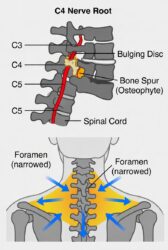
Your cervical spine (neck) consists of seven vertebrae labeled C1 through C7. Nerve roots exit the spinal cord at each level and branch out to supply sensation and muscle control to different parts of the body. The C4 nerve root exits between the C3 and C4 vertebrae. When this nerve becomes compressed or irritated a condition called impingement or radiculopathy — it disrupts normal nerve signaling. This leads to pain, numbness, tingling, or weakness in the areas the nerve supplies.

Unlike lower cervical nerves (like C6 or C7) that send symptoms down the arm and into the fingers, C4 impingement typically produces symptoms higher up — in the neck, upper shoulders, and trapezius region. This “cape-like” distribution across the shoulders is a classic sign.

Common Causes of C4 Nerve Root ImpingementSeveral factors can lead to compression of the C4 nerve root:

  • Herniated or bulging discs — The soft inner material of a disc pushes out and presses on the nerve.
  • Degenerative changes Bone spurs (osteophytes), arthritis, or facet joint hypertrophy narrow the space where the nerve exits (foramen).
  • Poor posture Forward head posture from prolonged phone or computer use is extremely common in the Bay Area.
  • Trauma or injury Whiplash from car accidents, sports injuries, or falls.
  • Spinal stenosis Narrowing of the spinal canal or foramina due to age-related changes.
  • Muscle tension Tight scalene or trapezius muscles can contribute to irritation.

In younger patients, disc herniations are more common. In older adults, degenerative changes and bone spurs tend to be the primary culprits.

Symptoms of C4 Nerve Root ImpingementC4 radiculopathy has a distinctive symptom pattern. Patients often report:

  • Deep, aching pain in the lower neck and upper shoulder girdle.
  • Sharp or burning pain that may feel like it’s spreading across the shoulders in a “cape” distribution.
  • Pain that worsens with neck extension, rotation, or looking upward.

Sensory Changes

  • Numbness or tingling in the upper shoulders and trapezius area.
  • A pins-and-needles sensation that doesn’t always travel far down the arm.

Muscle Weakness

  • Difficulty with shoulder elevation or shrugging (involving the trapezius and levator scapulae muscles).
  • Fatigue or heaviness in the shoulders and upper back.
  • In more severe cases, subtle weakness in neck stabilization.

Other Associated Symptoms

  • Headaches, especially at the base of the skull.
  • Muscle spasms in the neck and upper back.
  • Reduced range of motion in the neck.
  • Sleep disturbance due to discomfort when changing positions. aafp.org

Many patients describe the pain as constant but fluctuating in intensity. Activities like driving, carrying bags on the shoulder, or even deep breathing can aggravate symptoms. Why Accurate Diagnosis MattersC4 symptoms can overlap with other conditions such as shoulder impingement, rotator cuff problems, or even thoracic outlet syndrome. A thorough examination by an experienced San Leandro chiropractor includes:

  • Orthopedic and neurological testing.
  • Range of motion assessment.
  • Palpation of the cervical spine.
  • Review of posture and daily habits.
  • Referral for imaging (X-ray, MRI) when necessary.

How Chiropractic Care Helps C4 Nerve Root Impingement

Chiropractic treatment focuses on addressing the root cause restoring proper alignment, reducing nerve compression, and improving function rather than just masking symptoms.

Common Techniques Used:

  1. Gentle Cervical Adjustments — Specific, low-force manipulations help restore normal joint motion and take pressure off the C4 nerve root.
  2. Spinal Decompression Therapy — A gentle traction technique that creates more space in the cervical foramina, allowing the nerve to breathe.
  3. Soft Tissue Therapy — Trigger point release, myofascial release, and massage to relax tight muscles that may be contributing to compression.
  4. Corrective Exercises — Strengthening deep neck flexors and scapular stabilizers while improving posture.
  5. Postural Correction & Ergonomic Advice — Practical tips for your workstation, phone use, and sleeping position.

Studies and clinical experience show that many patients with cervical radiculopathy experience significant improvement with conservative care, including chiropractic adjustments, often within weeks.

What to Expect During Treatment

Most patients begin noticing relief within the first few visits, with progressive improvement over 4–8 weeks. Treatment plans are customized based on severity, duration of symptoms, and individual goals. At Burt Chiropractic in San Leandro, we combine hands on care with home exercises and lifestyle modifications. Our goal is not only to reduce your current pain but also to prevent recurrence.

Prevention Tips for San Leandro Residents

  • Maintain good posture while commuting on BART or driving.
  • Take regular breaks from desk work (follow the 20-20-20 rule).
  • Strengthen your neck and upper back with simple daily exercises.
  • Use a supportive pillow that maintains neutral neck alignment.
  • Stay active with low-impact activities like walking or swimming.

When to Seek Help

Don’t wait until symptoms become severe. See a chiropractor promptly if you experience:

  • Persistent neck and shoulder pain lasting more than a few days.
  • Numbness, tingling, or weakness in the shoulders/arms.
  • Pain that interferes with sleep or daily activities.
  • Symptoms following a car accident or injury.

Early intervention often leads to faster, more complete recovery and helps avoid chronic issues. Find Relief with a Local San Leandro Chiropractor. Living with C4 nerve root impingement is unnecessary when effective, natural solutions are available right here in San Leandro. Chiropractic care offers a safe, non-invasive path to recovery by addressing the underlying mechanical problems in your neck. If you’re tired of dealing with neck and shoulder pain, we invite you to schedule a consultation at Burt Chiropractic Rehabilitation Center. Dr. Eduard Burt and our team have helped hundreds of East Bay residents overcome similar conditions and return to the active lifestyles they love. Call (510) 481-2225 today or visit burtchiropractic.com to book your appointment.

Filed Under: Chiropractic, Headache, Insomnia, Neck Pain Tagged With: pain, pain management, san leandro chiropractor, spine

Hippocrates, spine and his opinion about chiropractors if he would be alive

May 18, 2026 by drburt

Hippocrates (c. 460–370 BCE), the “Father of Medicine,” placed great importance on the spine. He would likely view modern chiropractors positively (or at least see strong alignment with his own ideas), as he advocated spinal knowledge and manual manipulation techniques that resemble early forms of spinal care.

Key Hippocratic Views on the Spine

Hippocrates stressed the spine’s central role in health. Famous (and widely cited) quotes attributed to him include:

  • “Get knowledge of the spine, for this is the requisite for many diseases.”
  • “Look well to the spine for the cause of disease.”

He saw spinal issues as linked to many health problems and believed physicians needed deep understanding of spinal structure and function.

In works like On Articulations and On the Nature of Bones, he described spinal anatomy, deformities (e.g., kyphosis, scoliosis), dislocations, and treatments. He used manual techniques, traction devices (like the Hippocratic ladder, board, and bench), leverage, and hands-on methods to address “prominent vertebrae” and joint issues. He often combined manipulation with exercises afterward.

These practices were not exactly modern chiropractic (which emerged in the late 19th century with D.D. Palmer), but they involved spinal manipulation for both musculoskeletal problems and broader health benefits—very much in the spirit of what chiropractors do.

Hypothetical Opinion on Chiropractors If Alive Today If Hippocrates were alive now, he would probably:

  • Approve of the focus on the spine as a key to overall health, aligning with his holistic, “find and remove the cause” philosophy (vis medicatrix naturae — the body’s natural healing power).
  • Support evidence-based spinal manipulation for back pain, joint issues, and mobility, as he practiced and documented similar methods.
  • Appreciate the emphasis on non-drug, natural approaches, consistent with his rejection of superstition in favor of observation and reason.
  • Be cautious or critical of overclaims (e.g., curing all diseases solely via adjustments), given his scientific mindset. He would demand careful diagnosis, observation, and integration with other medical knowledge.
  • Value the hands-on, patient-centered approach, though he might suggest combining it with modern diagnostics, imaging, and his own traction/exercise methods.

Chiropractic often cites him as a foundational influence, and historical accounts of manipulative therapy trace back to him.

In short, Hippocrates was a strong early proponent of spinal care through manipulation and knowledge. Modern chiropractors carry forward aspects of that tradition, which he would likely respect as a continuation of seeking natural causes and remedies. His core message remains relevant: the spine is crucial to health.

Filed Under: Chiropractic, Spine Tagged With: chiropractic, chiropractor, health, spine

Chiropractic Care, Golf and Back Injury

January 21, 2011 by drburt

GOLF AND BACK PAINMost everyone who plays golf has a greater chance of low back injury. Recent study shows that about 35% of amateur and 22-24% of professional golfers susceptible to lumbar spine injuries. Collectively, the incidence of lower back pain in the male golfer is 25% to 36% and 22% to 27% in the female golfer. Many just want to learn how to hit the ball as far as possible and forgetting the basics of soft tissue trauma prevention. Below is the list of the risk factors that could cause lower back pain:

  • Arthritis, disc injuries or stress fractures
  • Weak abdominal musculature
  • Poor muscle trunk stabilization and strength
  • Poor warm up and flexibility
  • Overuse or repetitive stress from technique
  • Improper swing or technique
  • Poor posture or scoliosis
  • Age
  • Overweight and general poor health
  • Previous history of back pain or injury

What Is the Mechanism Injury of Lower Back While Playing Golf

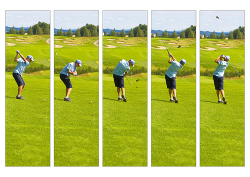
Lumbar Spine consists of the following structures: vertebral bodies, IVD – Inter Vertebral Disc, Ligaments, Muscles and Tendons. Lower back injuries are the most common golf related injuries followed by, elbow, wrist and shoulder injuries.  Occasionally golfers suffer from hip and knee pain as well. The most common mechanism of injury is the twisting and pulling that takes place during the golf swing against a spine that is not moving through its full range of motion. During golf swing the spine is exposed to extra load and tensile movement. It is estimated that during the swing phase the soft tissue of the lumbar spine is exposed to a force eight times of the body weight. Prolonger standing, twisting, and bending are the contributing factors for stress accumulation on the supporting structures of the lumbar spine. When the force dissipates through the vertebral body, muscles, discs and ligaments can be damaged and be the cause of low back injury.

Preventing Low Back Injuries from Golfing

  • Less than 5% of amateur golfers fail to adequately stretch or warm up before the game. A proper warm up will provide the following benefits to the spine:
  • Increasing circulation
  • Increasing the range of motion
  • Preparing for increased loading and stress
  • Below is an example of good warm up activities:
  • light jog or brisk walk, stretching the larger muscles or major muscle groups, swinging a club in both directions to mobilize the trunk muscles and increase circulation, Fluid, gentle practice swings preparing the relevant structures of the spine and muscles groups for the activity.

Improve Muscle Strength and Tone and Flexibility

Strengthening the abdominal and lower back muscles will help to stabilize the spine during the swing phase and in turn produce more powerful, longer shots. Strong quadriceps, buttock and hamstring muscles are another important key factor that should not be neglected. Here is link to a “Two Stretching Exercises for Golf Back Pain.”  Pilates for Golfers (affiliate link) has been a very popular technique in preventing back injuries and elbow injuries while golfing. Pilates for Golfers is a step-by-step guide to identify and correct golf swing faults using the Pilates Method.

Consult Your Personal Chiropractor or Medical Professional

If you injured yourself while golfing, you must do the following in order to prevent farther injury:

  1. Discontinue any activities that aggravates the pain
  2. Apply ice to injured area ASAP – 15 minutes on and 45 minutes off
  3. After 72 hours you can switch to heating moist pads for increased blood flow
  4. Do not lye in bed for a prolonged period of time
  5. Force yourself for light activity
  6. Avoid Heavy Lifting
  7. Avoid Prolonged Sitting
  8. Avoid Prolonged Bending
  9. Suspend Golfing Activities

A visit to your local chiropractor would be a great benefit to your lower back pain. Make sure that your local chiropractor has physical therapy modalities such as, electric stimulation, moist heat, ultrasound, cold laser and certified massage therapist as a staff member. Spinal Chiropractic Adjustment can do wonders to your spine and overall well being.

Filed Under: Chiropractic, Sports Tagged With: back injury, chiropractic, Chiropractic Care, disc injuries, Golf, golf injuries, golf injury, golf swings, injuries, lumbar spine, lumbar spine injuries, play golf, professional golfers, shoulder injuries, spine

The First Scoliosis Coil in the Country – East Bay Upright MRI

November 8, 2010 by drburt

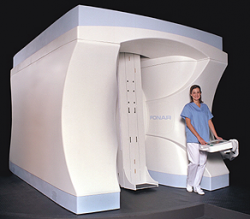
The First Scolisos Coil  - East Bay MRI
East Bay MRI - Hayward, CA

East Bay Upright MRI has acquired a coil that take a full image of the entire upright spine – it takes only eight minutes to complete this process. This radiation free evaluation can also monitor the success of treatment provided by a Doctor. The only way that evaluation of scoliosis can be accurate is when the patient is in upright position. Conventional, recumbent MRI machines can not deliver necessary results. This radiation-free application can be performed in the same amount of time and at the same cost as diagnosis and monitoring by X-RAY. Coil MRI sees curvature of  the vertebrae and the soft tissue as well. There are sagital and axial views of the entire spine – with no radiation exposure whatsoever. The 3 plane visualizations are achieved by 3D acquisition with curved multi planar reconstruction. Both Cobb angles and angular rotation of the vertebrae are measured, including the spinal cord, intervertebral discs, nerve roots and spinal ligaments. The National Cancer Institute reported a study in 2000 of 5466 women that demonstrated with scoliosis experienced a 70% greater risk of developing breast cancer that resulted from their protracted exposure to diagnostic X-RAY.

This is what a practicing neurosurgeon, Dr. Joseph Afertzon, M.D. has to say about this technology: “This technology offers unique advantages in scoliosis imaging. It can show dynamic properties of the scoliotic curve in lateral bending. It is also becoming a unique tool in screening and following pediatric patients with scoliosis. It offers precise three dimensional data preferable to regular x-ray and saves our young patients from significant radiation exposure caused by numerous follow-up X-RAYS.”

Multi positional Technology MRI benefits

  1. Patients are scanned upright in weight-bearing positions, in positions of pain or other symptom, and positions of flexion, extension, lateral bending and rotation. This is made possible by the upright MRU’s unique configuration that includes a spacious vertical gap.
  2. A seat can be attached to the bed so patients can be scanned in an upright seated position.
  3. The bed rotates from upright to horizontal so patients can also be scanned recumbent.
  4. Recumbent-only MRI can underestimate the maximum degree of the pathology and miss its dynamics nature
  5. Large patients can be scanned. The is rated for up to 500 pounds
  6. Patients that can not lie down can be scanned, such a patient wit severe kyphosis.
  7. There is unparallel patient comfort because there is nothing in front of the patient’s face except for a 42-inch flat-screen television

Question: What is your opinion about Upright MRI? Please leave your feedback in a comment section.

Filed Under: Posture, Spine Tagged With: bay, coil, coils, east bay, east bay upright mri, kyphosis, magnetic resonance imaging, medical imaging, medicine, mri, mri machine, radiology, scoliosis, spine, the first, the usa, upright, upright mri, usa east, vertebra, vertebral column

  • 1
  • 2
  • Next Page »

PLEASE FOLLOW & LIKE B.C.

RSS
Follow by Email
Facebook
Facebook
fb-share-icon
Twitter
Visit Us
Follow Me
Post on X
YouTube
YouTube
LinkedIn
LinkedIn
Share

15200 Hesperian Blvd #104

San Leandro, CA. 94578

(510) 481-2225

drburt@burtchiropractic.com


SEARCH

Categories

Recent Posts

  • Loss of Cervical Lordosis: How a Straight Neck and Pain Impact Your Health—and How a San Leandro Chiropractor Can Help Restore It
  • Hidden Injuries from Car Accidents That a San Leandro Chiropractor Can Help You Detect
  • Best San Leandro Chiropractor for Sciatica Pain Relief: Natural, Drug-Free Solutions That Work