Top Chiropractor in San Leandro, CA

San Leandro Chiropractor

  • blog
  • About Our Practice
  • What is Chiropractic?
  • SERVICES
    • Personal Injury
    • Cold Laser Therapy
    • Massage
    • Ultrasound
    • Electric Stimulation
    • Sports Injury
    • Workers Compensation
  • FAQs
  • Locations
  • CONTACT US
  • New Patient Forms
  • Nutrition Store
  • Home

Powered by Genesis

Backpacks, Children, Nook, Kindle and Bad Posture

March 30, 2011 by drburt

BACKPACKI wrote a post in September of 2010 – “Backpack Safety – Back To School and 14 Helpful Tips.” Millions of kids wear heavy backpacks that affect their posture, which results in interfering with a proper functioning of nervous system and thus leads to sick days and unnecessary pain. A post about “Relationship of Nervous System and Spine to Organs”, will provide you a better understanding of what I am talking about. A developing young organism must be free of any obstacles for proper development. It is even more true for young girls. These individuals are the future of this society. With advancing technology our future generation can save their posture by carrying all of their heavy load of books on an electronic book reader. I am talking about iPad, Kindle, Nook and probably some other electronic gadgets that are available on the market today.

These devices are not as expensive as they used to be. It is a very minor investment in the future of your kids. My boy is turning four next month and pretty soon he is going to go to school. Currently he is practicing on my iPhone to play with different apps.  Some of my patients are principles at schools and I have talked to them  about this issue. With budget cuts in every State in the United States and over 26 billion dollars deficit for 2011 in a State of California alone it is not an easy task to accomplish. Education budget cuts are growing every year and with bureaucratic system that the State make the transfer to electronic book reader is a distant possibility.

What is the solution to this problem? I think parents must take action in their own hands and provide their kids with these light readers that weight less than a pound versus full back pack of books which can weight up to 15 pounds and sometimes even more. The solution is easy the implementation is not. Below are comparison videos of the Nook from Barnes & Nobles and Kindle from Amazon that your child can use in school.

Getting the books you buy onto as many readers as possible is a matter of great interest to educators. Right now, there are basically three ways to leverage e-books to increase distribution of titles in schools.

When Amazon came out with the Kindle, the company realized that book-buyers would want to be able to load their purchases onto more than one reading device. So the company made it possible for customers to load their purchases onto as many as six devices, in most case, if the devices were registered to the same account. As schools began to implement ereader programs, educators saw the benefit of this policy: if a school purchases six or more Kindle, every book they buy can be distributed to six devices, effectively cutting the cost of an already lower-priced e-book by a factor of six. It is like buying six copies for the price of one. And with a little extra management, this “sharing” of books among devices registered to the same account has worked well. Here is how it works for two major booksellers:

Amazon Kindle: You can download up to six copies of each book to different platforms.

Nook/Nook Color: You can download each book within devices on an account, limit six.

I think parents should take advantage of this program and send their kids to school with Kindle or Nook, pen and notepad. Make a change now before it is too late. Currently there several models available on the market: Kindle 3, Kindle DX,  Nook Black & White, and Nook Color.

Filed Under: Advice, Children, Posture Tagged With: amazon kindle, amazon.com, backpack safety, backpacks, bad posture, children, e book, electronic publishing, heavy backpack, kindle, kindles, low back pain, mass media, media technology, nervous system, nooks, posture, printing, ur

96 Tips For a Perfect Posture

August 5, 2010 by drburt

The spine, same as our feet, gets the hardest job in our body as it is used in practically every movement we make and it takes pressure from other body parts such as from the neck, shoulders, head and our arms. As we walk, stand, sit, carry a heavy object or dance, our spine takes the pressure to keep our body erect but at the same time it also has to have the flexibility to make other kinds of movements while keeping our balance.

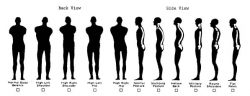
One of the following can be noticed when one has a bad posture: high shoulder, a forward stooping head, a rotated trunk (torso), a hunch back, a high hip, and a side-bent neck and one of the feet will be externally or internally rotated.  Abnormal  posture can result from trauma (like a car accident or fall), repetitive movements (turning your neck towards the monitor), and certain bad postural habits  (sleeping on your stomach).

The human body is often in a state of strain which causes a loss of proper balance between parts of the body and gravity. Such imbalance of posture distortion usually indicates internal body changes before  any  body functions appear disturbed.

All parts of the body are situated so this so this that they can interact efficiently with one another as well as with gravity. The body is able to repair itself and adjust to the many forces to which it is subjected, both internally and externally. This relationship produces a feeling of youth, energy and vitality.

By having correct posture, we are keeping our spinal vertebrae from being misaligned or subluxated.  Our spine is not only reliant on the strength of our back muscles but it also relies on its two arches (lumbar and cervical lordosis) which is why correct posture is vital. If we have poor posture, these natural arches would disappear and there’s going to be nothing left  that can absorb shock in our back. Once this happens, a person will experience pain in the neck and lower back. This paves the way for vertebral osteoarthritis, herniated disc and excessive pressure on the peripheral nerve. Osteoarthritis and herniated disc caused by uneven weight distribution on the vertebral bodies of the spine. Poor posture can lead to difficulty breathing by interfering with proper ribcage expansion, muscle soreness along the back of your neck, shoulders and upper back, as well as lower back pain.

When you already have poor posture, you can start practicing the correct posture by keeping yourself aware of the correct positions to maintain a good posture. There is a correct sitting position where you sit while keeping your back straight and your buttocks should be touching the back of the chair. When you want to lift a heavy object, you have to maintain your back straight and bend your knees & hips to lift the object up. You can start doing your research as to the correct positions to maintain a healthy spine. Also, muscle strengthening exercise is a must for a spine, for a better support of the spine.  Improper posture weakens muscles of the spine because they are not being used. By providing musculature the strength it needs, one can achieve a better maintenance of a good posture.

Also remember that this is not going to be a quick solution as it will take time especially with muscle strengthening. You may want to correct your posture now but won’t take it to heart and practice it daily then you won’t see real results. There should be a lifestyle change so that your body will get used to the correct posture that eventually you don’t even have to think about it.

You are probably wondering by now where  is the part about 96 tips for a perfect Posture. Below are the 5 links that  brings up total to 96 tips. Without further ado:

  1. 10 Tips for improving Posture and Ergonomics, by Dr. Kelly Andrews, D.C.
  2. 13 Tips on Getting a Good Posture, by  Celestine Chua
  3. 20 Tips from Yoga to Go, by Nancy Wile, Ed. D
  4. 32 Tips on how to Improve your Posture, by Savialeigh, Ben Rubenstein, Krystle C and many others
  5. 21 Tips on How to Maintain Good Posture, by ACA

To help you out, try finding ways to get yourself reminded of keeping a good posture. Perhaps you can put post-it notes on places that you would see on a regular basis. Like on your computer, put a small post-it note that says “stop slouching” or other reminders. You can also use an alarm that is set every 30 minutes or so to keep yourself aware and maintain a good posture.  I phone or any other smart phone has a build in calendar that can be set up as whatever time frequency you desire. I think it is one of the best ways to remind yourself about good posture habits. No one ever leaves a house without a cell phone in our days. These are simple solutions that really work as you exert an effort to inculcate the correct posture into your lifestyle.

Question: Have You Checked Your Posture Lately?  Do You Have Any Tips on How to Keep a Good Posture?

Filed Under: Posture, Spine Tagged With: anatomy, back posture, bad posture, body, correct posture, exercise, for a, health, human behavior, human body, improve posture, neck pain, necked, neutral spine, pain, perfect posture, poor posture, posture, posture and occupational health, posture brace, prevention, shoulder, sitting, spinal cord, spine, tips

11 Symptoms as a Sign of Warning That Your Spine is in Trouble

August 3, 2010 by drburt

spine
Three-Way Piece Vertebrae

Spine and 11 Symptoms as a Sign of Warning That it is in Trouble

There’s no other health care profession other than Chiropractic that can detect as well as treat the condition that is called as the Vertebral Subluxation Complex (VSC). In chiropractic, this is what is found to be the contributor for the spinal and other spine-related disorders.

In order to understand the VSC, it’s best to know what vertebral subluxation means. When a vertebra is not in its normal position compared to the vertebrae above or below, it is called a subluxated  vertebrae (misaligned vertebrae). When a vertebrae is misaligned, it produces a mechanical stress to the  surrounding soft tissues: discs, muscles, joints, ligaments and tendons through regular wear and tear. In effect, the patient would experience muscle spasms on the affected area, inflammation, tenderness, pain and even reduced mobility of the spine.  With the effects of the subluxation, nerve functions may also be impaired and once this happens, the communication between the nerves of our body’s organs is compromised and the optimal health as well as our well-being would be affected.

The Vertebral Subluxation Complex has 5 components. These components must all be eliminated in order for a complete and proper healing to take place.  The 5 components of the  VSC are:

  1. Kinesiopathology – which is the loss of the motion and positioning of the vertebra compared to the vertebrae alongside it.
  2.  Myopathology – which refers to muscle atrophy or spasm
  3.  Neuropathology – is the irritation or compression of the nerve tissue
  4.  Histopathology – is the localized inflammation or swelling.
  5. Pathophysiology – It is the pathophysiological change experienced after the first four components already took place.

During the first episode of VSC, the first 4 components take place. You can consider this as similar to having an inflamed tooth. With an inflamed tooth you would notice some swelling on the area of the jaw where the tooth is. Similar type of inflammation one will find on the area where the VSC occurs.  In order to get this treated, you should not rely on pain as an indicator. Even if there is no more pain on the affected area, this does not mean that the vertebral subluxation had already healed and normalized with or without any treatment. Pain is a poor indicator when the healing process is not completed even when the pain has already subsided. The 5th component, the pathology occurs when all the first four components had already occurred and this is the end result of vertebral subluxation complex when it remains untreated.

So, is there a way to avoid vertebral misalignment?  The VS have many causes which we are all exposed to on a daily basis. There are physical causes such as repetitive motions that are affecting our spine, an acute trauma to body, bad posture, bad habits at work where the workstation is not ergonomic.  Aside from the physical causes, there are also the chemical and emotional causes.  Chemical causes include poor diet and nutrition, intake of alcohol or use of drugs, chemicals in the water and the air we breath as well as ingestion of toxins through the foods we eat.  The emotional cause of vertebral subluxation is stress. Emotional stress has an impact on our physical body and health. With emotional stress, we become more prone to diseases and even injury. Sadly, we cannot really prevent vertebral subluxation and the vertebral subluxation complex that goes with it as we are all exposed to its cause every day. If you want to find out which vertebral level is subluxated, an appointment with your local  Doctor of Chiropractic would be a good start. Some of the offices offer FREE consultation and orthopedic and neurological  examination.

One might experience the following symptoms that would confirm you have a vertebral subluxation.

1. posture  imbalance

2. neck pain: sore, stiff or tender

3. back pain: sore, stiff, or tender

4. muscle spasm on the spine- tight or weak spasms

5. headaches

6. hypomobility

7. joint pain

8. stiffness

9. dizziness

10. low energy

11. poor state of health

Often times a person might not have any symptoms at all, however, it doesn’t mean one is free from a vertebral subluxation.  Again, as an example, the tooth with cavities won’t hurt unless the cavities reach the sensitive dentin layer. So it doesn’t mean that if you don’t feel any pain or numbness, you don’t have cavities. Regular evaluation of the spine is recommended to check if subluxation is present on the vertebrae.

Your local Doctor of Chiropractic knows how to correct vertebral subluxations through different techniques and procedures. Spinal adjustments are involved to correct the spinal vertebrae that suffer from subluxation. By this adjustment, the subluxated vertebra will eventually reach normal biomechanics on the vertebrae above and below and will help to restore the function of the joint. Corrected joint will maintain a proper posture of your spine.

Question: Have you ever experienced any of the 11 symptoms? What was your course of action in order to stop these symptoms?

Filed Under: Spine Tagged With: affect, alternative medicine, back, bad habits, bad posture, causes, chiropractic, fringe science, manipulative therapy, medicine, muscle spasms, pain, repetitive motion, spinal adjustment, spine, subluxation, symptoms, trouble, vertebrae, vertebral, vertebral column, vertebral subluxation, vitalism

PLEASE FOLLOW & LIKE B.C.

RSS
Follow by Email
Facebook
Facebook
fb-share-icon
Twitter
Visit Us
Follow Me
Post on X
YouTube
YouTube
LinkedIn
LinkedIn
Share

15200 Hesperian Blvd #104

San Leandro, CA. 94578

(510) 481-2225

drburt@burtchiropractic.com


SEARCH

Categories

Recent Posts

  • Loss of Cervical Lordosis: How a Straight Neck and Pain Impact Your Health—and How a San Leandro Chiropractor Can Help Restore It
  • Hidden Injuries from Car Accidents That a San Leandro Chiropractor Can Help You Detect
  • Best San Leandro Chiropractor for Sciatica Pain Relief: Natural, Drug-Free Solutions That Work