Top Chiropractor in San Leandro, CA

San Leandro Chiropractor

  • blog
  • About Our Practice
  • What is Chiropractic?
  • SERVICES
    • Personal Injury
    • Cold Laser Therapy
    • Massage
    • Ultrasound
    • Electric Stimulation
    • Sports Injury
    • Workers Compensation
  • FAQs
  • Locations
  • CONTACT US
  • New Patient Forms
  • Nutrition Store
  • Home

Powered by Genesis

Electric Stimulation and Chiropractic Rehabilitation

September 15, 2010 by drburt

Electric stimulation rehabilitation or electrotherapy had been discovered way back in 400 BC with the help of a torpedo fish that produces an electric shock reaching up to 150 volts. People used to take these fish from streams and they place them on the body’s painful area and the electricity produced from the fish controlled the pain.

It was when the gate control theory of pain in 1965 that reintroduced electric stimulation rehabilitation after it had lost the interest of many skeptics in the nineteenth century. The theory suggests that when the large nerve fibers activity increases, it tends to close the gate blocking information or signals of pain to the brain.

Electric stimulation rehabilitation is a form of therapy that introduces electricity to stimulate the muscles and treat the pain & spasms. This type of therapy can be administered to the patient by a professional or you can purchase a home kit and use it at home.

There are three types of the electrical stimulation rehabilitation and they are the general electric therapy, muscular electric therapy and the transcutanous electrical nerve stimulation otherwise known as TENS. The general electric therapy relieves the pain and also heals wounds while the muscular electrical therapy helps in strengthening the muscles by reducing the spasms, while the TENS is used for treating chronic types of pain.

Electric stimulation rehabilitation has several applications. It is used to manage pain either acute or chronic. TENS is most successful in the control of the postoperative incision pain especially if it’s on a small area and self limiting with regards to time, severity and course.

IFC or interference current is another form of the electric stimulation rehabilitation treatment used for pain control. Some clinicians believe that this is more effective in treating muscle pain compared to TENS.

Electrotherapy is also applied to reduce edema of various types. Edema can be a result of trauma that disrupts the blood vessels and the electrical stimulation with voluntary muscle pump activity is effective. Other than this approach, sensory level stimulation is also used but this does not contract the muscles.

Electric stimulation also improves circulation through the neuromuscular electrical stimulation or NMES. It is most effective at a frequency of just 20 to 30 pps with a 10 to 30% contraction at a maximum of 30 minutes of treatment at a time.

Electric stimulation is also applied for a speedier wound healing.

This type of treatment has contraindications. It should not be placed peripherally to the heart or when the patient has a pacemaker. It shouldn’t be placed near the phrenic nerve and must not be used in the presence of malignancy.

If a recently sutured tendon or nerve is present, a superficial metallic implant, pregnancy during the first trimester and active bleeding are experienced by the patient then this type of treatment must also be avoided.

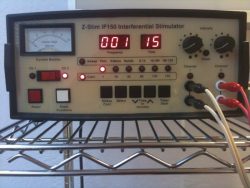
There are several electric stimulators available such as the Z-Stim IF 150 and the H-Wave electric stimulator. The Z-Stim IF 150 produces TRUE interferential therapy by its two channels with 4 pad output. It is used to stimulate the nerves and muscles for edema, acute pain and for rehabilitation of muscles. The H-Wave is an ultra low frequency electric stimulator that helps in pain control and functional restoration. It has a 3-channel and 2-channel models. The 3-channel model is used in clinics while the 2-channel is a home therapy model. Both of these models are available for rehabilitation of our patients.

Question: Have you ever experienced electrical stimulation therapy while rehabilitating your injury?

Filed Under: Ankle, Modalities Tagged With: bc, electric shock, electric stimulation, electric therapy, electrical muscle stimulation, electrical stimulation, electroanalgesia, electrotherapy, fishing, functional electrical stimulation, medicine, neuroprosthetics, neurotechnology, nociception, pain, produce, rehabilitation, sacral nerve stimulation, torpedo fish, transcutaneous electrical nerve stimulation

Isometric Neck Exercises

August 26, 2010 by drburt

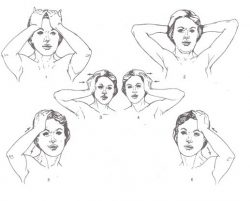
It is best if you do these exercise 2-3 times a day at a different time. Breath air out with a “haaaaa” sound  as you strain during exercises. Hold each contraction for a count of 5.

  1. Place both hands against your forehead.  Push your head forward against the heels of your palms without moving your head. Hold.
  2. Place both hands behind your head.  Pull your head back against your hands while pulling forward with your hands so your head doesn’t move.  Hold
  3. Place your right hand against the right side of your head.  Push your head hard against the heel of your palm without allowing it to move.  Hold.
  4. Place your left hand against the left side of your head.  Push your head against the heel of your palm without allowing it to move.  Hold.
  5. Place your right hand against your right temple.  Try to bring your chin down to your right shoulder without allowing your head to move.  Hold.
  6. Place your left hand against your left temple.  Try to bring your chin down to your left shoulder without allowing your head to move.  Hold.

Question: Did you try these exercises? Were these exercises helpful?

Filed Under: Exercises, Neck Pain Tagged With: cervical spine, exercises, isometric neck exercises, muscle strengthening, neck, rehabilitation

Chiropractic Rehabilitation and 4 Stages of Soft Tissue Healing

August 20, 2010 by drburt

The healing process is divided into four broad stages which are not mutually exclusive and overlap considerably.

1. Initial vascular reaction – Active Swelling

2. Inflammatory response – Passive Congestion

3. Proliferative phase – Repair

4. Remodeling 

Wound healing refers to the body’s replacement of destroyed tissue by living tissue (Walter & Israel 1987). It comprises of two essential components whose differentiation is based on resultant tissue: Regeneration and Repair.

TISSUE INJURY CAUSES RESTRICTION OF MOTION DUE TO:

  1. Inflammation & Swelling
  2. Pain
  3. Muscle Spasm 

THE MAJOR GOALS OF CHIROPRACTIC CARE:

  1. Relieve Pain
  2. Promote Full Healing
  3. Restore & Maintain Full Function
  4. Reduce the Likelihood of Re-Injury
  5. Prevent Accelerated Degeneration 

Chiropractic Care Should Continue Throughout the Repair Stage. It Take Longer For Tissues to Heal & Normal Function to be Restored Than it Takes for Pain Relief. Pain Relief is not the Only Goal.  Chiropractic Helps:

  1. Restore Normal Motion, Function & Biomechanics
  2. Improve Alignment of New Connective Tissue
  3. Prevent Shortening of Scar Tissue & Chronic Stiffness
  4. Restore & Maintain Flexibility of Ligaments & Muscles
  5.  Restore Normal Muscle Tone
  6. Promote Quicker, More Effective Healing
  7. Restore & Maintain Normal Sensation
  8. Reduce the Risk of Re-Injury and Degeneration 

STAGES OF SOFT TISSUE HEALING


STAGE I: ACTIVE SWELLING

  1. Swelling Occurs for 12 to 72 hours
  2. Motion is lost and pain increases 

Goals of Care: Minimize pain and swelling

Care:

  1. Rest & Support of Injured Area
  2. Ice to Block Swelling, Pain, and Spasm 

STAGE II: PASSIVE CONGESTION   

Fluid trapped in tissues restricts motion, causes pain, & delays healing. Begins by second to fourth day

Goals of Care for Passive Congestion:

  1. Remove fluid
  2. Pain Relief
  3. Begin to restore range of motion 

Care:

  1. Chiropractic Adjustments Help
  • restore motion
  • block pain
  • restore normal sensation
  • relax tight muscles
  • remove swelling
  • accelerate healing
  1. Heat and Cold to Remove Fluid
  2. Controlled Motion Exercises
  3. Physical Therapy helps in Some Cases
  4. Acupuncture Can Help With Pain Control 

STAGE III: REPAIR

Beginning 5 days after injury, scar tissue is made for up to 6 weeks. 

Lack of motion causes excess scar tissue in dense patterns disrupting normal function causing:

  1. Excess Scarring
  2. Chronic Stiffness
  3. Limited Range of Motion
  4. Poor Biomechanics
  5. Chronic Pain
  6. Weak Muscles & Ligaments
  7. Loss of Normal Sensation
  8. Poor Nutrition
  9. Increased risk of Re-Injury
  10. Accelerated Degeneration 

If Motion is Restored & Maintained, Tissues Heal in a Much More Functional Way.

Coals of Repair Stage:

  1. Restore Normal Range of Motion
  2. Restore Sensation
  3. Promote Full Healing
  4. Relieve Pain 

STAGE IV: REMODELING 

Connective tissue remodels for better strength & flexibility. This often takes 3 to 14 week but may take up to 1 year with severe injury. 

Chiropractic Helps Achieve these Goals:

  1. Improve & Maintain Motion & Flexibility
  2. Restore & Maintain Function
  3. Reduce Chronic Pain
  4. Reduce Risk of Re-Injury & Degeneration

This Post was based on Dr. Malik Slosberg’s Research.

Filed Under: Auto Accidents, Carpal Tunnel Syndrome - CTS, Chiropractic, Low Back Pain, Neck Pain, Personal Injury, Shoulder, Soft Tissue Injury, Spine Tagged With: alternative medicine, biology, chiropractic, Chiropractic Care, chiropractic rehabilitation, connective tissue, healing, manipulative therapy, medicine, pain, pain relief, physiology, rehabilitation, relieve pain, scar tissue, soft tissue, spinal adjustment, stages, stages of soft tissue healing, tissues, traumatology, wound healing

What is Whiplash?

July 31, 2010 by drburt

Personal injury is a term often used to describe an injury most commonly caused by a car accident. It may also include other types of injury such as a slip or fall. Whiplash is most commonly associated with rear-end car collisions in which the heads of those in the front car are suddenly snapped back and forth by the impact. It is more accurately called cervical acceleration/deceleration (CAD) trauma or syndrome, which describes the rapid movements that can injure the vertebrae of the neck and the muscles and ligaments that support them.

whiplash2

Who suffers from whiplash?

Anyone can be subjected to whiplash, even in a low-force car crash at speeds as low as 5mph. But injuries associated with whiplash can also result from other mishaps in which the head is pushed or jerked beyond its normal range of motion. Whiplash most commonly causes serious and lingering neck pain, but there may also be back pain, headaches and dizziness. As much as bruising of the brain can sometimes occur in auto accidents. Severe cases of whiplash, may include symptoms such as blurred vision, ringing in the ears, nausea and numbness.
[Read more…]

Filed Under: Auto Accidents, Personal Injury Tagged With: accidents, alternative medicine, car collision, cars accident, cars crash, chiropractic, commonly, injuries, manipulative therapy, medicine, neck, neck pain, pain, personal injury, rehabilitation, san leandro chiropractor, spinal adjustment, symptoms, whiplash, whiplash injury

  • 1
  • 2
  • Next Page »

PLEASE FOLLOW & LIKE B.C.

RSS
Follow by Email
Facebook
Facebook
fb-share-icon
Twitter
Visit Us
Follow Me
Post on X
YouTube
YouTube
LinkedIn
LinkedIn
Share

15200 Hesperian Blvd #104

San Leandro, CA. 94578

(510) 481-2225

drburt@burtchiropractic.com


SEARCH

Categories

Recent Posts

  • Loss of Cervical Lordosis: How a Straight Neck and Pain Impact Your Health—and How a San Leandro Chiropractor Can Help Restore It
  • Hidden Injuries from Car Accidents That a San Leandro Chiropractor Can Help You Detect
  • Best San Leandro Chiropractor for Sciatica Pain Relief: Natural, Drug-Free Solutions That Work