Top Chiropractor in San Leandro, CA

San Leandro Chiropractor

  • blog
  • About Our Practice
    • YELP REVIEWS
  • What is Chiropractic?
  • SERVICES
    • Personal Injury
    • Cold Laser Therapy
    • Massage
    • Ultrasound
    • Electric Stimulation
    • Sports Injury
    • Workers Compensation
    • HS Sports Physical Examination
  • FAQs
  • CONTACT US
  • New Patient Forms
  • Nutrition Store

Powered by Genesis

Sciatica Pain Relief and Chiropractic Treatment

November 5, 2010 by drburt

What is Sciatica?

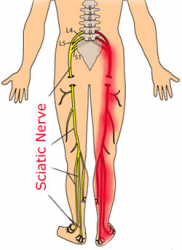
SCIATIC NERVE AND CHIROPRACTICSciatica is not a medical condition in itself but rather a symptom of other medical problems. It refers to the pain, numbness, tingling or weakness felt in the legs as an effect of compression or injury of the sciatic nerve.

The pain is usually felt in the buttocks, lower back or at various parts of the patient’s leg including the foot. The pain is usually severe combined with weakness of the muscles as well as numbness and tingling sensation. This condition is usually felt only on one side of the patient’s body.

Treatment Options

The treatment for the symptoms depends on the problems that cause the symptoms. Sciatica can be caused by spinal disc hernia, spinal stenosis, pregnancy, piriformis syndrome and many other conditions. What’s important is that the patient gets a proper diagnosis of his or her problem in order to get the right treatment.

Treatments for this condition vary from taking pain medications to surgery. Anti-inflammatory medications and paracetamol are taken to relieve the pain experienced by the patient. If this isn’t enough, narcotics can also be used especially if the pain is already severe.  Steroid injections provide short-term relief and benefits as well. Acupuncture, physical therapy, massage therapy and chiropractic care are also great treatment for sciatica. Some also benefit from yoga sessions and weight loss to reduce the pressure on the nerve roots of the spine.

Chiropractic treatment

Sciatica is treatable by chiropractic care and most of the time, it responds positively after spinal adjustments on the patient’s lower lumbar vertebrae as well as on the sacroillac joints. Some types of nerve irritation respond much faster while some takes a little while depending on the severity of the case and especially if the symptoms are already chronic.

A type of sciatica that is very difficult to deal with even for a chiropractor is when there is an actual herniation of the patient’s intervebral disc. This causes extreme pain that even taking narcotics and analgesics won’t give enough relief for the patient.

Before considering a chiropractic treatment to aid in your symptoms, you must know that most spinal adjustments done can only provide you with short-term relief to pain. It really depends on what causes the symptoms of nerve irritation and you must consult with your health professional regarding the matter. Your local chiropractor would tell you if your problem that results to sciatica symptoms can be improved through chiropractic care.

The best way to get real pain relief the pain in this condition is to relieve the sciatic nerve of the pressure. Correcting the root of the problem is the best solution in order to completely recover from the injury. If you only want pain relief then it will only be a temporary solution. Finding the real source and correcting it would get rid of the symptoms for a long time. By permanently relieving pressure off the sciatic nerve is the best solution to the problem.

Question: Have you or anyone you know experienced Sciatica?  What kind of treatment have you had?
Filed Under: Low Back Pain Tagged With: acupuncture, chiropractic, chiropractic treatment, general practice, intervertebral disc, manipulative therapy, medical conditions, medicine, neurology, orthopedic surgery, pain, pain medication, pain relief, piriformis syndrome, sciatic nerve, sciatica, sciatica pain relief, sciatica symptoms, spinal adjustment, treatment

Healthy Hints For a Healthy Back

September 1, 2010 by drburt

Standing and Walking:

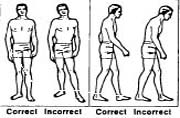
1hints1Try to toe straight ahead when walking; put most of your weight on your heels; hold your chest forward and elevate the front of the pelvis as if walking up an incline. Avoid wearing high heels. Stand as if you are trying to touch the ceiling with the top of yur head, eyes straight ahead. All the elements of good posture will flow from these simple maneuvers.

Sitting:

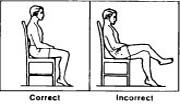
2hints2Sit on a hard-back chair with spine pushed back; try to eliminate the hollow in the lower back. If possible, elevate the knees higher than hips while in an automobile. Secretaries should adjust posture chairs accordingly. Sit all the way back in the chair with your back erect.

Lifting:

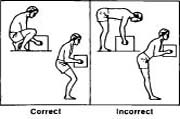
3hints1Bend your knees; squat and lift with your thigh muscles, not your back. Never bend over with your knees straight and lift with the upper torso. Move slowly and avoid sudden movements. Try to avoid lifting loads in front of you above the waste line. Avoid bending over to lift heavy objects from car trunks, as this places a strain on low back muscles

Sleeping:

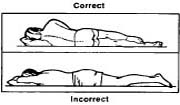
4hintsSleep on a firm mattress; a ¾ inch plywood bed board is helpful and should be used with all but a very firm orthopedic mattress. With acute back pain, sleep with a pillow or blanket rolled under the knees and a pillow under the head. Keep your knees and hips bent when sleeping on your side.

Driving:

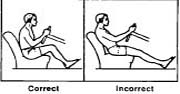
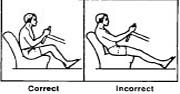
5hints3Use a firm seat with a padded plywood or special seal support. Sit close to the wheel with knees bent. On long trips, stop every one to tow hours and walk to relieve tensions and relax muscles

                                                                                                                                                                                                                                                                                                                                                                                                    Working:

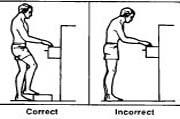
6hints1Try to avoid fatigue caused by work requiring long standing. Flex hips and knees by occasionally placing a foot on a stool or bench. Take exercises breaks from desk work by getting up, moving around and performing a few back exercises in the standing position.

Question: Did you try these exercises? Were these exercises helpful?

Filed Under: Exercises, Low Back Pain Tagged With: low back exercises, low back pain prevention, low back strengthening, low back support exercises., lumbar exercises, lumbar spine, lumbar spine strengthening, rehabilitation exercises for low back

Lower Back Exercises

August 20, 2010 by drburt

General Instructions:

Your muscles are the best back support available. Keeping a regular schedule for your exercises eliminates the necessity of  a brace or corset. Supporting para-spinal  musculature of the lumbar spine is all the support that is necessary and can be achieved by regular exercises.

Exercises:

Increase the frequency of your exercises as your pain level of discomfort level goes down. Do not continue if you your pain level has gone up or your muscles fatigued. If you have tight muscle take a hot bath or hot shower before you begin your exercises. Slight ache after exercises is a normal feeling.

Use soft cover on the floor – rug or mat. Use of a small pillow under your neck is beneficial. Do not wear shoes and use  loose clothing. Stop exercises if they cause additional pain or discomfort.

Start slowly and gradually, increase speed and repetition. Don’t overdo it. Try to perform exercises daily. The important thing is to relax. Exercise on a rug or mat. Put a pillow under your neck. Dress comfortably: no shoes or socks. Stop doing any exercises that causes pain untill you have checked with your doctor.

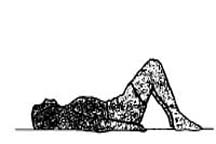
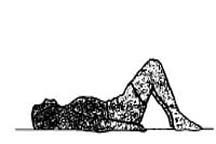
111Lie on your back with knees bent. Feet flat on the floor. Take a deep breath and relax. Press your back against the floor and tighten your stomach and seat muscles. This should cause the lower end of the pelvis to rotate forward. Hold for 5 seconds. Relax. Repeat 5-10 times

27Lie on your back with knees bent. Feet flat on the floor. Take deep breath and relax. Grasp one knee with both hands and pull it as close to your chest as possible. Return to starting position. Repeat 5-10 times for each leg, alternating legs.

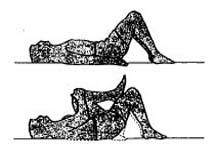
32Lie on your back with knees bent. Feel the floor. Take a deep breath and relax. Grasp both knees and pull them as close to your chest as possible. Return to starting position. Straighten legs. Return to starting position. Relax. Repeat 5-10 times.

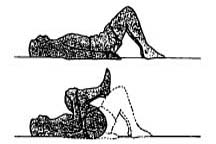
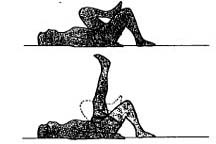
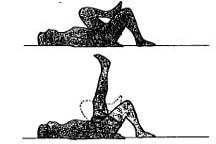
42Lie on your back with knees bent. Feet flat on the floor. Take a deep breath and relax. Draw one knee to chest. Then point leg upward as far as possible. Return to starting position. Relax. Repeat 5-10 times, alternating legs. NOTE: This exercise is not recommended for patients with sciatic pain

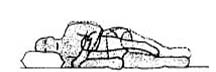
51Lie on side with knees bent. Take a deep breath and relax. Slide upper knee toward chest as far as possible. Return to starting position. Relax. Repeat 5-10 times on each side.

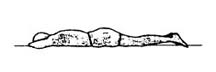
61Lie on your stomach with your head on your hands. Take a deep breath and relax. Tighten your seat muscles. Hold for 2 seconds. Relax. Repeat 5-10 times

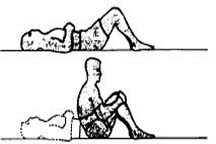
71This exercise should not be started until the others have been done for several weeks. Lie on your back with knees bent. Feet flat on the floor. Take a deep breath and relax. Pull up to sitting position keeping knees bent. Return to starting position. Relax. Having someone hold your feet down can facilitate this exercise. Repeat 5-10 times

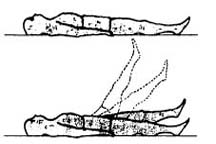
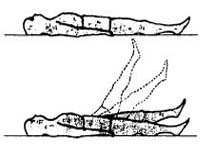
82Lie on your back with your legs straight out, knees unbent and arms at your sides. Take a deep breath and relax. Raise legs one at a time as high as comfortable and lower to floor as slowly as possible. Repeat 5 times for each leg

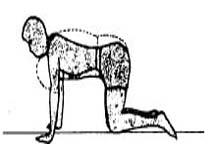
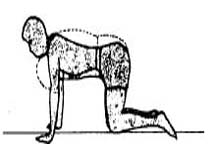
92Get down on your hands and knees. Take a deep breath and relax. Pull stomach in and curve back upward. Let head hang down. Now arch back and look up. Relax. Repeat 5-10 times

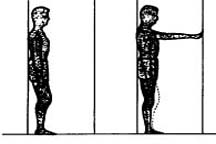
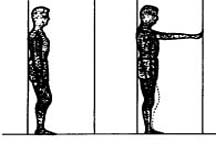
102Stand with your back against doorway. Place heels four inches away from frame. Take a deep breath and relax. Press your back against doorway. Tighten your stomach and seat muscles, allowing your knees to bend slightly. This should cause the lower end of the pelvis to rotate forward (as in exercise 1). Press your neck up against doorway. Press both hands against opposite side of doorway and straighten both knees. Hold for 2 seconds. Relax. Repeat 5-10 times.

Helpful Hints for a Healthy Back.

Always sit all the way in a chair with your back erect. When you lift any object from the floor, bend your legs and keep your back straight, and make your leg muscles do the work. Sleep on a firm mattress or put a 3/4” plywood board under a soft one. If you sleep on your back, put pillow under your knees not under your head. Keep your knees bent when sleeping on your side.  Don’t sleep on your stomach. When driving a car, keep the seat forward so your body is erect. On long trips, stop every hour or so and walk around to relieve tension and relax muscles.

When doing any work that requires standing, place one foot on a stool or bench. Be conscious of your posture and avoid “sway” back. Tuck the pelvis forward to straighten the back. Walk whenever you get the chance.

Once your backache is gone, get regular exercise and make a conscious effort to relax several times a day. If your back acts up, see your doctor immediately. Don’t wait until it gets worse.

Question: Did you try these exercises? Were these exercises helpful?

Filed Under: Exercises, Low Back Pain Tagged With: low back exercises, low back strengthening, low back support exercises., lumbar exercises, lumbar spine strengthening, rehabilitation exercises for low back

Chiropractic Rehabilitation and 4 Stages of Soft Tissue Healing

August 20, 2010 by drburt

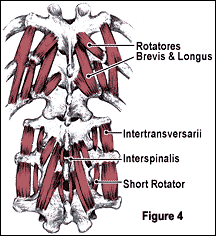
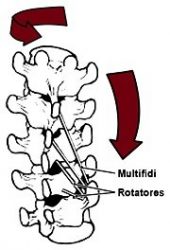
The healing process is divided into four broad stages which are not mutually exclusive and overlap considerably.1ST PICTURE2

1. Initial vascular reaction – Active Swelling

2. Inflammatory response – Passive Congestion

3. Proliferative phase – Repair

4. Remodeling 

Wound healing refers to the body’s replacement of destroyed tissue by living tissue (Walter & Israel 1987). It comprises of two essential components whose differentiation is based on resultant tissue: Regeneration and Repair.

TISSUE INJURY CAUSES RESTRICTION OF MOTION DUE TO: SOFT TISSUE SCAR FORMATION

  1. Inflammation & Swelling
  2. Pain
  3. Muscle Spasm 

THE MAJOR GOALS OF CHIROPRACTIC CARE:

  1. Relieve Pain
  2. Promote Full Healing
  3. Restore & Maintain Full Function
  4. Reduce the Likelihood of Re-Injury
  5. Prevent Accelerated Degeneration 

Chiropractic Care Should Continue Throughout the Repair Stage. It Take Longer For Tissues to Heal & Normal Function to be Restored Than it Takes for Pain Relief. Pain Relief is not the Only Goal.  Chiropractic Helps:

  1. Restore Normal Motion, Function & Biomechanics
  2. Improve Alignment of New Connective Tissue
  3. Prevent Shortening of Scar Tissue & Chronic Stiffness
  4. Restore & Maintain Flexibility of Ligaments & Muscles
  5.  Restore Normal Muscle Tone
  6. Promote Quicker, More Effective Healing
  7. Restore & Maintain Normal Sensation
  8. Reduce the Risk of Re-Injury and Degeneration 

STAGES OF SOFT TISSUE HEALING


STAGE I: ACTIVE SWELLINGMUSCLE SPASMMUSCLE SPASM.21

  1. Swelling Occurs for 12 to 72 hours
  2. Motion is lost and pain increases 

Goals of Care: Minimize pain and swelling

Care:

  1. Rest & Support of Injured Area
  2. Ice to Block Swelling, Pain, and Spasm 

STAGE II: PASSIVE CONGESTION   

Fluid trapped in tissues restricts motion, causes pain, & delays healing. Begins by second to fourth day

Goals of Care for Passive Congestion:

  1. Remove fluid
  2. Pain Relief
  3. Begin to restore range of motion 

Care:

  1. Chiropractic Adjustments Help
  • restore motion
  • block pain
  • restore normal sensation
  • relax tight muscles
  • remove swelling
  • accelerate healing
  1. Heat and Cold to Remove Fluid
  2. Controlled Motion Exercises
  3. Physical Therapy helps in Some Cases
  4. Acupuncture Can Help With Pain Control 

STAGE III: REPAIR

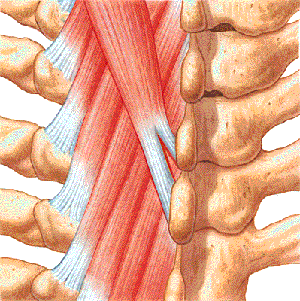
Beginning 5 days after injury, scar tissue is made for up to 6 weeks.  RELAXED MUSCLES OF THE SPINE

Lack of motion causes excess scar tissue in dense patterns disrupting normal function causing:

  1. Excess Scarring
  2. Chronic Stiffness
  3. Limited Range of Motion
  4. Poor Biomechanics
  5. Chronic Pain
  6. Weak Muscles & Ligaments
  7. Loss of Normal Sensation
  8. Poor Nutrition
  9. Increased risk of Re-Injury
  10. Accelerated Degeneration 

If Motion is Restored & Maintained, Tissues Heal in a Much More Functional Way.

Coals of Repair Stage:

  1. Restore Normal Range of Motion
  2. Restore Sensation
  3. Promote Full Healing
  4. Relieve Pain 

STAGE IV: REMODELING 

Connective tissue remodels for better strength & flexibility. This often takes 3 to 14 week but may take up to 1 year with severe injury.  SOFT TISSUE HEALING

Chiropractic Helps Achieve these Goals:

  1. Improve & Maintain Motion & Flexibility
  2. Restore & Maintain Function
  3. Reduce Chronic Pain
  4. Reduce Risk of Re-Injury & Degeneration

This Post was based on Dr. Malik Slosberg’s Research.

Filed Under: Auto Accidents, Carpal Tunnel Syndrome - CTS, Chiropractic, Low Back Pain, Neck Pain, Personal Injury, Shoulder, Soft Tissue Injury, Spine Tagged With: alternative medicine, biology, chiropractic, Chiropractic Care, chiropractic rehabilitation, connective tissue, healing, manipulative therapy, medicine, pain, pain relief, physiology, rehabilitation, relieve pain, scar tissue, soft tissue, spinal adjustment, stages, stages of soft tissue healing, tissues, traumatology, wound healing

  • « Previous Page
  • 1
  • …
  • 7
  • 8
  • 9
  • 10
  • Next Page »

PLEASE FOLLOW & LIKE B.C.

RSS
Follow by Email
Facebook
Facebook
fb-share-icon
Twitter
Visit Us
Follow Me
Post on X
YouTube
YouTube
LinkedIn
LinkedIn
Share

15200 Hesperian Blvd #104

San Leandro, CA. 94578

(510) 481-2225

drburt@burtchiropractic.com


SEARCH

Categories

Recent Posts

  • Nutrition and Habits That May Support Pineal Gland Health and Reduce Factors Linked to Calcification
  • Fluoride in San Leandro Drinking Water, the Pineal Gland, and Questions About Human Free Will: A Local Holistic Perspective
  • San Leandro Chiropractor: How Expert Care Helps Injured Patients Navigate SDI and EDD Benefits