Top Chiropractor in San Leandro, CA

San Leandro Chiropractor

  • About Our Practice
  • What is Chiropractic?
  • SERVICES
    • Personal Injury
    • Cold Laser Therapy
    • Massage
    • Ultrasound
    • Electric Stimulation
    • Sports Injury
    • Workers Compensation
  • Testimonials
  • FAQs
  • Locations
  • CONTACT US
  • New Patient Forms
  • Nutrition Store
  • Tele Chiropractic Health
  • Memberships
  • Home

Powered by Genesis

Healthy Hints For a Healthy Back

September 1, 2010 by drburt

Standing and Walking:
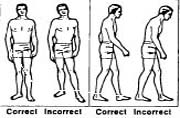
Try to toe straight ahead when walking; put most of your weight on your heels; hold your chest forward and elevate the front of the pelvis as if walking up an incline. Avoid wearing high heels. Stand as if you are trying to touch the ceiling with the top of yur head, eyes straight ahead. All the elements of good posture will flow from these simple maneuvers.

Sitting:
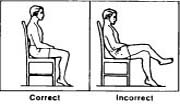
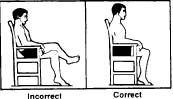
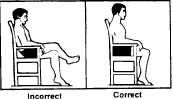
Sit on a hard-back chair with spine pushed back; try to eliminate the hollow in the lower back. If possible, elevate the knees higher than hips while in an automobile. Secretaries should adjust posture chairs accordingly. Sit all the way back in the chair with your back erect.

Lifting:
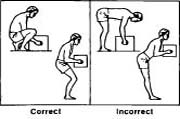
Bend your knees; squat and lift with your thigh muscles, not your back. Never bend over with your knees straight and lift with the upper torso. Move slowly and avoid sudden movements. Try to avoid lifting loads in front of you above the waste line. Avoid bending over to lift heavy objects from car trunks, as this places a strain on low back muscles

Sleeping:
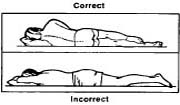
Sleep on a firm mattress; a ¾ inch plywood bed board is helpful and should be used with all but a very firm orthopedic mattress. With acute back pain, sleep with a pillow or blanket rolled under the knees and a pillow under the head. Keep your knees and hips bent when sleeping on your side.

Driving:
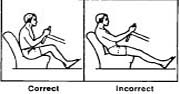
Use a firm seat with a padded plywood or special seal support. Sit close to the wheel with knees bent. On long trips, stop every one to tow hours and walk to relieve tensions and relax muscles

                                                                                                                                                                                                                                                                                                                                                                                                    Working:
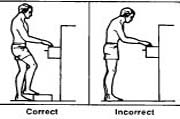
Try to avoid fatigue caused by work requiring long standing. Flex hips and knees by occasionally placing a foot on a stool or bench. Take exercises breaks from desk work by getting up, moving around and performing a few back exercises in the standing position.

Question: Did you try these exercises? Were these exercises helpful?
Filed Under: Exercises, Low Back Pain Tagged With: low back exercises, low back pain prevention, low back strengthening, low back support exercises., lumbar exercises, lumbar spine, lumbar spine strengthening, rehabilitation exercises for low back

Ankle Injury and Rehabilitation Options

August 30, 2010 by drburt

 People tend to injure their ankles at least at one point in their lives. Adults who play sports and children alike can sustain an injury. For instance, kids can play outside with their friends and come home complaining about their ankle. They could also hurt themselves by jumping around the bed or playing by themselves at home. Games like basketball, football, soccer or running could cause some serious injury to ones ankle. It’s important to spot the difference on the type of injury suffered by the kids or adults as the injured ankle could have a sprain, strain or have a torn ligament. By knowing the signs, you could treat the injury appropriately.

So, what’s the difference between a sprain, strain or torn ligament? A strained injury happens when you twist the ankle and is usually quite common as the tendon is only stretched but not torn. If it’s a sprained injury, the ligament is partially torn while the torn ligament injury has a completely torn ligament in the ankle.

Ankle injury usually heals by resting and protecting the injured part. Swelling usually occurs and an ice pack would help reduce the swelling. Typical advice by a majority of health care practitioners is to follow a typical advice: R.I.C.E. (Rest, Ice, Compression and Elevation). Though rest alone can heal the injured ankle eventually, as our body naturally can heal itself, this can take a lot of time without proper rehabilitation. Proper rehabilitation process will help to expedite the healing process of the surrounding injured soft tissues around the ankle.  By rehabilitating the injured ankle, you allow the blood to flow into the area and scar tissue build up is prevented. It also gives you a lower risk of future injury as the ankle becomes much stronger and flexible.

Rehabilitation – The process of restoring a person to goo: health, condition, operation, capacity, and life – through the use of therapy and education.

Rehabilitation Therapy – acts as a medical treatment that restores, improves and maintains strength, fitness, movements, and function of areas of the body that have been injured or impaired.

Other treatments for ankle injury are also being offered or studied. One treatment is by thermal therapy for sprained ankles. What it does is it relieves the symptoms of the sprain through heat therapy. But, there’s a different effect for heat therapy as compared to cold therapy. If the sprain is more severe and there’s a lot of swelling, using heat therapy will only worsen it. For milder sprains, you can use the heat therapy treatment. For severe sprains, it has to be avoided.

In heat therapy, timing is important. Heat allows the blood vessels to relax and this means, it can swell. Make sure you time the treatment when the sprain already had a chance to heal enough and the swelling is down. Usually this is 3 days after the injury occurred. By using this therapy, you are allowing your ankle to improve its mobility but it doesn’t help in relieving pain. This is particularly helpful when you start feeling your ankle is stiffening.

Another treatment that is still being studied right now is the “cross-over” effect where you train your uninjured ankle and gain improvement on your injured and immobilized ankle. Clinical studies have shown a small percentage of improvement by training a non-dominant leg with the dominant leg and it’s believed to be the case for the ankles as well. This is because of how our nervous system works. It learns to coordinate movements from one part of the body to the other similar body part by improving it even if the other similar body part is immobilized.

At my clinic I use PT modalities (Electric Stimulation and Moist Heat combination, Ultrasound, Erchonia PL 5000 Cold Laser, Elastic Wrap, CMT (Certified Massage Therapy) and Manual Chiropractic Adjustment). Electric Stimulation helps to bring the pain level down in the first couple of week of the therapy and heat brings more blood to the injured area as well as allows it to be more relaxed for the next step. Next modalities are Ultrasound or Erchonia PL5000 Cold Laser. I alternate them with every other session. Next patient sees my CMT for 15 minutes, My massage therapist breaks the scar tissue down and moves injured ankle through its natural Range of Motion. After massage I adjust an ankle and wrap it witt an elastic wrap for a better support.

Question: Did You Ever Have Ankle Injury? What Kind of Rehabilitation process did you have?

Filed Under: Ankle

Isometric Neck Exercises

August 26, 2010 by drburt

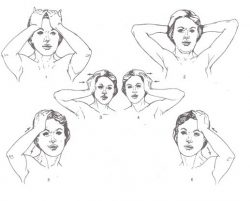
It is best if you do these exercise 2-3 times a day at a different time. Breath air out with a “haaaaa” sound  as you strain during exercises. Hold each contraction for a count of 5.

  1. Place both hands against your forehead.  Push your head forward against the heels of your palms without moving your head. Hold.
  2. Place both hands behind your head.  Pull your head back against your hands while pulling forward with your hands so your head doesn’t move.  Hold
  3. Place your right hand against the right side of your head.  Push your head hard against the heel of your palm without allowing it to move.  Hold.
  4. Place your left hand against the left side of your head.  Push your head against the heel of your palm without allowing it to move.  Hold.
  5. Place your right hand against your right temple.  Try to bring your chin down to your right shoulder without allowing your head to move.  Hold.
  6. Place your left hand against your left temple.  Try to bring your chin down to your left shoulder without allowing your head to move.  Hold.

Question: Did you try these exercises? Were these exercises helpful?
Filed Under: Exercises, Neck Pain Tagged With: cervical spine, exercises, isometric neck exercises, muscle strengthening, neck, rehabilitation

Helpful Hints For a Healthy Neck

August 25, 2010 by drburt

Standing and Sitting:

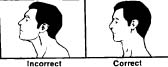
While standing or sitting keep neck drawn back and chin tucked in, not up.


A proper chair will support your arms and shoulders and help prevent strains of the neck due to forward thrust.


Reaching:

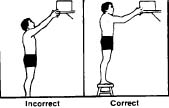
Don’t reach for a shelf higher than your head. Stand on a stool. Don’t reach or look up for any length of time.

                                                                                                                                                                                                                                                                                                                                                                                                                                                                                  Driving:

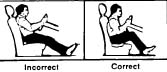
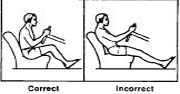
Don’t drive with the seat too far back or too low. If necessary, sit on a pillow or use a seat support such as Sacro-Ease to avoid stretching up and forward to see over the steering wheel.


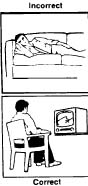
Resting   and   Sleeping                                                                                                                                                                                                                                                                                                                                                                                                                                                                                                                                                                                                                                                                                                                                                                                                                                                                                                                                                                                     RDon’t lie on the sofa to watch TV: sit up or forward on high pillows while reading or watching TV.


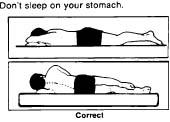
Don’t sleep on your stomach. Lie on your side and adjust your pillow to maintain your head and neck in a neutral position. Keep your arms down.


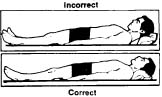
If you sleep on your back, put a pillow under your neck, not your head. Use a bed board or a firm orthopedic mattress. A proper pillow is 3-4 inches thick, 6-7 inches wide, 16 inches long. If you have a neck problem, try an inexpensive contoured pillow, such as Jackson Cervipillo. Don’t sleep in a chair.

Filed Under: Exercises, Neck Pain Tagged With: good habbits, healthy neck, helpful hints, helpful tips, helthy cervical spine, hints, posture, prevention, spine

  • « Previous Page
  • 1
  • …
  • 51
  • 52
  • 53
  • 54
  • 55
  • …
  • 61
  • Next Page »

PLEASE FOLLOW & LIKE B.C.

RSS
Follow by Email
Facebook
Facebook
fb-share-icon
Twitter
Visit Us
Follow Me
Post on X
YouTube
YouTube
LinkedIn
LinkedIn
Share
Instagram

Burt Chiropractic Rehabilitation Center

15200 Hesperian Blvd #104

San Leandro, CA. 94578

(510) 481-2225

drburt@burtchiropractic.com

https://shorturl.at/nDHP2

SEARCH

Categories

Recent Posts

  • Soft Tissue Injuries in Tennis: Causes, Common Types, and Chiropractic Rehabilitation in San Leandro, CA
  • The Female Pelvis, Sacroiliac Joint Dysfunction, and Its Impact on Knee Alignment and Pain: A Chiropractic Perspective
  • Chiropractic Rehabilitation of soft tissue after a Car Accident in San Leandro, CA