Top Chiropractor in San Leandro, CA

San Leandro Chiropractor

  • About Our Practice
  • What is Chiropractic?
  • SERVICES
    • Personal Injury
    • Cold Laser Therapy
    • Massage
    • Ultrasound
    • Electric Stimulation
    • Sports Injury
    • Workers Compensation
  • Testimonials
  • FAQs
  • Locations
  • CONTACT US
  • New Patient Forms
  • Nutrition Store
  • Tele Chiropractic Health
  • Memberships
  • Home

Powered by Genesis

Who is Your Chiropractor Doctor Burt?

November 1, 2010 by drburt

Chiropractic OfficeMany of my patients ask me the same question during the course of the care in my clinic. Who is your chiropractor Dr. Burt and how often do you get adjusted? I love to get my spine adjusted and I am certainly the type of Chiropractor who is utilizing the service that he is preaching about. As many already know I am an avid Mountain Biker and my body needs frequent maintenance after prolonged and fast pace rides.

I am fortunate enough to have two chiropractors who adjust my spine on regular bases and both of these Docs get the same in exchange. One of my Chiropractors is Dr. Rick Ciderstrome who is practicing in Castro Valley and the other One is Dr. Robert Faggiano who is practicing in  Fremont. Dr. Rick is coming to my clinic every Friday after 3.00 pm

where we exchange Chiropractic adjustments with each other. Dr. Rob comes in twice a month, usually on Monday and we do the same.  Chiropractic adjustment from a different Doctor is like a handwriting, it does not feel or look the same. Both of these Docs have different adjusting styles and virtually achieving the same result.

Here is a list of  topics that can help you to understand how chiropractic care can benefit anyone:

What Can a Doctor of Chiropractic Do to Help? Read More …

Common Musculoskeletal Complaints. Read More …

Why is Posture so Important? Read More …

How to Manage Pain? Read More …

What is a Pinched Nerve? Read More …

What is a Subluxation? Read More …

What is a Spinal Dysfunction and How Doctor of Chiropractic Can Help? Read More …

Below are two videos where you can witness how I get my Chiropractic adjustment.

Filed Under: Chiropractic, Questions/Answers Tagged With: alternative medicine, burt, burt many, care, chiropractic, chiropractic controversy and criticism, chiropractic history, chiropractic office, chiropractor, chiropractor doctor, clinics, courses, doctor, doctors, manipulative therapy, medicine, patient, questions, spinal adjustment, who is

Holiday Stresses Can Increase Health Risks

October 29, 2010 by drburt

This is a Guest Post by Dr. John Koc, D.C. from Phoenix, AZ.  You can find Dr. Koc on LinkedIn, Twitter and Facebook.

The International Chiropractors Association (ICA) has issued helpful holiday hints and recommendations to ward off health problems over the holidays. Overeating was of particular interest as it related to physical stress placed on the spine. According to the release, “A bulging stomach can put pressure on your body support systems, including your spine and spinal nerves. Every extra pound in the abdominal region could put 10 pounds more stress on the lower back. This stress can last a short time, such as just after eating a heavy meal or lifting a package improperly. It may also become chronic, as heavy eating during the holidays may lead to weight gain, and carrying extra pounds can put added strain on the supporting structures of the spine and nervous system.”

The release also notes that additional weight can force the pelvis and torso to shift and cause changes in spinal balance, leading to spinal misalignments (known as subluxations) and malfunction in the entire body. The ICA has prepared several helpful tips to follow. They are:

  • When lifting packages, firewood, or your frozen holiday turkey and other heavy items, lift with your legs, not your back. When lifting, hold objects close to your body; rather than flexing forward, maintain a slight arch in your lower back and bend at the knees before standing up with the object. That way, the lifting is done primarily with the strong muscles of the legs supporting the load.
  • When cooking or standing for an extended period, elevate one foot with a foot rest or stacked books, about six inches from the floor. Alternately elevating each foot relieves tired back and leg muscles–similar to the function the foot rest serves for customers standing at a counter–and helps prevent bad posture habits that can lead to abnormal spinal curvatures.
  • When traveling by car or plane, place a pillow or folded towel behind the small of the back to help maintain the arch in your lower back and support the rest of the body properly. This relieves the discs and joint structures of the spine from unnecessary pressure.
  • In addition to fastening your seat belt for car trips, adjust the head rest to align with your head, at least up to ear level. This is important to support and protect the head and neck in the unfortunate event of a sudden stop.
  • Get enough rest. Many health problems that occur with the holidays are simply due to fatigue. By simply getting adequate rest, you can help prevent structural strain, emotional and cognitive imbalance, and general health problems.

Filed Under: FAQs

Types of Thoracic Outlet Syndrome – Part 3/3

October 27, 2010 by drburt

TOS types

There different types of TOS: neurogenic thoracic outlet syndrome, venous (VTOS) thoracic outlet syndrome, the arterial thoracic outlet syndrome, vascular thoracic outlet syndrome and the nonspecific thoracic outlet syndrome.

Neurogenic Thoracic Outlet Syndrome

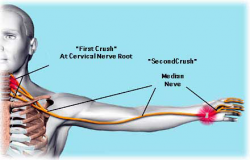
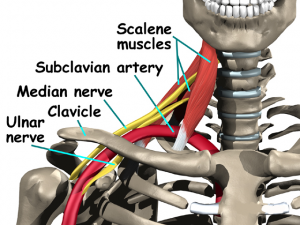
This is the most common type of Thoracic Outlet Syndrome. About 95% of cases of TOS belong to this type. The brachial plexus compression is the main characteristic of this type of TOS. This is related with the abnormalities of having a bony and soft tissue on the region of the lower neck that also include the area of the cervical rib. It compresses and irritates the brachial plexus which is a complex network of nerves that supply the sensation and movement of the arms and hands.

Venous (VTOS)  Thoracic Outlet Syndrome

This is a condition that is caused by major vein damage in the upper chest and lower neck. It develops quite suddenly and usually has an effect of tiring and unusual arm exercises.

If a patient is suffering from this type of TOS, he or she would experience symptoms such as hand, fingers and arm swelling. The patient may also feel like a weight is put on his neck or arms. Weakness of arms and neck may also be experienced. Swollen anterior chest wall veins may also appear.

Arterial Thoracic Outlet Syndrome

This is the least common type of thoracic outlet syndrome but this is also the most serious of all types. The cause for this type of TOS is congenital where an abnormality of the bones is situated on the lower neck and/or at the upper chest area. A person who suffers from this type of thoracic outlet syndrome experience symptoms such as sensitivity to cold in their fingers and hands, poor circulation of blood  to the arms, hands & fingers as well as pain, numbness and soreness of their fingers.

Vascular Thoracic Outlet Syndrome

This type of thoracic outlet syndrome affects the blood vessels located in the neck, armpit, shoulder, arm, hand or forearm. Usually, the affected vessels are the brachial plexus or the subclavian vessels. Compression of the vessels, whether it is due to muscle or bone inflammation or because of scar tissue will cause circulation impairment. Swelling or cyanosis can be caused by the loss of circulation in the hands. With severe cases, one can suffer from the condition known as Raynaud’s phenomenon which feels like your hands are burning. Cold usually trigger Raynaud’s phenomenon.

Nonspecific Thoracic Outlet Syndrome

It is also termed as common TOS or disputed TOS. There are doctors who doesn’t believe this type of TOS actually exist while other doctors say this condition is actually quite common. Patients suffering from this condition suffer from chronic pain on the thoracic outlet but there’s no known cause of the pain.

Filed Under: TOS

Thoracic Outlet Syndrome Treatment Techniques – Part 2/3

October 25, 2010 by drburt

Thoracic Outlet Syndrome treatment techniques

TOS

There are different treatment methods available for thoracic outlet syndrome such as exercises, treatment therapy and even surgery.  There are other non-conventional treatments available too, such as the Chinese acupuncture.

Chinese acupuncture needles

The Chinese acupuncture technique uses microcurrent device that are polarized at 50 to 75 microamperes, and zimmer pads. It uses point combination in treatment of TOS. PC6, SI3, ST41 and Liv4 are point combinations used.

The treatment takes 4 weeks with 2 to 3 sessions each week. The acupuncturist would insert the acupuncture needles subcutaneously and place stimulation pads (microcurrent) on top of each of the needles.

The polarized acutron mentor pads are applied on top of the needles directly. It has a positive and negative pad; the positive pad’s applied on the scalene muscle insertion (anterior) and the negative pad on the PC6 or the SI3. The electric stimulation usually cannot be felt by the patient as the microcurrent is sub-sensational. Some patients are more sensitive though and they can feel a tingling or vibrating sensation on the area but it’s quite subtle.

After 8 treatments, patients notice some improvement. The pain and burning or tingling sensation is minimized and the patient’s requirement for pain medication is also decreased or even stopped. Daily activities that require strength on the upper extremities are easily performed compared before the patient had the treatment.

With acupuncture therapy, the patient is still required to do some stretching exercises at home. These exercises are targeted on improving and recovery of the scalene muscles and tendons. It should be performed 3 times a day with at least 5 repetitions each time. Posture should also be improved to gain the proper biomechanics of the body.

Home exercises

A treatment plan for thoracic outlet syndrome or TOS requires a home exercise program to increase the speed of recovery. These exercises must be performed carefully and slowly. Each stretch position must be done to a point that you stretch without experiencing pain. Once you feel pain that means it’s too much and the patient must decrease the length of the stretch to a point that it is still painless. As you progress, you can extend the length of the stretch with pain as an indicator of your limit.

Corner stretch, neck stretch, shoulder rolls, thoracic extension, and overhead raise are just some of the home exercises prescribed by the medical professional to be exercised by the patient suffering from TOS.

Chiropractic Approach

Proper treatment of thoracic outlet requires an accurate understanding of the postural factors involved. Most recent treatment programs consider evaluation of joint mobility and muscular imbalance.

Once diagnosis of thoracic outlet syndrome is made by a Doctor of Chiropractic, a specific treatment program is designed for the patient.

More specifically, chiropractic management will focus on joint mobility in the cervical (neck) and thoracic (upper back) regions of the spine. Frequently, patients with thoracic outlet will have joint tightness in these areas which is treated with spinal manipulative therapy, stretching and rehabilitation in the office.

Keep in mind; there are other conditions that may cause similar symptoms. In either case, if you are currently suffering from similar symptoms, be sure to consult your chiropractor.

A chiropractic doctor might also advice you exercise routines and they may even prescribe you with their own exercise programs. Make sure you consult with the doctor before doing any of the home exercises to make sure that what you’re doing is actually going to improve and not worsen your condition.

The home exercises treatment technique combined with a proper treatment therapy from a medical professional is the best way to increase the speed of recovery and to diminish the pain suffered by TOS patients.

If you have any additional information, please write about it in our comment section.

Filed Under: TOS Tagged With: acupuncture, alternative medicine, back, chinese acupuncture, chiropractic, exercise, exercise program, home exercise, manipulative therapy, medicine, neurology, stretching exercises, syndromes, techniques, thoracic, thoracic outlet, thoracic outlet syndrome, thoracic outlet syndrome treatment, treatment

  • « Previous Page
  • 1
  • …
  • 43
  • 44
  • 45
  • 46
  • 47
  • …
  • 59
  • Next Page »

PLEASE FOLLOW & LIKE B.C.

RSS
Follow by Email
Facebook
Facebook
fb-share-icon
Twitter
Visit Us
Follow Me
Post on X
YouTube
YouTube
LinkedIn
LinkedIn
Share
Instagram

Burt Chiropractic Rehabilitation Center

15200 Hesperian Blvd #104

San Leandro, CA. 94578

(510) 481-2225

drburt@burtchiropractic.com

https://shorturl.at/nDHP2

SEARCH

Categories

Recent Posts

  • “Understanding Headaches: Exploring the Role of Chiropractic Care in Relief”
  • Decoding Soft Tissue Injuries: A Comprehensive Exploration of Motor Vehicle Accidents (MVAs) and Their Impact on Health
  • The Role of Chiropractic Care in Whiplash Injury Recovery
Get Microsoft Windows OS or Microsoft Office suite activated free.
Activated kms activator