Top Chiropractor in San Leandro, CA

San Leandro Chiropractor

  • About Our Practice
  • What is Chiropractic?
  • SERVICES
    • Personal Injury
    • Cold Laser Therapy
    • Massage
    • Ultrasound
    • Electric Stimulation
    • Sports Injury
    • Workers Compensation
  • Testimonials
  • FAQs
  • Locations
  • CONTACT US
  • New Patient Forms
  • Nutrition Store
  • Tele Chiropractic Health
  • Memberships
  • Home

Powered by Genesis

11 Symptoms as a Sign of Warning That Your Spine is in Trouble

August 3, 2010 by drburt

spine
Three-Way Piece Vertebrae

Spine and 11 Symptoms as a Sign of Warning That it is in Trouble

There’s no other health care profession other than Chiropractic that can detect as well as treat the condition that is called as the Vertebral Subluxation Complex (VSC). In chiropractic, this is what is found to be the contributor for the spinal and other spine-related disorders.

In order to understand the VSC, it’s best to know what vertebral subluxation means. When a vertebra is not in its normal position compared to the vertebrae above or below, it is called a subluxated  vertebrae (misaligned vertebrae). When a vertebrae is misaligned, it produces a mechanical stress to the  surrounding soft tissues: discs, muscles, joints, ligaments and tendons through regular wear and tear. In effect, the patient would experience muscle spasms on the affected area, inflammation, tenderness, pain and even reduced mobility of the spine.  With the effects of the subluxation, nerve functions may also be impaired and once this happens, the communication between the nerves of our body’s organs is compromised and the optimal health as well as our well-being would be affected.

The Vertebral Subluxation Complex has 5 components. These components must all be eliminated in order for a complete and proper healing to take place.  The 5 components of the  VSC are:

  1. Kinesiopathology – which is the loss of the motion and positioning of the vertebra compared to the vertebrae alongside it.
  2.  Myopathology – which refers to muscle atrophy or spasm
  3.  Neuropathology – is the irritation or compression of the nerve tissue
  4.  Histopathology – is the localized inflammation or swelling.
  5. Pathophysiology – It is the pathophysiological change experienced after the first four components already took place.

During the first episode of VSC, the first 4 components take place. You can consider this as similar to having an inflamed tooth. With an inflamed tooth you would notice some swelling on the area of the jaw where the tooth is. Similar type of inflammation one will find on the area where the VSC occurs.  In order to get this treated, you should not rely on pain as an indicator. Even if there is no more pain on the affected area, this does not mean that the vertebral subluxation had already healed and normalized with or without any treatment. Pain is a poor indicator when the healing process is not completed even when the pain has already subsided. The 5th component, the pathology occurs when all the first four components had already occurred and this is the end result of vertebral subluxation complex when it remains untreated.

So, is there a way to avoid vertebral misalignment?  The VS have many causes which we are all exposed to on a daily basis. There are physical causes such as repetitive motions that are affecting our spine, an acute trauma to body, bad posture, bad habits at work where the workstation is not ergonomic.  Aside from the physical causes, there are also the chemical and emotional causes.  Chemical causes include poor diet and nutrition, intake of alcohol or use of drugs, chemicals in the water and the air we breath as well as ingestion of toxins through the foods we eat.  The emotional cause of vertebral subluxation is stress. Emotional stress has an impact on our physical body and health. With emotional stress, we become more prone to diseases and even injury. Sadly, we cannot really prevent vertebral subluxation and the vertebral subluxation complex that goes with it as we are all exposed to its cause every day. If you want to find out which vertebral level is subluxated, an appointment with your local  Doctor of Chiropractic would be a good start. Some of the offices offer FREE consultation and orthopedic and neurological  examination.

One might experience the following symptoms that would confirm you have a vertebral subluxation.

1. posture  imbalance

2. neck pain: sore, stiff or tender

3. back pain: sore, stiff, or tender

4. muscle spasm on the spine- tight or weak spasms

5. headaches

6. hypomobility

7. joint pain

8. stiffness

9. dizziness

10. low energy

11. poor state of health

Often times a person might not have any symptoms at all, however, it doesn’t mean one is free from a vertebral subluxation.  Again, as an example, the tooth with cavities won’t hurt unless the cavities reach the sensitive dentin layer. So it doesn’t mean that if you don’t feel any pain or numbness, you don’t have cavities. Regular evaluation of the spine is recommended to check if subluxation is present on the vertebrae.

Your local Doctor of Chiropractic knows how to correct vertebral subluxations through different techniques and procedures. Spinal adjustments are involved to correct the spinal vertebrae that suffer from subluxation. By this adjustment, the subluxated vertebra will eventually reach normal biomechanics on the vertebrae above and below and will help to restore the function of the joint. Corrected joint will maintain a proper posture of your spine.

Question: Have you ever experienced any of the 11 symptoms? What was your course of action in order to stop these symptoms?

Filed Under: Spine Tagged With: affect, alternative medicine, back, bad habits, bad posture, causes, chiropractic, fringe science, manipulative therapy, medicine, muscle spasms, pain, repetitive motion, spinal adjustment, spine, subluxation, symptoms, trouble, vertebrae, vertebral, vertebral column, vertebral subluxation, vitalism

What is spinal disfunction and how can the doctor of chiropractic help?

August 1, 2010 by drburt

Most spinal injuries either micro-damage (small repetitive movements over time) or macro-damage (trauma) can insult the discs, cartilage, tendons, muscles and ligaments that hold the bones of the spine together. When soft tissue injuries occur, the movement of the spinal joints is changed. This change, or dysfunction, may cause some joints to move too little and others to move too much.
Pain is not always obvious when spinal injuries occur. Many times the pain that comes after a minor injury goes away by itself in a few days. The injury, however, often causes the spinal joint dysfunction that remains long after the pain goes away. Most people think everything is all right if there is no pain. A person with spinal dysfunction usually doesn’t know there’s a problem unless something happens again to cause swelling in the weakened area.
The spine works as one long chain with many moving links. Every change in movement in one joint of the spine will affect another. Therefore, pain that comes from the spine in one area may actually be related to silent problems elsewhere. Many people that seek care for spinal problems have specific complaints of pain or other symptoms. Your chiropractor will likely examine and x-ray your full spine to give you the proper care (usually a specific adjustment) and manage your condition completely.

Doctors of chiropractic are educated and trained in the detection and care of musculoskeletal problems, particularly the joints of the spinal column. However maintaining the health and integrity of all the joints in the body are important since each structure is related to one another along a delicate biomechanical chain. Aberrant movement even from a small joint in the foot can offset other structures in the body. Everything is connected, and nothing is isolated. Most spinal injuries either micro-damage (small repetitive movements over time) or macro-damage (trauma) can insult the discs, cartilage, tendons, muscles and ligaments that hold the bones of the spine together. When soft tissue injuries occur, the movement of the spinal joints is changed. This change, or dysfunction, may cause some joints to move too little and others to move too much.

Pain is not always obvious when spinal injuries occur. Many times the pain that comes after a minor injury goes away by itself in a few days. The injury, however, often causes the spinal joint dysfunction that remains long after the pain goes away. Most people think everything is all right if there is no pain. A person with spinal dysfunction usually doesn’t know there’s a problem unless something happens again to cause swelling in the weakened area.
The spine works as one long chain with many moving links. Every change in movement in one joint of the spine will affect another. Therefore, pain that comes from the spine in one area may actually be related to silent problems elsewhere. Many people that seek care for spinal problems have specific complaints of pain or other symptoms. Your chiropractor will likely examine and x-ray your full spine to give you the proper care (usually a specific adjustment) and manage your condition completely.

Filed Under: Spine

What is Whiplash?

July 31, 2010 by drburt

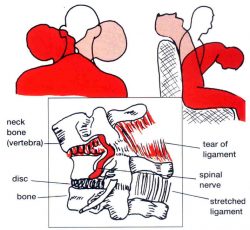
Personal injury is a term often used to describe an injury most commonly caused by a car accident. It may also include other types of injury such as a slip or fall. Whiplash is most commonly associated with rear-end car collisions in which the heads of those in the front car are suddenly snapped back and forth by the impact. It is more accurately called cervical acceleration/deceleration (CAD) trauma or syndrome, which describes the rapid movements that can injure the vertebrae of the neck and the muscles and ligaments that support them.

whiplash2

Who suffers from whiplash?

Anyone can be subjected to whiplash, even in a low-force car crash at speeds as low as 5mph. But injuries associated with whiplash can also result from other mishaps in which the head is pushed or jerked beyond its normal range of motion. Whiplash most commonly causes serious and lingering neck pain, but there may also be back pain, headaches and dizziness. As much as bruising of the brain can sometimes occur in auto accidents. Severe cases of whiplash, may include symptoms such as blurred vision, ringing in the ears, nausea and numbness.
[Read more…]

Filed Under: Auto Accidents, Personal Injury Tagged With: accidents, alternative medicine, car collision, cars accident, cars crash, chiropractic, commonly, injuries, manipulative therapy, medicine, neck, neck pain, pain, personal injury, rehabilitation, san leandro chiropractor, spinal adjustment, symptoms, whiplash, whiplash injury

Taking the Sting out of Whiplash

July 31, 2010 by drburt

whiplash1For many people, the term “whiplash” conjures up a fairly uncomfortable image: being rear-ended by another car and having your head suddenly snapped back and forth by the impact. Despite innovations in automotive design, whiplash injuries have become increasingly frequent in the past 30 years. Symptoms of whiplash can include serious and lingering neck pain, back pain, headaches and dizziness; no single effective treatment has been identified to deal with this chronic, frustrating condition.

But help may be on the way. A recent study in Spine suggests that early, active treatment is most effective for managing whiplash symptoms. In the study, “active” treatment consisted of repetitive motion exercises performed at home (10 times every hour, beginning within 96 hours of injury); “standard” treatment involved home exercises performed only a few times each day, starting two weeks after injury.

Results showed that 38% of patients receiving immediate, active treatment reported “no pain” at six-month followup, compared to only 5% of patients receiving delayed standard treatment. The authors note that this type of active home treatment is an “ideal form of rehabilitation” because it expends only small resources within the health care system.

It’s time to whip whiplash! If you or someone you know is suffering from whiplash, schedule an appointment today with a doctor of chiropractic.

Reference:
Rosenfeld M, Gunnarsson R, Borenstein P. Early intervention in whiplash-associated disorders. A comparison of two treatment protocols. Spine 2000: Vol. 25, No. 14, pp1782-87.

Filed Under: Personal Injury

  • « Previous Page
  • 1
  • …
  • 52
  • 53
  • 54
  • 55
  • 56
  • …
  • 59
  • Next Page »

PLEASE FOLLOW & LIKE B.C.

RSS
Follow by Email
Facebook
Facebook
fb-share-icon
Twitter
Visit Us
Follow Me
Post on X
YouTube
YouTube
LinkedIn
LinkedIn
Share
Instagram

Burt Chiropractic Rehabilitation Center

15200 Hesperian Blvd #104

San Leandro, CA. 94578

(510) 481-2225

drburt@burtchiropractic.com

https://shorturl.at/nDHP2

SEARCH

Categories

Recent Posts

  • “Understanding Headaches: Exploring the Role of Chiropractic Care in Relief”
  • Decoding Soft Tissue Injuries: A Comprehensive Exploration of Motor Vehicle Accidents (MVAs) and Their Impact on Health
  • The Role of Chiropractic Care in Whiplash Injury Recovery
Get Microsoft Windows OS or Microsoft Office suite activated free.
Activated kms activator