Top Chiropractor in San Leandro, CA

San Leandro Chiropractor

  • About Our Practice
  • What is Chiropractic?
  • SERVICES
    • Personal Injury
    • Cold Laser Therapy
    • Massage
    • Ultrasound
    • Electric Stimulation
    • Sports Injury
    • Workers Compensation
  • Testimonials
  • FAQs
  • Locations
  • CONTACT US
  • New Patient Forms
  • Nutrition Store
  • Tele Chiropractic Health
  • Memberships
  • Home

Powered by Genesis

Thoracic Outlet Syndrome, Physiology and Causes – Part 1/3

October 22, 2010 by drburt

What is Thoracic Outlet Syndrome?
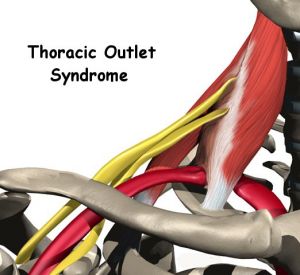
TOS

In order to know what Thoracic Outlet Syndrome is, or TOS, it’s best to know what and where you can find the Thoracic Outlet. The space between the collarbone and the first rib is known as the Thoracic Outlet.

The TOS involves a group of disorders that involves the thoracic outlet whether as caused by an injury, compression or irritation of the blood vessels, nerves and veins. The patient may experience neck pain and/or shoulder pain that reaches the arms and even causes finger numbness.

What Are the Causes of  TOS?

The causes for Thoracic Outlet Syndrome vary greatly but generally, it is caused by compression of the blood vessels and nerves in the thoracic outlet. This compression can be caused by any of the following: trauma, congenital defects, poor posture, activity, joint pressure or even pregnancy.

You can have a congenital defect that may cause you to suffer from this condition. If you have an extra rib just above your first rib (cervical rib), or if you have an abnormal fibrous band that connects the spine to your rib, then you are more likely to have TOS.

If you suffer from an accident that causes compression to your thoracic outlet and you experience pain in that area, then you may be suffering from TOS. The onset of the symptoms doesn’t occur after the trauma though as it is usually delayed.

Poor posture can compress the thoracic outlet. Drooped shoulders as well as constantly keeping a forward head position could cause TOS. Repetitive activity is also another cause as the body’s tissue can wear out over time as you do the same activity over and over again. The types of repetitive activities vary from typing to swimming.

Being overweight causes different types of problems. When you are overweight or obese, you tend to put more pressure on your joints that can also cause Thoracic Outlet Syndrome. It’s like carrying around a huge backpack wherever you go.

Pregnancy, just like with obesity, can also cause thoracic outlet syndrome. But with pregnancy, the woman’s body changes and one of these changes happen in the joints. The joints tend to loosen up during pregnancy and women become more prone to suffering from TOS.

What are the Symptoms to Watch out for?

The symptoms of the Thoracic Outlet Syndrome vary as it depends on which of the structures are suffering from compression. The nerves, veins or arteries can get compressed and symptoms such as shoulder or neck pain, pain on the hands and arms, numbness of fingers, vein thrombosis, swelling and arm pain, collarbone throbbing, and discoloration of the hand are just some of the symptoms associated with Thoracic Outlet Syndrome.

How is it detected?

The Thoracic Outlet Syndrome is difficult to diagnose as the severity and symptoms vary greatly. Doctors would suggest the patient to take medical tests to see if they are indeed suffering from TOS. Such tests include Adson’s maneuver, Wright test and Roos stress test.

If you have any additional information about TOS please feel free to ad it in a comment section.

Filed Under: Shoulder

Hospital Emergency Room vs. Chiropractic Office Experience

October 20, 2010 by drburt

Hospital EmergencyOften times when you call your doctor and no one answers the phone the message will usually say: ” In case of emergency call 911.”  The only reason why our patients call us first is because they want to avoid prolonged and painful hours at E.R. waiting room. Some of my patients had to wait for eight hours before they were seen by a doctor or a nurse.  These patients arrived to a Hospital E. R. in order to get an immediate pain relief. However, the E.R. works differently than the way I operate my clinic, or many other private practice doctors, when someone wants to get an immediate pain relief.

Last Friday my wife called me at 6.45pm. I was finishing up with my files for the day. She informed me that our three and a half year old boy got inside of the bag which was hidden in a kitchen cabinet. Inside of the bag was a bottle of Resveratrol that my wife is taking as a daily nutrition supplement. We were not sure either he ate or he threw the pills in a toilet, like he has a tendency to do with everything else. Regardless of what happened my wife took him to a local Hospital E.R.

Hospital

I have arrived to a Hospital E.R. at 7.00 pm. When I walked into the ER the nurse was checking the vitals of our son. She has informed us that we are on a fast track and will be seen by a specialist in 20-30 minutes. She also informed us that while we are waiting she is going to check with Poison Control about how toxic the supplements are to a Child.

Two hours later she informed us that the supplements are not toxic at all and the child will be fine. However, she insisted for us to stay and have blood and urine analysis done. We agreed.

BabyThey called us in at 9.30 pm,  that was already two hours behind the promised schedule. Taking blood from a child was a nightmare. They had to do it two times. It was a traumatizing experience for me watching it and holding him.

Nurse informed us that the lab work will take about 20 minutes and they will know what is going on. That was around 10.00 pm. While we were waiting a nurse suggested that we provide a urine sample as well.  We stayed at the hospital till 11.30 pm and waited for the lab results.

EmergencyA simple procedure took four and a half hours. If I had to take this amount of time in my office to treat patients with the pain I would be out of business by now. I don’t understand how cone these Hospitals prosper and at the same time run so inefficient. My only assumption is that Hospital Administration knows that they are they only game in town and patients have no place to go but to stay and wait. This is not the case with

Chiropractic care in my clinic. If I don’t provide the best possible care to my patients in a timely manner these patients will go to another Chiropractor. I want to assure you that there are more Chiropractic offices in five miles radius of my practice than there coffee shops.

Does this story sound familiar to you or am I the only one who spent many hours in a Hospital E.R? Please tell me about your Hospital E.R. Experience in a comment Section. Thank you.

Filed Under: Chiropractic Tagged With: alternative medicine, chiropractic, chiropractic office, doctors, emergency, emergency call, emergency department, emergency medicine, experience, health, hospital emergency, hospital emergency room, hospitals, local hospital, manipulative therapy, medicine, pain relief, vs

Pillow Advice From Your Chiropractor

October 18, 2010 by drburt

PillowWhen we expect a good night sleep, the majority of us consider mattress characteristic and features, room temperature, room illumination, and noise. Hardly ever we will think about our pillows. There are a lot of options available nowadays. It is important to know that our cervical spine alignment is an important feature of our general well being. Selecting a head support which is equally comfortable to sleep with as well as be able to improve the quality of good night sleep, has to be a necessary foundation for a good nigh sleep.

What is the frequency of pillow replacement?


Six months to two years is life span of a pillow. A great deal of the time frame will depend upon the pillow you have bought. A folding method would be a good test to measure the replacement status of your pillow. Just fold your head support in half. A brand new pillow will spring right back after you release the pressure, however, an old beaten up one will stay folded. This test is like check engine light in your car. If you wait too long the problem will cost you literally: “Pain in Your Neck.”

How Do You Sleep?

Prior to the first possible pillow you see in the store, consider your sleeping patterns. Your goal is always to keep the head, neck, and spine aligned as straight as possible during sleeping hours. The simple answer to what position you sleep in can tell you a lot about which pillow to purchase. For instance, if you predominantly sleep face up, a flatter head support will do a better job for your neck and will help to keep it aligned as straight as possible with your back. If you sleep on your side, one has to compensate for the depth of their shoulder, so a firmer pillow that has more depth to its filling should be considered. Stomach sleepers also need to consider how they sleep in regards to their arms. Are your arms usually tucked beneath your head or at your sides? Your main goal is to keep your head, neck, and spine as straight and aligned as possible.


Additional Tips

  1. When choosing a pillow, be selective. When lying on your side, your head and neck should remain level with your mid and lower spine. When lying on your back, your head and neck should remain level with your upper back and spine. In other words, your pillow should not be so thick that it causes your head and neck to be propped up or angled sharply away from your body.
  2. Be wary of pillows that are made out of mushy foam materials. The weight of your head can displace this kind of foam, leaving little support. Choose firmer foam and materials that press back and support the head.
  3. If you find yourself sleeping on your side with one hand propped under your pillow, that’s a clue that you’re not getting the support you need from that pillow.
  4. There is no such thing as a universal fit when it comes to pillows. Find one that is consistent with the shape and size of your body.

Question: Was this Advice Helpful?

Filed Under: Advice Tagged With: advice, bedding, cervical spine, characteristics, chiropractor, good night sleep, mattress, mattresses, orthopedic pillow, pillow, pillows, pillows advice, pillows replacement, sleep, sleeping, sleeping pattern

Mattress Advice From Your Chiropractor

October 15, 2010 by drburt

MATRESSMany patients have been asking my professional advice on which mattress they should buy. There is not a definite answer for  every patient. Every single one is going to need a different one in order to get a good night sleep for years to come. Below are some tips and tricks that you can use when buying a new mattress.
  • A mattress should provide uniform support from head to toe. If there are gaps between your body and your mattress (such as at the waist), you’re not getting the necessary support that your body requires.
  • If you do have back pain and your mattress is too soft, you might want to firm up the support of your mattress by placing a board underneath it. But do this just until the pain goes away; such firmness is not good for “routine” sleeping.
  • Every few months, turn your mattress clockwise, or upside down, so that body indentations are kept to a minimum. It’s also good to rotate the mattress frame every so often to reduce wear and tear.
  • If you’re waking up uncomfortable, it may be time for a new mattress. There is no standard life span for a mattress. It all depends on the kind of usage it gets.
  • Be aware that changes in your life can signal the need for a new mattress. For example, if you’ve lost or gained a lot of weight, if a medical condition has changed the way you sleep, or even if you have changed partners, it could mean that it’s time to find a new mattress that will accommodate those changes and help you sleep more soundly.
  • If you’re not in the market for a new mattress, and your current mattress is too firm, you can soften it up by putting a 1- to 2-inch-thick padding on top of it – usually available at mattress and bedding stores

Question: Was this Advice Helpful?

Filed Under: Advice, Insomnia Tagged With: advice, answering, bed, bedding, beds, chiropractor, definite, health, human interest, mattress, mattress advice, mattress frame, mattresses, medicine, memory foam, new mattresses, patient, personal life, professional advice, sleeping, vacuum mattress

  • « Previous Page
  • 1
  • …
  • 44
  • 45
  • 46
  • 47
  • 48
  • …
  • 59
  • Next Page »

PLEASE FOLLOW & LIKE B.C.

RSS
Follow by Email
Facebook
Facebook
fb-share-icon
Twitter
Visit Us
Follow Me
Post on X
YouTube
YouTube
LinkedIn
LinkedIn
Share
Instagram

Burt Chiropractic Rehabilitation Center

15200 Hesperian Blvd #104

San Leandro, CA. 94578

(510) 481-2225

drburt@burtchiropractic.com

https://shorturl.at/nDHP2

SEARCH

Categories

Recent Posts

  • “Understanding Headaches: Exploring the Role of Chiropractic Care in Relief”
  • Decoding Soft Tissue Injuries: A Comprehensive Exploration of Motor Vehicle Accidents (MVAs) and Their Impact on Health
  • The Role of Chiropractic Care in Whiplash Injury Recovery
Get Microsoft Windows OS or Microsoft Office suite activated free.
Activated kms activator