Top Chiropractor in San Leandro, CA

San Leandro Chiropractor

  • blog
  • About Our Practice
  • What is Chiropractic?
  • SERVICES
    • Personal Injury
    • Cold Laser Therapy
    • Massage
    • Ultrasound
    • Electric Stimulation
    • Sports Injury
    • Workers Compensation
  • FAQs
  • Locations
  • CONTACT US
  • New Patient Forms
  • Nutrition Store
  • Home

Powered by Genesis

Stretching Before a Workout Can Actually Do More Harm than Good

September 17, 2014 by drburt

yogaStretching Before a Workout Can Actually Do More Harm than Good

By SpineCare Chiropractic

From the first time we ever walk into a gym or onto an athletic field of any kind, we are conditioned to always stretch before strenuous activity. Such is the case in P.E. classes in grade school as well as in certain corporate work environments. It’s common knowledge, really: Before your body works, it needs to stretch. Or does it?

Do we even consider why this knowledge is so common and spread so easily? After all, what does stretching before a workout do that so wonderfully enhances human performance? The reality is that stretching is like flossing our teeth. We do it because we’re told to and even though we don’t know for sure that it helps, it sure does make us feel better at the end of the day to say we did. (And the first time something goes wrong, it’s simply because we didn’t floss enough.)

As it turns out, static stretching (the stationary “stretch and hold” types of stretches) before a workout, or any activity for that matter, isn’t all it’s cracked up to be.

Is stretching before a workout bad?

Ian McMahan, a writer and sports medicine professional based in San Francisco, states that “When it comes to static stretching, research has now repeatedly shown that stretching before exercise is counterproductive and results in a temporary loss of muscle strength. These losses can be as much as 5 percent and are magnified in those that hold a stretch for longer than 45 seconds.”1

Consider for a moment what stretching is supposed to accomplish. Most people would probably agree that they stretch to “lengthen the muscles” or something of that nature. Think of your muscle as a rubber band. Naturally it is meant to expand and contract, however, once it has been stretched to the point of reduced elasticity it does not perform as well as it should.

Experts have augmented this idea by maintaining that a certain amount of “tightness” in the muscles is needed for some sports and activities.2

In other words, stretching may increase flexibility and weaken the stretched muscles at the same time. For some activities and sports, excessive flexibility is necessary. However, for most individuals and athletes, such flexibility is unnecessary and can even be detrimental.

Doesn’t stretching prevent injury?

McMahan explains that static stretching could reduce the risk of muscular strains in explosive-movement sports (football, track, etc.), but studies that found a decrease in muscle strain also noticed an increase in ligament sprains and other injuries after stretching.1

AP medical writer Maria Cheng, CDC points out that experts who reviewed more than 100 stretching studies found that “people who stretched before exercise were no less likely to suffer injuries such as a pulled muscle, which the increased flexibility from stretching is supposed to prevent.”2

In other words, stretching does not necessarily prevent injury. At least not as effectively as we have been intended to believe.

So what should you be doing before you exercise?

Warm up by doing simple movements with little to no resistance in a controlled setting (air squats, jumping jacks, pushups, etc.). This type of movement allows your body’s breathing rate, circulation and heart rate to increase in order to supply your working muscles with the blood, nutrients and oxygen they need. It also helps lubricate your joints. Stretching does not accomplish these very important goals and therefore should not be considered a warm-up.2

Mark Sisson quoted a study on his blog (marksdailyapple.com) that essentially found evidence that “dynamic stretching (think walking lunges, leg swings, stuff like that) improves flexibility and retains performance, while evidence is strong that static stretching does not.”3

Mark also cites another study that found that athletes who performed a brief warmup imitating the intended workout tended to perform better than those who performed a longer warmup.3

Keep it simple, keep it safe, and don’t overdo it. It’s called a warm-up for a reason.

Here are a few general warm-up ideas:

  • Foam rolling (if possible)
  • Movements that help maintain or increase range of motion at the joints
  • Movements that mimic the activity to be performed, but in a controlled atmosphere with little to no resistance.
  • A few specific examples of great warm-up movements are:
    • Bodyweight Squats
    • Walking Lunges
    • Bent-Over Thoracic Spine Rotations
    • Pushups
    • Ankle mobility movements
  • Click to get more warmup ideas from Stack.com

So next time you’re in the gym, on the field, or simply getting prepared for any physical activity, use common sense and warm up in a way that will benefit your body and actually prevent injury. (Oh, and don’t forget to floss your teeth.)

What do you think about stretching before exercise? Do you agree or disagree? Let us know what you think in the comments below.


About the author:

SpineCare Chiropractic provides a chiropractic blog with tips and tools to help you maintain a healthy and productive lifestyle.


Photo credit: coachfitness.com

Sources:

  1. http://m.theatlantic.com/health/archive/2014/08/stretching-before-exercise-is-overrated/376089/
  2. http://www.sparkpeople.com/blog/blog.asp?post=4_reasons_to_stop_stretching_before_you_exercise
  3. http://www.marksdailyapple.com/are-stretching-and-warmups-overrated/#axzz3ClJUAyLd
  4. http://www.stack.com/2013/12/10/pre-workout-warm-up/

 

Filed Under: Exercises

Stabilizer Muscles’ Role on Injury Prevention

February 28, 2011 by drburt

MUSCLE STABILIZERMost people who go to the gym or trains are paying close attention to their body’s stability, structure and alignment. They focus more on flattening their stomach to get that 6-pack abs they’ve been dreaming of and with toning their legs and arms and improving their performance on their sport. It’s not cool to have all these but suffer from all sorts of pain, such as back pain, or suffer from an injury as caused by imbalanced muscles. Many people don’t exercise their stabilizer muscles and they end up with injuries because of an imbalance with their muscle group.
Our muscles have two types and they are the stabilizer muscles and the movers. The mover muscles are those that we use to create movement while the stabilizers are there to stabilize our joints & spine as we move. Stabilizer muscles are important and functions by controlling our extra movement and limits it to the point that we don’t damage our body. Movers may be the most prominent muscle type but without the help of the stabilizer muscles then it’s going to cause a big problem. If there is too much movement without stabilization can cause the spine and joints to degenerate and have poor biomechanics. Wear and tear is greatly reduced if the stabilizer muscles are strong. Stabilizer muscles also reduce energy waste as muscles get to work more efficiently. That means you get a better balance and coordination as well as speed and power.
Core stabilizer muscles are those that are responsible for the spinal stabilization. Core stability is the way of contracting the back muscles and the deeper muscles of the abdomen. This is your powerhouse muscle and if this is strong and stable then you prevent injuries that can lead to back pain. If this is strong your posture is also corrected.
The gluteus maximus and gluteus medius are the muscles that stabilize the hip and knee joints. If these are stable, knee injuries can be prevented. Iliotibial band syndrome and other knee injuries and pain are results of weak hip stabilizers. The stabilizers of the knee joint are mostly made up of ligaments instead of muscles but the hamstring and quadriceps are there to help in stabilizing the joints of the knees.
The most mobile joint in our body are the shoulder joints thus it requires a lot of stability in order for it to function well and to avoid any type of shoulder injury. The rotator cuff muscles are the main stabilizers and they are the ones responsible for holding the ball joints against its socket as we move our shoulders. Soft tissue injuries can be the effect of poor performing rotator cuff muscles. Scapula muscles, those that are attached to the shoulder blades are also important for stabilizing the joints of the shoulders and are important for shoulder injury prevention.

If you have anything to add to this post, please feel free to Post a comment or share your thoughts through Facebook, Twitter or comment section below to join the conversation.

Filed Under: Exercises

Healthy Hints For a Healthy Back

September 1, 2010 by drburt

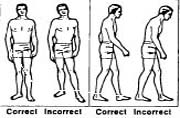
Standing and Walking:

Try to toe straight ahead when walking; put most of your weight on your heels; hold your chest forward and elevate the front of the pelvis as if walking up an incline. Avoid wearing high heels. Stand as if you are trying to touch the ceiling with the top of yur head, eyes straight ahead. All the elements of good posture will flow from these simple maneuvers.

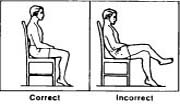
Sitting:

Sit on a hard-back chair with spine pushed back; try to eliminate the hollow in the lower back. If possible, elevate the knees higher than hips while in an automobile. Secretaries should adjust posture chairs accordingly. Sit all the way back in the chair with your back erect.

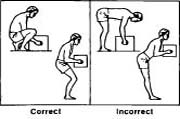
Lifting:

Bend your knees; squat and lift with your thigh muscles, not your back. Never bend over with your knees straight and lift with the upper torso. Move slowly and avoid sudden movements. Try to avoid lifting loads in front of you above the waste line. Avoid bending over to lift heavy objects from car trunks, as this places a strain on low back muscles

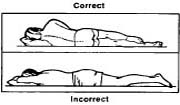
Sleeping:

Sleep on a firm mattress; a ¾ inch plywood bed board is helpful and should be used with all but a very firm orthopedic mattress. With acute back pain, sleep with a pillow or blanket rolled under the knees and a pillow under the head. Keep your knees and hips bent when sleeping on your side.

Driving:

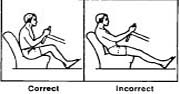
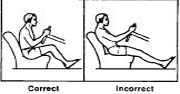
Use a firm seat with a padded plywood or special seal support. Sit close to the wheel with knees bent. On long trips, stop every one to tow hours and walk to relieve tensions and relax muscles

                                                                                                                                                                                                                                                                                                                                                                                                    Working:

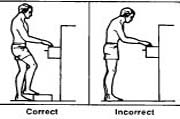
Try to avoid fatigue caused by work requiring long standing. Flex hips and knees by occasionally placing a foot on a stool or bench. Take exercises breaks from desk work by getting up, moving around and performing a few back exercises in the standing position.

Question: Did you try these exercises? Were these exercises helpful?

Filed Under: Exercises, Low Back Pain Tagged With: low back exercises, low back pain prevention, low back strengthening, low back support exercises., lumbar exercises, lumbar spine, lumbar spine strengthening, rehabilitation exercises for low back

Isometric Neck Exercises

August 26, 2010 by drburt

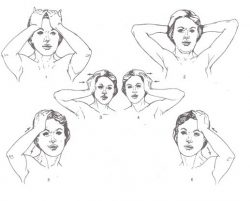
It is best if you do these exercise 2-3 times a day at a different time. Breath air out with a “haaaaa” sound  as you strain during exercises. Hold each contraction for a count of 5.

  1. Place both hands against your forehead.  Push your head forward against the heels of your palms without moving your head. Hold.
  2. Place both hands behind your head.  Pull your head back against your hands while pulling forward with your hands so your head doesn’t move.  Hold
  3. Place your right hand against the right side of your head.  Push your head hard against the heel of your palm without allowing it to move.  Hold.
  4. Place your left hand against the left side of your head.  Push your head against the heel of your palm without allowing it to move.  Hold.
  5. Place your right hand against your right temple.  Try to bring your chin down to your right shoulder without allowing your head to move.  Hold.
  6. Place your left hand against your left temple.  Try to bring your chin down to your left shoulder without allowing your head to move.  Hold.

Question: Did you try these exercises? Were these exercises helpful?

Filed Under: Exercises, Neck Pain Tagged With: cervical spine, exercises, isometric neck exercises, muscle strengthening, neck, rehabilitation

  • « Previous Page
  • 1
  • 2
  • 3
  • Next Page »

PLEASE FOLLOW & LIKE B.C.

RSS
Follow by Email
Facebook
Facebook
fb-share-icon
Twitter
Visit Us
Follow Me
Post on X
YouTube
YouTube
LinkedIn
LinkedIn
Share

15200 Hesperian Blvd #104

San Leandro, CA. 94578

(510) 481-2225

drburt@burtchiropractic.com


SEARCH

Categories

Recent Posts

  • Loss of Cervical Lordosis: How a Straight Neck and Pain Impact Your Health—and How a San Leandro Chiropractor Can Help Restore It
  • Hidden Injuries from Car Accidents That a San Leandro Chiropractor Can Help You Detect
  • Best San Leandro Chiropractor for Sciatica Pain Relief: Natural, Drug-Free Solutions That Work