Top Chiropractor in San Leandro, CA

San Leandro Chiropractor

  • blog
  • About Our Practice
  • What is Chiropractic?
  • SERVICES
    • Personal Injury
    • Cold Laser Therapy
    • Massage
    • Ultrasound
    • Electric Stimulation
    • Sports Injury
    • Workers Compensation
  • FAQs
  • Locations
  • CONTACT US
  • New Patient Forms
  • Nutrition Store
  • Home

Powered by Genesis

Alzheimer’s Disease and its Warning Signs

May 12, 2012 by drburt

alzheimer's disease

 Alzheimer’s Disease and  its Warning Signs

This is a guest post by Josh Anderson.  According to the Alzheimers’ Association, someone in the world is diagnosed with Alzheimer’s Disease every 70 seconds. Little is known about this debilitating disease and although it is genetically linked, there is no specific race, nationality or sex that it is directly linked to. Everyone is just as susceptible as the next person.

However, scientists have discovered that Alzheimer’s Disease is caused by a chemical change to the neurotransmitters in the brain, which leads to the “loss” of brain cells. Once this change occurs, the disease interferes with how the brain brain functions. Mental abilities then begin to deteriorate. Cognitive functions such as memory, reasoning and perception are usually severely affected, but physical functions, such as muscle or organ control can also be affected. Here are some of the most prominent warning signs of those afflicted with this terrible condition.


Short-term Memory Loss

It’s not uncommon that while someone can seem to remember something that happened in their childhood, they easily forget just what they did the day before.

Problem Solving Impairment

It can often become hard to understand sequences of numbers, including days and months. A simple cooking recipe or instruction sheet can become a challenge too.

Daily Task Obstruction

An average task, such as grocery shopping or remembering to take medication, can become very confusing and hard to follow for someone with Alzheimer’s.

Misperception of Time

Besides losing track of important dates, time spans become altered in many patients. Often, one will live in the past and mistake people for relatives that have departed. They also, at times, cannot remember where they are or who they are with.

Visual Perception

Not only does eyesight deteriorate, perception is altered. For instance, someone with Alzheimer’s might perceive people on television or a reflection in a mirror to actually be in the room.

(Mis)Communication Skills

Conversations may become repetitive, and it can be hard to follow what others are saying. As the illness progresses, often times one will just “ramble” on, lose track of what they are saying or “babble” without making any sense at all.

Misplaced Objects

Many forget where they have placed items and cannot retrace their steps, while others “hide” objects in unusual places and then forget where they placed them.

Strange Decisions

Priorities, such as daily hygiene, often become forgotten, while something frivolous like watching television or feeding the birds over and over again becomes priority.

Shuffling Feet

Strange but true, many suffering from Alzheimer’s constantly shuffle when they walk, without picking up their feet, and not just when they are tired.

Emotional Outbursts

Quite often, someone will state that “you just don’t understand them” and outbursts of anger will erupt even in the gentlest of people, and physical confrontation is possible.

Swearing

Even the most mild-mannered among may cuss like a sailor, especially during emotional outbursts. Don’t be surprised to hear things you never imagined.

Insomnia

Even though as the body ages, it requires less sleep, a person with Alzheimer’s may just take frequent naps, avoiding sleeping overnight all together.

Paranoia

People with Alzheimer’s become paranoid believing that others want to do them harm, are stealing from them or strangers are “after” them.

Wandering

Many will wander from their home to look for the home they “remember” from the past and can get lost even routes all the time.


Alzheimer’s occurs differently with everyone. In some, the progression is very sudden, while in others, warnings can plateau years down the road. Unfortunately, death usually occurs within 7-10 years of the onset. Professionals use a 7-stage scale to determine the severity of the case, with #1 having no cognitive decline (otherwise normal), while #7 will be marked by severe cognitive decline. If diagnosed at an early stage, there is some medication available to slow down the progression, but no cure.

If you have anything to add to this post, please feel free to Post a comment or share your thoughts through Facebook, Twitter, Google+ or comment section below to join the conversation.
Filed Under: Health Tagged With: aging associated diseases, alzheimer's disease, associations, brain cells, brain function, chemical change, cognitive function, cognitive reserve, debilitating disease, depression of alzheimer disease, Diagnose, disease, josh anderson, neurological disorders, psychiatry, warning signs

Nervous System, Spine And Its Relationship To Organs

August 10, 2010 by drburt

nervous system

Nervous System, Spine And Its Relationship To Organs

Dr. Henry Windsor, who was a Medical Doctor from the University of  Pennsylvania, has performed a medical experiment in 1921. In his clinical research he wanted to proof the existence of diseased organs and its interconnection to the curvatures of the spine (improper posture and misaligned vertebrae). In this study he made experiments on 50 cadavers from the pathology department. Dr. Windsor dissected the bodies and looked at the diseased organs. Out of 50 bodies he found 139 organs that were in a different degree of disease. He found diseased kidneys, livers, pancreases, hearts, , gall bladders, lungs etc, etc. Dr. Windsor traced the nerve root of each diseased organ back to the spine and found out that 128 diseased organs from 50 cadavers had a relationship with the curve of the vertebrae or postural disturbances. These nervous system roots belonged to the same sympathetic segments as the diseased organs 128 times. 11 other diseased organs had different origin of a disease.

My previous posts: 96 Tips For a Perfect Posture and 11 Symptoms as a Sign of Warning That Your Spine is in Trouble are good prerequisite reading materials. Both of these articles go in depth about DOs and DONT’s on keeping your Posture in Check and what will happen to a spine if one will not take a good care of it.

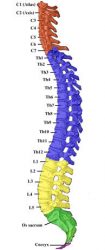
Without the right signals from our brains, our organs cannot function at their optimum level. When a subluxation is present, musculoskeletal factors around one or more vertebrae interfere with the normal function of the nerves, affecting the nerves ability to transmit information from the brain to the rest of the body and vice-versa. Below is a list of 26 nerve roots that provide neurological supply to the vital organs and musculoskeletal system and the symptoms that associated with these nerve roots. Each vertebral Level will have a hyperlink to a 3D view of the relationship of the nervous system and spine to organs for a better visual understanding.


C1  AREAS & PARTS OF  BODY: Blood supply to the head, the pituitary gland, the scalp, bones of the face, the brain itself, the  middle and inner ear, the sympathetic nervous system

POSSIBLE SYMPTOMS: Headaches, nervousness, insomnia, head colds, high blood pressure, migraine headaches, nervous breakdown, amnesia, chronic tiredness, dizziness or vertigo.

C2  AREAS & PARTS OF  BODY : Eyes, optic nerve, auditory nerve, sinuses, mastoid bones, tongue, forehead

POSSIBLE SYMPTOMS: Sinus trouble, allergies, crossed eyes, deafness, eye trouble, earache, fainting spells, certain causes of  blindness.

C3 AREAS & PARTS OF  BODY :Cheeks, outer  ear, face bones, teeth, face bones, teeth, trifacial nerve

POSSIBLE SYMPTOMS: Neuralgia, neuritis, acne or pimples, eczema


C4  AREAS & PARTS OF  BODY : Nose, lips, mouth, eustachian tube

POSSIBLE SYMPTOMS: Hat fever, catarrh, hard of hearing, adenoids, runny nose


C5  AREAS & PARTS OF  BODY : Vocal cords, neck, glands, pharynx

POSSIBLE SYMPTOMS: Laryngitis, hoarseness, throat conditions like a sore throat or quinsy


C6  AREAS & PARTS OF  BODY : Neck Muscles, shoulders, tonsils

POSSIBLE SYMPTOMS: Laryngitis, hoarseness, throat conditions like a sore throat, stiff neck, pain in upper arm, tonsilitis, chronic cough, croup


C7  AREAS & PARTS OF  BODY : Thyroid gland, bursae in the shoulders and elbows

POSSIBLE SYMPTOMS: Laryngitis, hoarseness, throat conditions like a sore throat, bursitis, colds, thyroid conditions


T1  AREAS & PARTS OF  BODY : Arms from the elbow down, including the hands, wrists, fingers, also the esophagus and trachea.

POSSIBLE SYMPTOMS: Asthma, cough, difficult breathing, shortness of breath, pain in lower arms and hands.


T2  AREAS & PARTS OF  BODY : Heart, including its valves and covering, coronary arteries.

POSSIBLE SYMPTOMS: Functional heart conditions and certain chest conditions.


T3  AREAS & PARTS OF  BODY : Lungs, bronchial tubes, pleura, chest, breast

POSSIBLE SYMPTOMS: Bronchitis, pleurisy, pneumonia, congestion, influenza.


T4  AREAS & PARTS OF  BODY : Gallbladder, common duct.

POSSIBLE SYMPTOMS: Gallbladder conditions, jaundice, shingles.


T5  AREAS & PARTS OF  BODY : Liver, solar plexus, circulation (general)

POSSIBLE SYMPTOMS: Liver conditions, fevers, blood pressure  problems, poor circulation, arthritis.


T6  AREAS & PARTS OF  BODY : Stomach.

POSSIBLE SYMPTOMS: Stomach trouble including: nervous stomach, indigestion, heartburn, dyspepsia.


T7  AREAS & PARTS OF  BODY : Pancreas, duodenum

POSSIBLE SYMPTOMS: Ulcers, gastritis.


T8  AREAS & PARTS OF  BODY : Spleen, diaphragm

POSSIBLE SYMPTOMS: Lowered resistance, hiccoughs


T9  AREAS & PARTS OF  BODY : Adrenal and suprarenal glands.

POSSIBLE SYMPTOMS: Allergies, hives


T10  AREAS & PARTS OF  BODY : Kidneys.

POSSIBLE SYMPTOMS: Kidney troubles, hardening of the arteries, chronic tiredness, nephritis, pyelitis.


T11  AREAS & PARTS OF  BODY : Kidneys, ureters

POSSIBLE SYMPTOMS: Skin conditions such as acne, pimples, eczema, boils.


T12  AREAS & PARTS OF  BODY : Small intestine, lymph circulation

POSSIBLE SYMPTOMS: Rheumatism, gas pains, certain types of sterility


L1  AREAS & PARTS OF  BODY : Large intestines, inguinal rings

POSSIBLE SYMPTOMS: Constipation, colitis, dysentery, diarrhea, some ruptures or hernia


L2  AREAS & PARTS OF  BODY: Appendix, abdomen, upper leg.

POSSIBLE SYMPTOMS: Cramps, difficult breathing, minor varicose veins.


L3  AREAS & PARTS OF  BODY : Sex organs, uterus, bladder, knees.

POSSIBLE SYMPTOMS: Bladder troubles, menstrual troubles such as painful or irregular periods, miscarriages, bed wetting, impotency, change of  life symptoms, many knee pains.


L4  AREAS & PARTS OF  BODY: Prostate  gland, muscles of the lower back, sciatic nerve

POSSIBLE SYMPTOMS: Sciatica, lumbago, difficult and painful or too frequent urination, backaches.


L5  AREAS & PARTS OF  BODY : Lower legs, ankles, feet

POSSIBLE SYMPTOMS: Poor circulation in the legs, swollen ankles, weak ankles and arches, cold feet, weakness in the legs, leg cramps.


Sacrum AREAS & PARTS OF  BODY : Hip bones, buttocks.

POSSIBLE SYMPTOMS: Sacroiliac conditions, spinal curvatures.


Coccyx AREAS & PARTS OF  BODY : Rectum, anus.

POSSIBLE SYMPTOMS: Hemorrhoids (piles), pruritus (itching), pain at end of spine on sitting


Below is the summary in a SlideShare Presentation that I have created when I was in Chiropractic School. This Presentation has some additional useful information.

RELATIONSHIP OF THE NERVOUS SYSTEM AND SPINE TO ORGANS from Eduard Burt, D.C., MUAC

Questions:  Have You Had Any of the Above Mentioned Symptoms and Medications Were Not Helpful at All? Has Your Doctor Referred You to Other  Health Care Practitioners in Order to Improve Your Health? Have You Checked Your Posture Lately?


Filed Under: Chiropractic, Spine Tagged With: disease, health, nervous system, vital organs

PLEASE FOLLOW & LIKE B.C.

RSS
Follow by Email
Facebook
Facebook
fb-share-icon
Twitter
Visit Us
Follow Me
Post on X
YouTube
YouTube
LinkedIn
LinkedIn
Share

15200 Hesperian Blvd #104

San Leandro, CA. 94578

(510) 481-2225

drburt@burtchiropractic.com


SEARCH

Categories

Recent Posts

  • Loss of Cervical Lordosis: How a Straight Neck and Pain Impact Your Health—and How a San Leandro Chiropractor Can Help Restore It
  • Hidden Injuries from Car Accidents That a San Leandro Chiropractor Can Help You Detect
  • Best San Leandro Chiropractor for Sciatica Pain Relief: Natural, Drug-Free Solutions That Work