WHAT CAN CAUSE NECK PAIN?
 Your neck is the vital passageway through which the spinal cord passes to connect the brain to the arms and legs and key bodily organs and tissues. The brain, spinal cord, and spinal nerves control and coordinate almost all body functions.
The seven cervical vertebrae (spinal bones) in the neck have highly mobile joints so that you can easily move your head in multiple directions and a large range of motion. Since the neck is exceptionally flexible, it lends itself easily to injury and pain.
Depending upon its severity, an insult to the head or neck may injure the supporting muscles, tendons and ligaments of the neck and perhaps interfere with essential circulation to the head and brain. A neck injury may even disrupt the functioning of the spinal cord and the spinal nerves distributed by the cervical vertebrae. This can result in serious interference with the life-support communications network of the body.
Some neck pain may be job related (micro-damage). Individuals who sit in the same position and face the same direction for long periods, such as administrative workers and computer operators, may experience neck stiffness and/or muscular spasms. Other industry type jobs, such as those involving repetitive motions may also lead to neck pain. Workers who operate a drill press, power equipment or continuos assembly line operations may feel fatigue and soreness in the supporting head-and-neck muscles. These and similar situations can bring on muscle tension and irritation of the nerves and blood vessels in the neck.
Strains to the cervical vertebrae are another common cause of neck pain. Strains can be brought on by a forceful movement of the neck, strenuous lifting, swinging or pulling motions of the arms, or a fall. One of the most frequent of neck ailments – whiplash – can produce mild or severe reaction, even resulting in debilitating, permanent damage.
Osteoarthritis, a degenerative disease of the bones and joints can also be a source of neck pain. Sometimes called “wear and tear” disease or “old-age”, it can be the result of a lifetime of physical traumas (shocks) or even poor posture. Slumping, rounded shoulders, and even a straight military posture can be harmful. Osteoarthritis occurs when the discs become thin – pulling the bones closer together and producing grinding sounds. This leads to pain and nerve disturbances, and may eventually cause the vertebrae to fuse together.
Still other causes of neck pain may include osteoporosis, swelling of tissue, irritation of joints, damage to the nerves or spinal cord, fracture of a vertebra, tumors and cancerous conditions, and less obvious sources such as referred pain from a heart attack.
Symptoms of neck pain may include headaches, numbness, tingling in the arms and legs, and localized swelling and inflammation.
BACK PAIN
 Magnetic resonance imaging shows how disc bulging can put pressure on adjacent nerve tissue.
LOWER BACK
Poor posture, high-stress, a sedentary life-style, excessive physical exercise, and habitually sitting in one position or doing repetitive movements can make you a prime candidate for low back problems. The result is pinched nerves, causing pain and, if not relieved, even causing serious disability.
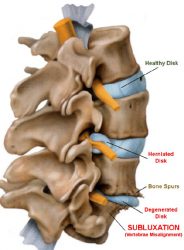
The lower back, or lumbar spine, bears most of the body’s weight-making it especially vulnerable to pains and problems. Between the vertebrae are circular discs of jelly like material encased in tough cartilage. Discs facilitate movement of the spine, serving as shock absorbers and reducing friction.
The underlying cause of back pain is an imbalance of the bony framework of the body, especially the spinal column.
The structure and balance of the spine may be disturbed by the common incidents of everyday life such as a fall or misstep, getting into or out of the car the wrong way, lifting the wrong way, and by an auto accident or other major and minor accidents.
Weak, flabby, under-exercised muscles contribute significantly to low back problems, as well as, over-exerted or overused muscles. Muscles subjected to the same stresses and strains day after day inevitably lead to back trouble. Fatigue makes the back more susceptible to injury, and emotional tension takes its toll by keeping muscles tense, shortened and tightened.
In some cases, low back pain may result from disease or infection, though less likely than the other causes.
Low back pain may indicate a problem within the structural elements of the back itself, or it may indicate a problem elsewhere in the body, since the spine is the body’s main line of service and communication. Problems related to the structure of the lower back include:
- Misaligned Vertebrae: If vertebrae are misaligned or slipped into abnormal position, the result may be disc and/or nerve problems.
- Pinched Nerves: Hundreds of thousands of nerve fibers pass through each small opening of the spine from the brain to the rest of the body. When a dislocation of a vertebra occurs, the small openings of the spine are partially closed, interfering with the normal nerve impulse pattern. The result is pinched nerves, causing pain and, if not relieved, even causing serious disability. Pinched nerves are deceiving, since they may masquerade as a number of illnesses: in this case, an organ supplied by the nerve is being affected and signaling its distress.
- Slipped Discs: Any of the spinal discs may be injured or degenerate. But because of their location, discs in the lower spine are subjected to the greatest weight-bearing stress and are most likely to slip or be compressed. The disc’s outer covering weakens and bulges, putting pressure on spinal nerves.
- Ruptured Discs: Occasionally a disc ruptures. In a rupture, the tough outer portion of the disc is torn or split and the soft inner portion then protrudes, often pressing against spinal nerves.
- Sciatica: Sciatica is a painful inflammation of the sciatic nerve which supplies the tissues of the thigh, lower leg and foot. Slipped discs and pinched nerves may cause sciatica. The roots of the sciatic nerve are in the lower spinal column. Most often, sciatica begins with a long period of intermittent low back pain, only erupting into violent pain following a sudden jarring or simply a wrong move.
- Disease and infection: Low back pain sometimes, though not often, indicates disease elsewhere in the body. Since the nerve system carries impulses from the brain along the route of the spinal column and out to the other parts of the body, it also transmits impulses from the various parts back to the brain. Infections, such as those of the genital or urinary tract, may produce low back pain. But diseases of the spine, such as arthritis and tuberculosis account for less than 5 percent of back pain.
HEADACHES
 Headaches are one of the most common reasons for visiting the doctor. More than 250 million work days are lost each year due to headache at a cost of 25 billion dollars per year. There are many types and causes of headaches Muscle tension headaches and migraine headaches are by far the most common types of headaches, but sinus infections and other problems such as high blood pressure can also lead to headaches. Regardless of the cause, no one likes to endure a headache.
This has produced a huge market for medications that cover up the symptoms of headaches. Powerful drugs can numb your nervous system so the pain doesn’t register. While these approaches may be convenient, they can cause adverse effects and kidney or liver damage. Worse, they don’t correct the underlying cause of he headache.
Headaches are rarely a sign of immediately serious or life threatening health problems. Some headaches are so painful, however, that it may seem that something is very wrong inside the head. A person may present to the medical doctor seeking an explanation of the cause of the headache. Many medical doctors order expensive tests such as MRI or CT scans of the brain to try to visualize the cause of the headache. It has been reported that only one in 11,200 patients with headache have a problem that shows-up on these types of tests. It is surprising, then, to note that between one-quarter to one-third of headache sufferers have had a CT or MRI scan. Most often the doctor and/or patient are searching for answers in the wrong direction.
Headache is a very common condition in patients with chiropractic problems. A cause of headaches can be from spinal bones in the neck that aren’t supporting your head properly. This can affect nerves, muscles and even the blood supply to your head. Research has shown that the most common types of headaches respond well to chiropractic care. The vast majority of even the most severe headaches are relieved when spinal subluxations (spinal joints that are out of alignment, don’t move well and also irritate the nerves) and jaw problems are corrected. The effects that these types of problems have on the nerves often results in pain in the head.
Chiropractic care and periodic checkups are useful ways of eliminating the most common cause of headaches – subluxation.
ARM AND SHOULDER PAIN
 Pain and other symptoms in the arm and shoulder may be due to injury of the neck or cervical spine. The seven cervical vertebrae (spinal bones) in the neck have highly mobile joints so that you can bend and tilt your neck. Since the neck is exceptionally flexible, it is susceptible to injury and pain which can be referred to the shoulder and the arm. However, pain in the arm and shoulder may be due to other conditions not related to the cervical spine such as frozen shoulder and strain/sprain syndromes.
The vertebrae are separated by discs, which are stiff jelly like pads that act as elastic cushions between the spinal bones. Neck, shoulder and arm pain may be caused by an abnormal bulging or protrusion of a disc in the cervical spine, The disc may impinge on the spinal nerve roots or irritate the spinal cord itself. This is also known as a herniated or slipped disc.
Cervical disc lesions that can cause arm and shoulder pain can be acute or chronic. For example, sudden and severe pain (acute torticollis) can result from lying too still for too long, on a pillow too thick or too thin, or in a position that keeps the neck in a sideways position for a long period.
Another way of developing acute torticollis is a whiplash injury or by simply stretching. Severe neck stiffness can result, sometimes with discomfort in both arms, and pins and needles in the fingers.
Pain in the shoulder blade may also be due to cervical disc trouble. It is also a common site for referred pain secondary to gall stones or a transverse humeral ligament tear or rupture. This shoulder blade pain may radiate from the shoulder blade up to the base of the skull. Pressure on the nerve that innervates the arm area from cervical disc injury can also cause pain in the shoulder, arm and chest.
Still other causes of shoulder and arm pain may include referred pain, such as from a heart attack, as well as regional disorders of the shoulder, elbow, wrist and hand. These conditions may include osteoporosis, tumors or cancerous growths, bursitis, neuritis and damage to the nerves and spinal cord.
CARPAL TUNNEL SYNDROME
 Carpus is the medical term referring to the wrist. The carpal tunnel is the passage for the major nerve in the wrist (the median nerve) and the tendons in the wrist formed by the ligament of the wrist and the carpal bones. The median nerve passes through the carpal tunnel to innervate the hand and fingers.
In carpal tunnel syndrome, the median nerve is compressed as it passes through the canal made by the wrist bones and the ligament of the wrist. The nerve may be compressed or trapped in its path due to joint changes in rheumatoid arthritis or other systemic diseases. In most cases, however, inflammation of the tendons and tissues of the wrist which causes the syndrome is not associated with systemic illness.
The majority of patients affected by this syndrome are middle-aged women. The usual symptoms are pricking numbness and pain which is most prominent in the first three fingers, the thumb, and the palm. This pain comes on especially during the night and is relieved by shaking the hand. Aching may accompany the numbness and extend up the arm. In late cases, there may be wasting of the hand and finger muscles innervated by the median nerve.